
Good to see you again. In the previous lesson, you established what a balanced diet provides and why energy and nutrient requirements vary between people. Now we examine what happens when those requirements are not met—either because total energy intake is far too low, particular nutrients are missing, or excess energy is stored over a long period.
For a written biology answer, aim for a chain rather than a list:
Cause what changes in the body observable effect or health consequence
By the end of this lesson, you should be able to explain the causes and effects of starvation, obesity, constipation, coronary heart disease, scurvy, vitamin D deficiency, iron deficiency, kwashiorkor, and marasmus.
One idea, several kinds of malnutrition
Malnutrition means poor nutrition: the diet supplies too little, too much, or an unsuitable balance of nutrients. It therefore includes both undernutrition and overnutrition.
Do not treat all nutrition-related conditions as the same:
- Starvation is a severe, long-term shortage of total food energy and nutrients.
- Marasmus and kwashiorkor are severe forms of protein-energy undernutrition, mainly seen in young children where diets are seriously inadequate.
- Scurvy, vitamin D deficiency, and iron-deficiency anaemia result from shortage of a particular vitamin or mineral.
- Constipation is often linked with too little fibre and water.
- Obesity commonly develops when energy intake exceeds energy expenditure over a long period, causing excess energy to be stored as fat.
- Coronary heart disease is a disease of the blood vessels supplying the heart; dietary patterns can increase its risk, but they are not its only cause.
This quick video consolidates the main vitamin, mineral, and protein deficiency conditions. It is most useful as a first-pass overview; the explanations below will add the biological links needed for a strong written answer.
GCSE Biology - Deficiency Diseases
Watch “GCSE Biology – Deficiency Diseases” from KayScience for a concise overview of protein, vitamin C, vitamin D, and iron deficiencies.
Watch protein deficiency to identify kwashiorkor and its visible signs. Then watch vitamin C deficiency, bone deficiency, and iron deficiency. Focus on connecting each missing nutrient to its effect, rather than only memorising the disease name.
Severe undernutrition: starvation, marasmus, and kwashiorkor
Starvation
Starvation is the most extreme form of undernutrition. It happens when there is a very serious shortage of food and nutrients for a prolonged period. Possible causes include famine, drought, war, poverty, food insecurity, severe illness, disorders that reduce nutrient absorption, or an eating disorder. It is important not to reduce starvation to an individual “choice”: social and environmental causes can be decisive.
When food intake becomes insufficient, the body uses stored materials in a sequence:
- It first uses available glucose and glycogen stores.
- It then breaks down stored fat for respiration.
- If the shortage continues, it breaks down protein, including muscle tissue, to release energy and provide materials for essential processes.
This produces a clear cause-and-effect chain:
Loss of muscle is particularly dangerous because muscles are needed for movement, breathing, and pumping blood. Starvation can therefore lead to fatigue, low body temperature, weakened immunity, poor wound healing, reduced growth in children, and—in severe cases—heart, respiratory, or organ failure.
Marasmus
Marasmus is severe deficiency of both energy (calories) and protein. It commonly affects infants and very young children when there is an extreme shortage of food.
Because the body lacks energy, it breaks down fat stores and muscle proteins. The typical effects are:
- severe weight loss and emaciation
- marked loss of muscle and body fat
- thin limbs and visible ribs
- stunted growth
- weakness and increased susceptibility to infection
A useful description is: “The child appears severely wasted because fat and muscle have been broken down to supply energy.”
Kwashiorkor
Kwashiorkor is a severe deficiency of protein, often in a diet that supplies some carbohydrate energy but too little protein. It may occur after weaning if a child receives a mainly starchy diet with very little protein-rich food.
Protein is needed to build body tissues, make enzymes, support growth, and maintain the protein concentration of blood plasma. A shortage therefore causes poor growth, muscle wasting, and weakened immunity.
A particularly recognisable effect is oedema: fluid accumulates in tissues, especially in the feet, legs, face, and abdomen. Blood proteins normally help keep water in blood vessels. With too little protein, water moves into surrounding tissues. This makes the child appear swollen, even though they may have lost muscle.
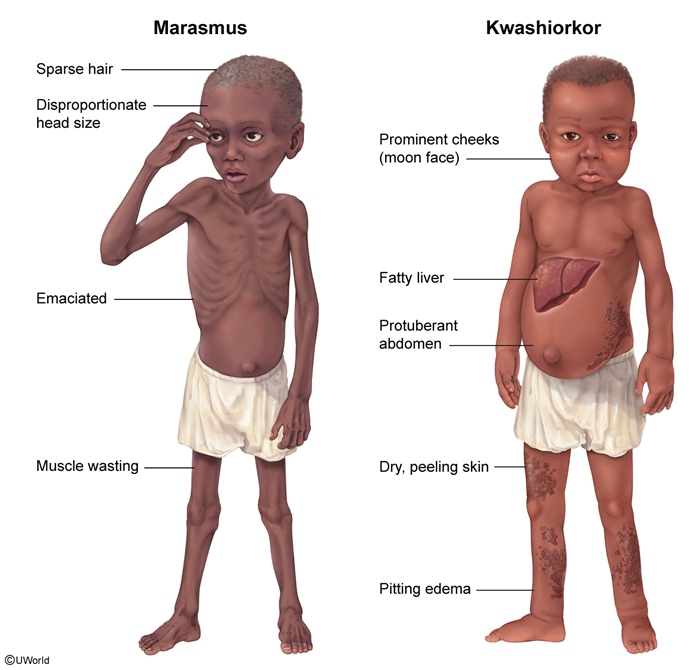
The image shows the classic exam distinction:
| Condition | Main dietary shortage | Key appearance | Biological explanation |
|---|---|---|---|
| Marasmus | Severe shortage of energy and protein | Very thin, emaciated body | Body breaks down fat and muscle for energy |
| Kwashiorkor | Mainly protein shortage | Swollen abdomen and pitting oedema; skin and hair changes | Low blood protein allows fluid to enter tissues; protein shortage also limits growth and repair |
In real life, conditions can overlap, so not every person will fit a textbook image perfectly. For assessment purposes, however, the contrast between wasting in marasmus and oedema in kwashiorkor is essential.
Use the Merck Manual reading to reinforce the differences and to see why prolonged undernutrition affects many body systems.
Undernutrition - Nutrition - Merck Manual Consumer Version
Read the relevant parts of “Undernutrition” from the Merck Manual Consumer Version. It distinguishes marasmus, kwashiorkor, and starvation, then traces the wider effects of severe undernutrition.
In the “Protein-Energy Undernutrition” section, read from the descriptions of marasmus and kwashiorkor. Focus on the difference between loss of fat and muscle in marasmus and fluid retention in kwashiorkor. Then, in the “Starvation” subsection, read the definition and possible causes. Finally, in “Symptoms of Undernutrition,” read the body-wide effects, especially the links to muscles, the heart, immunity, and growth.
Specific dietary deficiencies
Specific deficiencies occur when a person obtains enough total food energy to survive but lacks a particular nutrient needed for normal body processes.
Constipation: too little fibre and water
Constipation means passing stools less often than usual, or passing stools that are hard and difficult to expel. A common dietary cause is inadequate fibre (roughage), often combined with too little water.
Fibre is not digested, but it adds bulk to food in the gut and helps move material through the large intestine. If there is little fibre, there is less bulk to stimulate movement of the gut wall. If waste remains in the large intestine for longer, more water is absorbed from it. The stool then becomes dry, hard, and difficult to pass.
Low physical activity and ignoring the urge to pass a stool can also contribute.
Scurvy: vitamin C deficiency
Scurvy is caused by a lack of vitamin C. It can occur when a person eats very little fruit and vegetables for a prolonged period.
Vitamin C is needed to make and maintain collagen, a protein that helps provide strength to connective tissues, including skin, gums, and blood-vessel walls. Without enough vitamin C, these tissues become fragile.
Effects of scurvy include:
- bleeding or swollen gums
- loose teeth in severe cases
- easy bruising
- slow wound healing
- tiredness and weakness
A high-quality explanation states the mechanism:
A lack of vitamin C reduces collagen formation. This weakens gum tissue and blood-vessel walls, causing bleeding gums, bruising, and slow healing.
Vitamin D deficiency
Vitamin D is obtained from some foods and is also made in the skin when it is exposed to sunlight. A deficiency may result from too little dietary vitamin D, insufficient sun exposure, or problems absorbing the vitamin.
Vitamin D helps the small intestine absorb calcium. Calcium is needed to make bones hard and strong. Therefore:
In growing children, severe vitamin D deficiency can cause rickets, in which bones are soft and may bend, leading to bowed legs. In adults, poor bone mineralisation is called osteomalacia and can cause bone pain and weakness.
Iron deficiency
Iron is a mineral needed to make haemoglobin, the oxygen-carrying pigment in red blood cells. Iron deficiency can result from a diet low in iron, increased demand during growth, or blood loss—for example, menstrual blood loss.
With insufficient iron, the body cannot make enough functioning haemoglobin. The blood transports less oxygen to respiring cells, so less aerobic respiration can occur.
The condition is called iron-deficiency anaemia. Likely effects include tiredness, reduced exercise tolerance, dizziness, and pale skin.
Overnutrition, obesity, and coronary heart disease
Obesity
Obesity is a condition involving excess body fat. It often develops over a long period when energy intake from food and drink is consistently greater than energy expenditure. The body stores the excess energy, mainly as fat.
However, a strong biology answer should avoid blaming an individual or implying that body mass has a single cause. Energy balance is central, but food availability, income, activity opportunities, genetics, medicines, health conditions, mental health, and sleep can all influence energy intake, energy use, or both.
Possible effects associated with obesity include:
- increased risk of type 2 diabetes
- high blood pressure
- coronary heart disease and stroke
- joint and back pain due to increased load on joints
- breathlessness and reduced mobility
- fatty liver disease
Obesity is therefore not simply an appearance issue: it can affect several body systems and increase the risk of other conditions.
Coronary heart disease
Coronary heart disease (CHD) occurs when the coronary arteries—the vessels that supply oxygenated blood to the heart muscle—become narrowed or blocked.
Fatty deposits, including cholesterol-containing material, can build up in artery walls. This is called atherosclerosis. The artery’s lumen becomes narrower, so less blood can reach the cardiac muscle.
If heart muscle receives too little oxygen, it cannot release enough energy by aerobic respiration. This can cause chest pain during exertion, known as angina. If a coronary artery becomes completely blocked, part of the heart muscle may die: this is a heart attack or myocardial infarction.
Risk factors for CHD include:
- a diet high in saturated fat
- smoking
- high blood pressure
- physical inactivity
- diabetes
- obesity
- genetic predisposition
- increasing age
Notice the precise relationship: obesity and a diet high in saturated fat can increase the risk of CHD, but they are not the only possible causes.
The NHS resource is useful because it presents obesity as a health condition with multiple contributing factors, rather than as a simple matter of willpower.
Overweight and obesity in adults
Read the selected sections of the NHS overview “Overweight and obesity in adults.” It will help you distinguish the basic energy-balance mechanism from the wider factors that can affect body mass and health.
First find the section “Causes of overweight and obesity.” Read the explanation and contributing factors. Identify the core energy-storage idea, then note why genes, medicines, health conditions, and activity can matter. Next read the “Risks of living with overweight and obesity” section, especially the health effects. Focus on the distinction between an increased risk and an inevitable outcome.
An exam-ready comparison
A useful revision format is to turn each condition into a three-part statement.
| Condition | Main cause | Key effect to explain |
|---|---|---|
| Starvation | Prolonged, severe shortage of total nutrients and energy | Fat and muscle are broken down; weakness, infection risk, organ failure |
| Marasmus | Severe lack of protein and energy | Severe wasting of muscle and fat; very low body mass |
| Kwashiorkor | Severe lack of protein, often with some carbohydrate energy available | Oedema and swollen abdomen, muscle wasting, poor growth |
| Constipation | Too little fibre and/or water | Hard, dry stool becomes difficult to pass |
| Scurvy | Vitamin C deficiency | Reduced collagen causes bleeding gums, bruising, slow wound healing |
| Vitamin D deficiency | Insufficient vitamin D or sunlight exposure | Reduced calcium absorption; soft or weak bones, rickets in children |
| Iron-deficiency anaemia | Insufficient iron, increased demand, or blood loss | Less haemoglobin; reduced oxygen transport and fatigue |
| Obesity | Long-term energy intake greater than expenditure, influenced by multiple factors | Excess body fat; increased risk of several diseases |
| Coronary heart disease | Atherosclerosis in coronary arteries; multiple risk factors | Reduced oxygen supply to heart muscle; angina or heart attack |
When revising, cover the final two columns and practise reconstructing the causal chain aloud. For example:
Iron deficiency reduces haemoglobin production. Less haemoglobin means less oxygen is transported to cells, so aerobic respiration is limited and the person may feel tired.
That is much stronger than writing only “lack of iron causes tiredness.”
Key takeaways
- Starvation is a prolonged, severe shortage of total nutrients; the body eventually breaks down fat and muscle, causing weakness, poor immunity, and potentially organ failure.
- Marasmus involves severe shortage of energy and protein, producing extreme wasting. Kwashiorkor is mainly a severe protein deficiency and is associated with oedema and a swollen abdomen.
- Constipation is commonly linked to inadequate fibre and water; stools become dry and difficult to pass.
- Scurvy results from vitamin C deficiency, which reduces collagen formation and can cause bleeding gums and slow wound healing.
- Vitamin D deficiency reduces calcium absorption and can lead to soft, weak bones; in children, this can cause rickets.
- Iron deficiency reduces haemoglobin production, limiting oxygen transport and causing anaemia, fatigue, and weakness.
- Obesity commonly involves long-term excess energy storage but is influenced by biological, social, and environmental factors.
- Coronary heart disease involves narrowing of coronary arteries, reducing oxygen supply to the heart muscle and increasing the risk of angina or heart attack.
Next, you will move into digestion: tracing food through the alimentary canal and distinguishing ingestion, digestion, absorption, assimilation, and egestion.
Can't find a good explanation? Sign up and we'll make it for you
Sign up