
Hello! Welcome to your fifth lesson in the thermodynamics module.
In our last lesson, we learned how to apply the First Law of Thermodynamics, , to analyze energy changes in closed systems. We saw how to use property tables for substances like refrigerants to find the change in internal energy.
Today, we'll build directly on that foundation. The learning objective is to analyze common thermodynamic processes for ideal gases: isobaric, isochoric, isothermal, and adiabatic.
By focusing on ideal gases, we can move from relying on tables to using direct, powerful formulas. This formula-based approach is not only faster but also deepens our understanding of the physics. Mastering these four processes is crucial, as they form the fundamental "building blocks" of the thermodynamic cycles that power aircraft engines, such as the Brayton cycle for jet engines.
1. Overview of the Four Key Processes
Let's begin with a concise summary of the four processes. Each is defined by a single property that remains constant. This constraint has a unique impact on the energy balance described by the First Law.
Physics 27 First Law of Thermodynamics (21 of 22) Summary of the 4 Thermodynamic Processes
This video from Michel van Biezen provides a clear, high-level overview of each of the four processes. It introduces their definitions, shows how they look on a Pressure-Volume (P-V) diagram, and highlights their primary consequence for the First Law of Thermodynamics.
Watch from the beginning to 03:25. As you watch, focus on the defining characteristic of each process and its key result: Isobaric: Constant Pressure (P) ( ightarrow) Work is P\Delta V. Isochoric (or Isovolumetric): Constant Volume (V) ( ightarrow) Work is zero. Isothermal: Constant Temperature (T) ( ightarrow) Internal energy change is zero (for an ideal gas). Adiabatic: No Heat Transfer (Q=0) ( ightarrow) \Delta U = -W.
To give these abstract processes a more physical meaning, it's helpful to visualize them. The classic example of a gas trapped in a piston-cylinder device is perfect for this.
Thermodynamic Foundations – Introduction to Aerospace ...
Now, let's explore these processes visually and conceptually using a resource from Embry-Riddle Aeronautical University. This text connects the P-V diagrams to a tangible physical model.
First, review the section titled 'Property Diagrams'. Pay close attention to the figure showing the P-V and T-s diagrams. Compare the shapes of the four process lines on the P-V diagram; this visual signature is a key diagnostic tool. Next, read the section 'Piston-Cylinder System'. This will provide a tangible mental model for how each idealized process (Cases A, B, C, and D) could be achieved in a real device.
2. The Formulas for Ideal Gas Processes
Now we arrive at the core of today's lesson: the specific formulas for calculating work (), heat transfer (), and internal energy change () for an ideal gas undergoing these processes.
Specific Heats: and
Before we detail each process, we must introduce two critical properties of an ideal gas: specific heats.
- Specific heat at constant volume (): The energy required to raise the temperature of a unit mass of a substance by one degree while its volume is held constant.
- Specific heat at constant pressure (): The energy required to raise the temperature of a unit mass of a substance by one degree while its pressure is held constant.
For an ideal gas, the change in specific internal energy () and specific enthalpy () depend only on temperature change:
These two equations are fundamental and hold true for an ideal gas regardless of the process it undergoes.
Analysis of Each Process
Let's break down each of the four processes.
1. Isochoric (Constant Volume) Process
- Condition:
- Work (): Since , the boundary work is zero.
- First Law:
- Energy Changes: Any heat added goes directly into increasing the internal energy.
2. Isobaric (Constant Pressure) Process
- Condition:
- Work (): The gas expands or contracts against a constant pressure.
Using the Ideal Gas Law (), this can also be written as:
- First Law:
- Energy Changes:
For a constant pressure process, the heat transfer is equal to the change in enthalpy:
This is because some of the heat energy must also do the work of expansion, which is accounted for in the definition of enthalpy ().
The following video provides an excellent, detailed walkthrough of solving an isobaric process problem, including a clear explanation of specific heats.
Isobaric Process Thermodynamics - Work & Heat Energy, Molar Heat Capacity, & Internal Energy
This video from The Organic Chemistry Tutor provides a step-by-step guide to analyzing an isobaric (constant pressure) process. It clearly demonstrates how to calculate work, heat, and internal energy using the ideal gas formulas.
Watch the examples from the beginning up to 13:20. The video uses molar quantities (moles, n, and molar heat capacities, C_p, C_v), which are common in chemistry. The logic is identical if we use mass quantities (mass, m, and specific heats, c_p, c_v). Focus on these key points: Work Calculation: How W=P\Delta V is equivalent to W=nR\Delta T (or mR\Delta T) for this process. Specific Heats: The definitions for heat (Q = nC_p\Delta T) and internal energy (\Delta U = nC_v\Delta T). First Law Application: How \Delta U = Q - W is used to verify the results.
3. Isothermal (Constant Temperature) Process
- Condition:
- Internal Energy (): Since is constant, . For an ideal gas, this means there is no change in internal energy.
- First Law:
- Energy Changes: All heat added to the system is immediately converted into work done by the system.
Using , this integrates to:
4. Adiabatic (No Heat Transfer) Process
- Condition: (a perfectly insulated or very rapid process).
- First Law:
- Energy Changes: Any work done by the system comes at the expense of its own internal energy.
- Process Relations: Unlike the other processes, here P, V, and T all change. They are related by the following equations, where is the specific heat ratio (approx. 1.4 for air):
Test your understanding!
1.0 kg of air in a piston-cylinder device undergoes an isothermal expansion at 400 K from an initial pressure of 800 kPa to a final pressure of 200 kPa. For air, R = 0.287 kJ/kg·K.
Calculate the work done () and the heat transferred () during this process.
Show answer
-
Identify the Process: The process is isothermal (constant temperature).
-
Recall Key Formulas for Isothermal Ideal Gas:
- Change in internal energy:
- First Law simplifies to:
- Work done:
-
Calculate Work Done:
-
Calculate Heat Transferred:
Since it is an isothermal process for an ideal gas, .
The work done by the air is 159.2 kJ, and the heat transferred to the air is 159.2 kJ.
Summary
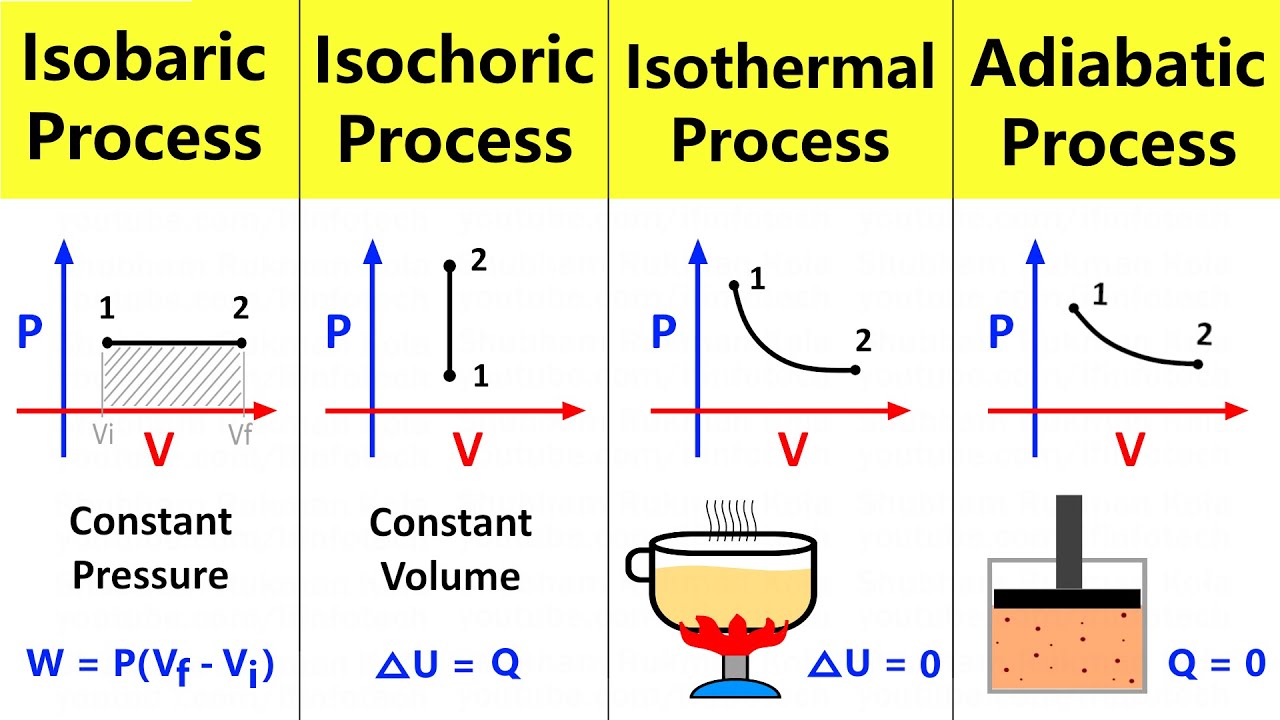
The four processes we analyzed are the theoretical cornerstones for understanding real-world engines. This image provides a concise summary of the key relationships for each.
Key Takeaways:
- For an ideal gas, changes in internal energy depend only on temperature change: .
- Isochoric (constant V): No work is done (), so all heat transfer changes the internal energy ().
- Isobaric (constant P): Work is done (), and heat transfer equals the change in enthalpy ().
- Isothermal (constant T): Internal energy does not change (), so all heat transfer is converted to work ().
- Adiabatic (): No heat is transferred, so work is done at the expense of internal energy ().
Preview of the Next Lesson:
We have now thoroughly analyzed processes in closed systems where the mass is fixed. However, many aerospace components—like jet engine compressors, combustors, and turbines—are open systems, where mass flows through them. In the next lesson, we will adapt the First Law of Thermodynamics to create the Steady-Flow Energy Equation (SFEE). This will allow us to analyze the energy transfers in these critical open-system devices.
Can't find a good explanation? Sign up and we'll make it for you
Sign up