
Introduction
Welcome back! In our last lesson, we explored the powerful symbolism of the anaconda as an ancestral creator in Amazonian mythologies. We saw how the Tukano people, for example, map their entire social structure onto the anaconda's body and how the communal longhouse, or maloca, is sometimes conceived as a representation of this ancestor.
Today, we will zoom in on that very structure. Our goal is to describe the cosmological significance of the 'maloca' in Amazonian cultures. This building is far more than just a shelter; it is a living, breathing model of the universe. For you as a designer and storyteller, the maloca is a masterclass in how architecture can embody a complete worldview, integrating space, time, myth, and social life into a single, coherent system.
Let's begin by looking at a maloca to ground our understanding.

The Maloca: The Universe in the Form of a House
At its most basic, a maloca is a large, communal house shared by multiple families in the Amazon. However, its true significance lies in its role as a physical manifestation of the cosmos. It is both a home and a sacred space, a social center and a map of the universe.
To get a foundational understanding of this concept, we'll start with an article that provides an excellent overview of the maloca's architectural and cultural roles.
The Indigenous Architecture of the Cosmos in the Amazon
Let's read the introductory sections of 'The Indigenous Architecture of the Cosmos in the Amazon' by Juan Sebastián Gómez-García. This will introduce the maloca as a physical representation of the cosmos and ancestral knowledge.
Please read the introduction and the section titled 'The Architecture of the Maloca.' Focus on how the structure is described as a representation of the human body, Mother Earth’s uterus, or the sun's house, and its role in transmitting knowledge.
As the article highlights, the maloca is not just built; it is designed with deep symbolic intent. Its very construction, using materials from the sacred environment and built through communal effort (mingas), reinforces its connection to the natural and social world.
The idea of the maloca as the "womb of Mother Earth" or a "receptacle of heavenly lightning" is a powerful starting point for visualizing its mythical role.
The magic behind the indigenous malocas
To reinforce this idea, let's briefly look at another source, 'The magic behind the indigenous malocas,' which emphasizes this womb-like symbolism.
Read just the first section, 'What is a maloca?' Notice the powerful phrases used, like 'tuning of the universe' and 'womb of Mother Earth.'
Mapping the Cosmos: The Maloca's Spatial Symbolism
Now, let's explore how the maloca functions as a map of the universe. Its cosmology is encoded in both its vertical and horizontal structure.
The Vertical Plane: Connecting Worlds
For many Amazonian peoples, the universe is multi-layered. The maloca is situated in the middle world, our terrestrial plane, but it acts as a conduit to the worlds above and below.
- The Roof represents the sky or the heavens.
- The Floor represents the earth.
- The Central Pillars are not just structural supports; they are cosmic pillars holding up the sky. For the Makuna people, these four pillars represent four mythical mountains that form the base of the sky.
- Below the Floor lies the underworld, a realm of spirits and ancestors, often associated with rivers that flow beneath the earth.
This vertical axis is the path shamans travel during their spiritual journeys, connecting the community to the spirit world.
The Horizontal Plane: A Map of Society and Territory
The floor plan of the maloca is just as symbolic. It maps out social relationships and the community's place in the wider world.
- Gendered Spaces: The central area, between the four main pillars, is the men's domain. This is the space for rituals, political decisions, and sacred knowledge. The surrounding areas are where daily activities like cooking and sleeping occur and are primarily the domain of women.
- Doors: The maloca often has two doors on opposite ends. For the Makuna, these represent the masculine and the feminine, separated by an imaginary central axis called the "River of Milk." This directly connects to the anaconda creation myth we studied, as this was the river the ancestral anaconda traveled.
- Social Geography: The layout can also represent the community's territory. The center of the house is the community's own location, while the outer areas correspond to the territories of neighboring and related groups.
This diagram from the article we read provides a fantastic visual summary of the Makuna maloca as a model of the cosmos.
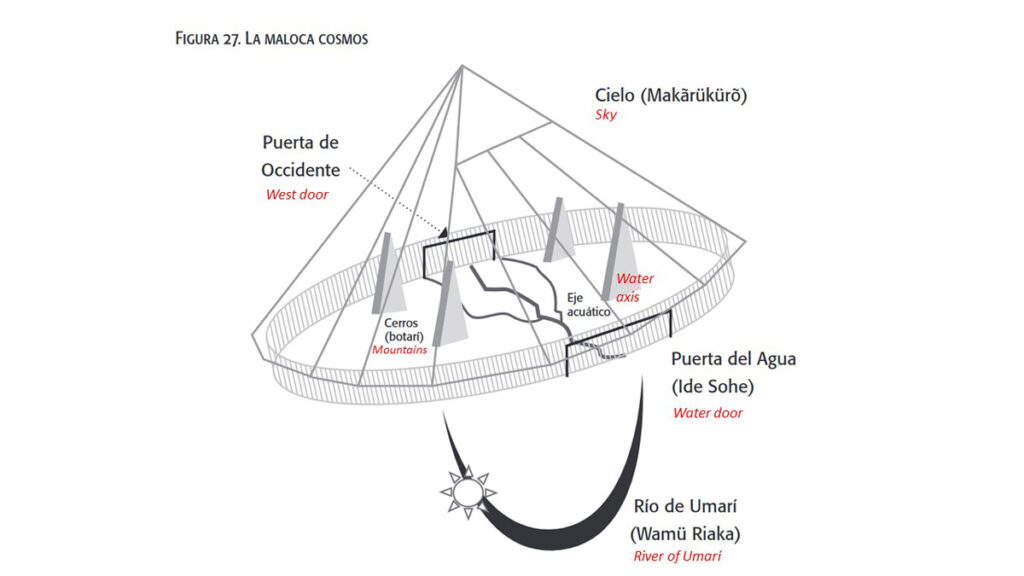
The Maloca as a Clock and Calendar
Beyond its spatial symbolism, the maloca is also a temporal device—a sophisticated instrument for tracking time.
The Indigenous Architecture of the Cosmos in the Amazon
Let's return to 'The Indigenous Architecture of the Cosmos in the Amazon' to understand how this works.
Read the section that begins 'Some malocas are also constructed to track time...' (you can find it under a picture of a maloca roof). Focus on how the sun's movement through openings in the roof creates a solar clock and calendar.
This is a brilliant example of design meeting function and belief. The architecture isn't just symbolic; it's a practical tool that governs daily life.
- Daily Clock: The path of sunlight moving across the floor and walls indicates the time for different activities.
- Seasonal Calendar: The shifting angle of the sun throughout the year tells the community when to sow, harvest, fish, or hold important rituals.
This design connects the grand, cosmic scale of the sun's journey directly to the human-scale activities of the community.
Test your understanding!
Given your background in product and user experience design, consider the maloca as a "product" designed for its "users." How does the maloca's design (as a solar clock, social map, and cosmic model) serve the needs of the community and reinforce their cultural values?
Show answer
Thinking of the maloca as a product, its design is a masterclass in user-centered and systems-level design.
- It solves user needs: It provides shelter, but also addresses higher-level needs for social cohesion, cultural continuity, and spiritual connection.
- It creates affordances: The movement of light affords time-telling; the layout affords social and gendered distinctions. The design guides behavior naturally.
- It reinforces the "brand" (culture): Every aspect of the design, from the materials used to the cosmic alignment, constantly reinforces the community's core beliefs and worldview. Living in the maloca is a daily act of participating in the myth.
- It's a system, not a feature: The maloca isn't just a house (a feature); it's an integrated system where the architecture, social rules, and cosmology are all interdependent. It's a physical embodiment of their entire "operating system" for life.
Conclusion: The Heart of Amazonian Culture
Today, we've seen that the Amazonian maloca is far more than a dwelling. It is the heart of cultural life—an architectural embodiment of cosmology that orders space, time, and society according to foundational myths.
Key Takeaways:
- A Model of the Universe: The maloca is a microcosm, a physical replica of the universe with its multiple layers (sky, earth, underworld).
- A Map of Society and Territory: Its internal layout defines social roles (especially gendered spaces) and represents the community's relationship with its neighbors.
- A Celestial Instrument: Through clever design, the maloca functions as a solar clock and calendar, synchronizing community life with cosmic rhythms.
- A Center for Culture: It is the primary space for transmitting knowledge, making collective decisions, and performing the most sacred rituals that sustain the community.
In essence, to live in a maloca is to inhabit the myth every single day.
Preview of the Next Lesson:
The maloca is the stage upon which much of Amazonian spiritual life unfolds. It is often from within this cosmic house that shamans embark on their journeys to interact with the spirit world. In our next lesson, we will explore some of the other common themes that arise from these interactions, identifying the significance of forest spirits, the concept of transformation, and the nature of shamanic journeys across Amazonian cultures.
Can't find a good explanation? Sign up and we'll make it for you
Sign up