
Introduction
Hello! In our last lesson, we explored the Amazonian maloca not just as a house, but as a complete model of the universe—a stage for social and spiritual life. We saw how its architecture maps the cosmos, tracks time, and organizes the community according to foundational myths.
This lesson takes us from the stage to the actors and the action. We will delve into the dynamic forces that animate the Amazonian worldview. Our learning outcome is to identify common Amazonian themes such as forest spirits, transformation, and shamanic journeys. These three concepts are deeply intertwined and form the bedrock of many indigenous cosmologies in the region.
For you, as an artist and storyteller aiming to illustrate these myths, this lesson provides the essential grammar for visually representing this spiritual world. We will explore:
- The diverse beings that inhabit the forest alongside humans.
- The fluid nature of identity, where beings can change their form.
- The ritual process through which humans connect with this unseen reality.
A World Alive with Spirits
The Amazonian worldview doesn't see the rainforest as an inanimate collection of resources. Instead, it is a vibrant, sentient world, teeming with non-human persons and consciousness. This concept, often called animism, posits that animals, plants, rivers, and mountains all possess spirits.
A foundational text for understanding this is Folktales of the Amazon. Its introduction sets the scene beautifully.
Let's read a short excerpt from the introduction to Folktales of the Amazon by Juan Carlos Galeano. It describes the traditional Amazonian perspective on the rainforest.
Please read the two paragraphs under the heading 'The Amazon,' starting from 'More than 800 indigenous ethnic groups...' and ending with '...an ecological way to live in the world.' Focus on how the rainforest is described as a world of spirits and how myths guide the relationship with this world.
These spirits, often called "owners" or "mothers" (dueños or madres in Spanish), are the guardians of the natural world. They are powerful, can be benevolent or malevolent, and humans must negotiate with them for survival.
- Guardians of the Animals: Figures like the Curupira or the Mapinguari act as protectors of the forest's fauna. They punish hunters who are disrespectful or greedy. The folktale of the Mapinguari, a terrifying one-eyed beast, is a vivid example of what happens when these rules are broken.
- Mothers of the Plants: Every plant, especially powerful "master plants" used in healing and ritual, has its own spirit or "mother." Healers must learn to communicate with these mothers to access the plant's knowledge and power.
- Spirits of Place and Ancestors: Rivers, waterfalls, and mountains have their own consciousness. The spirits of deceased ancestors also remain a tangible presence, sometimes interacting with the living.
Visually, these spirits often blend human, animal, and plant characteristics, reflecting their deep connection to the environment.
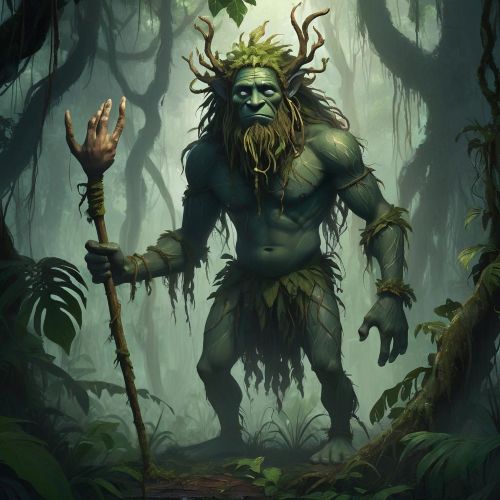
The exhibition catalog, the amazon on exhibition, is filled with art inspired by these beings. The artists often depict visions of these spirits revealed through dreams or shamanic rituals. For example, the art of Dimas Paredes, featured in the catalog, visualizes the "mothers" or guardian spirits of master plants, as well as mermaids and powerful boas that inhabit the spiritual dimension of the forest. You'll find these descriptions in the "MASTER PLANTS" section (page 62).
The Fluidity of Form: Transformation
A central theme that arises from this spirit-filled world is transformation. In the Amazonian cosmos, the boundaries between species and states of being are not fixed. Humans can become animals, animals can reveal a human consciousness, and spirits can take on physical form.
A key concept for understanding this is "perspectivism," which suggests that all beings share a similar kind of consciousness, but perceive the world from different bodies and viewpoints. What we see as a jaguar, the jaguar sees as a human. Transformation, then, is a change in perspective or body.
The foreword to Folktales of the Amazon provides a concise explanation of perspectivism and the theme of transformation.
Please read the three paragraphs starting with 'Amazonian cultures have been shown to abide by a complex philosophy termed "perspectivism"...' Focus on the ideas of shape-shifting and how the boundaries between worlds can be crossed.
This theme of transformation is a powerful source for visual storytelling:
- Mythic Origins: Creation stories often involve transformative acts. A deity or ancestor transforms into the sun, or a primordial anaconda's body becomes a river.
- Moral Consequences: As the Asháninka stories collected by Wilberto Casanto show, people who violate social norms (like being selfish) can be transformed into animals as a punishment. You can read about this in the "IMAGE AND WORD" section (page 122) of the amazon on exhibition.
- Shamanic Power: The most powerful shamans are often believed to have the ability to transform themselves, typically into a jaguar, an eagle, or a snake, to travel between worlds or fight spiritual battles.

The Bridge Between Worlds: The Shamanic Journey
If the world is full of spirits and beings are constantly transforming, how do humans navigate this complex reality? This is the role of the shaman, who acts as a diplomat, a doctor, and an explorer of the cosmos. The primary tool for this is the shamanic journey.
Through deep concentration, chanting, and often the ritual use of psychoactive "master plants" like Ayahuasca, the shaman enters a trance state. In this state, their soul is believed to travel to the other worlds that coexist with our own. The purpose of these journeys can be to:
- Diagnose and heal illnesses, which are often seen as spiritual in origin.
- Negotiate with the "owners" of animals to ensure a successful hunt.
- Retrieve a lost soul.
- Battle malevolent sorcerers.
- Gain knowledge from ancestors and spirits.
The following documentary provides a compelling look into the world of Shipibo healers in Peru and their use of Ayahuasca.
Onanya | Indigenous Shipibo Culture & Sacred Medicine of The Amazon Documentary (2024) Subtitles On
Let's watch some key segments from the documentary Onanya. This film offers a direct look into the practice of shamanism, the preparation of sacred medicine, and the nature of the visions experienced during a shamanic journey.
Please watch the two segments titled 'Discusses Ayahuasca...' (17:06 - 21:37) and 'Explains how Ayahuasca induces visions...' (25:28 - 37:48). As you watch, pay attention to: The concept of the 'dieta' as a preparation for the journey. The description of the visions and what they reveal. The role of 'ikaros' (healing songs) in guiding the experience.
As the film illustrates, the shamanic journey is not a chaotic hallucination. It is a structured, purposeful exploration of a reality that is considered just as real as our own. The visions often have a geometric quality, which for the Shipibo people, are the source of the intricate kené designs you see on their textiles and ceramics. This is a direct link between a spiritual experience and an artistic tradition. As described in the "MAYA MAYA BAINKIN" section (page 38) of the exhibition catalog, kené is considered a "healing design" or "design medicine."
Test your understanding!
From a user experience design perspective, a shamanic journey could be seen as a "flow" for interacting with a complex, non-ordinary information system (the spirit world). How do elements like the dieta (preparation), Ayahuasca (the interface), and ikaros (auditory guidance) work together to ensure a successful and safe "user journey" for the shaman?
Show answer
This is a great way to frame it.
- The Dieta (Onboarding & System Prep): The diet of restricting salt, sugar, etc., is like an onboarding process. It prepares the user's "system" (their body and spirit) to be receptive to the experience and minimizes "errors" (negative or dangerous visions). It attunes them to the specific frequency of the spirit world.
- Ayahuasca (The Interface/API): The sacred brew is the interface that grants access to the spirit world. It's the "key" or API (Application Programming Interface) that allows the shaman to send and receive information from this other dimension.
- Ikaros (Navigation & Firewall): The songs are not just music; they are active tools. They act as navigation, guiding the shaman (and the patient) through the visionary landscape. They can be used to call specific spirits, open or close visionary portals, and provide protection, acting like a spiritual "firewall" against malevolent forces.
Together, these elements create a highly structured and repeatable protocol for accessing and safely navigating an otherwise invisible and potentially dangerous dimension.
Conclusion
Today we have explored three foundational themes of Amazonian mythology that are inextricably linked:
Key Takeaways:
- Forest Spirits: The Amazon is a sentient world, populated by a vast array of non-human persons—guardians, masters, and ancestors—with whom humans must maintain a balanced relationship.
- Transformation: The boundaries between human, animal, and spirit are fluid. Beings can change form, and this shape-shifting is a core dynamic of the Amazonian cosmos, appearing in creation myths, morality tales, and shamanic practice.
- Shamanic Journeys: The shaman is the master navigator of this complex spiritual reality. Through ritual, sacred plants, and deep knowledge, they travel to other worlds to heal, gain wisdom, and maintain cosmic equilibrium.
These themes provide a rich tapestry of characters, settings, and plotlines for your illustrative work. The spirits offer endless possibilities for character design, the concept of transformation is visually dynamic, and the shaman's journey is the ultimate narrative framework.
Preview of the Next Lesson:
Now that we have a grasp of these broad Amazonian themes, our journey will circle back to Colombia. We will see how one specific culture, the U'wa, has developed its own unique and powerful cosmology based on these shared principles. In our next lesson, we will describe the U'wa concept of 'Ruwa' (the world as a living body) and their role as its guardians.
Can't find a good explanation? Sign up and we'll make it for you
Sign up