
Introduction
Hello again! In our last session, we explored the Tikuna creation myth, a dramatic story of transformation where the world was given light by felling a giant tree, which then became the Amazon River. This established a direct link between the river, its fish, and the Tikuna people themselves.
Today, we delve deeper into the mythology of the Amazon, focusing on one of its most powerful and recurring figures: the anaconda. Our goal is to explain the significance of the anaconda as an ancestral and creative figure in Amazonian mythologies.
While the Tikuna myth portrays the river as being created from a tree, many other Amazonian peoples, particularly in the northwestern Amazon (including parts of Colombia), see the river as an ancestral being—the anaconda itself. This figure is not just a fearsome predator but a primordial creator, a vessel for humanity, and a blueprint for society. For you, as a designer and storyteller, this myth offers a fascinating look at how a single, powerful symbol can be used to structure an entire worldview.
The River, the Canoe, the Ancestor
The connection between the anaconda and the river is a foundational concept in many Amazonian cosmologies. The sinuous, powerful movement of the snake mirrors the winding paths of the great rivers, making it a natural symbol for the source of life in the rainforest.
Let's begin by exploring the core narrative of the ancestral anaconda, which is central to the beliefs of many groups in the Vaupés region of Colombia and Brazil.
The Mythical Green Anaconda of the Amazon Rainforest
To understand this foundational myth, we'll read from an article called 'The Mythical Green Anaconda of the Amazon Rainforest' from The Collector. It provides an excellent overview of the anaconda's role as a creator and organizer of the world.
Please read the first two sections: 'Making a Myth: Why the Green Anaconda?' and 'The Ancestral Anaconda of the Amazon.' Focus on how the anaconda is simultaneously an animal, a canoe, and a creative force that establishes social and cultural order.
As you've just read, the myth presents a powerful and multi-layered image:
- The Anaconda as Creator: It journeys from a mythical origin point, bringing space and time into existence.
- The Anaconda as Canoe: It carries the first human communities within its body.
- The Anaconda as Social Organizer: As it travels upriver, it deposits different groups of people in their respective territories, giving them their unique languages, cultures, and social status.
This journey is not just a story of the past; it is a living map that explains the present-day relationships between different indigenous groups.
Visualizing an Ancient Belief
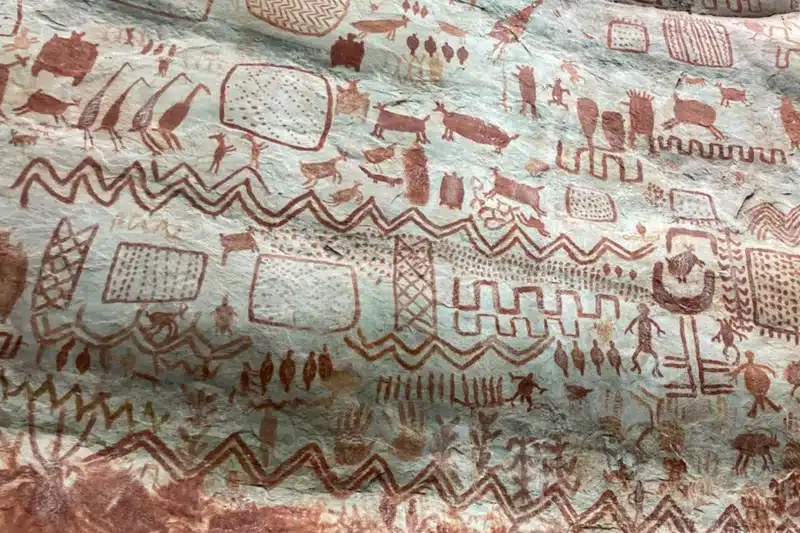
This ancestral anaconda myth is not a recent invention. It is an ancient belief, recorded for millennia in a form that will surely resonate with your background in art and design: rock art.
The article mentioned the discovery of ancient pictographs in the Serranía del Chiribiquete in the Colombian Amazon. These paintings depict what archaeologists interpret as "anaconda-canoes" with human figures on top, suggesting a shamanistic and ritual connection to this powerful being.
A Deep Dive: The Anaconda and Tukano Society
To see just how deeply this myth can shape a culture, let's focus on the Tukano peoples of the Vaupés region. For them, the ancestral anaconda is not just a historical creator but a constant, living principle that organizes their entire social and spiritual world.
Tukano - Indigenous Peoples in Brazil - PIB Socioambiental
The following text from 'Tukano - Indigenous Peoples in Brazil' by the Instituto Socioambiental provides a detailed look at how the anaconda myth is woven into the fabric of their society. It's a fantastic case study in applied mythology.
Please read the section that begins 'Each group has its own language...' and the following section, 'Social organization.' Pay close attention to how the anaconda's body serves as a model for social hierarchy.
This is where the myth becomes a system. The Tukano worldview provides a clear structure:
- Identity: Each group has its own Anaconda ancestor, whose body is their stretch of the river.
- Hierarchy: Society is organized like the anaconda's body. Higher-ranking clans are the "head of the Anaconda," middle-ranking clans are the body (specialist chanters and shamans), and lower-ranking clans are the "tail of the Anaconda."
This direct link between myth and social structure is a powerful example of systems thinking in a cultural context. The story provides the logic for social organization, land rights, and ritual responsibilities.
Test your understanding!
Imagine you are a designer tasked with creating an infographic for a museum exhibit on Tukano cosmology. How would you visually represent the interconnected concepts of the Ancestral Anaconda, the river, the social hierarchy (clans as head, body, tail), and the maloca (longhouse) in a single, coherent visual? Describe your design concept.
Show answer
A possible concept for the infographic could be a central, large illustration of a stylized anaconda winding its way across the design, morphing into a river.
- Anaconda/River: The anaconda's body would form the central axis of the infographic. Its head would be in the east (downstream), and its tail in the west (upstream). The texture of its skin could subtly blend into a map-like representation of the Uaupés river.
- Social Hierarchy: Along the anaconda's body, you could place icons or stylized figures representing the different clans. At the "head" section of the anaconda, you'd place symbols for the chief clans (e.g., a headdress). Along the "body," symbols for chanters and shamans (e.g., a rattle or musical instrument). At the "tail," symbols for servant clans. Lines could connect these clans to specific points along the river.
- The Maloca: You could show a cross-section of a maloca superimposed on the anaconda's body. The anaconda's spine would align with the maloca's ridgepole, its ribs with the house posts, visually reinforcing the idea that the house is the anaconda's body. You could label the men's door (east) and women's door (west), linking it to the anaconda's orientation.
This integrated visual would demonstrate that for the Tukano, the myth is not just a story, but a living blueprint for their world.
The Cycle of Life: Swallowed by the Anaconda
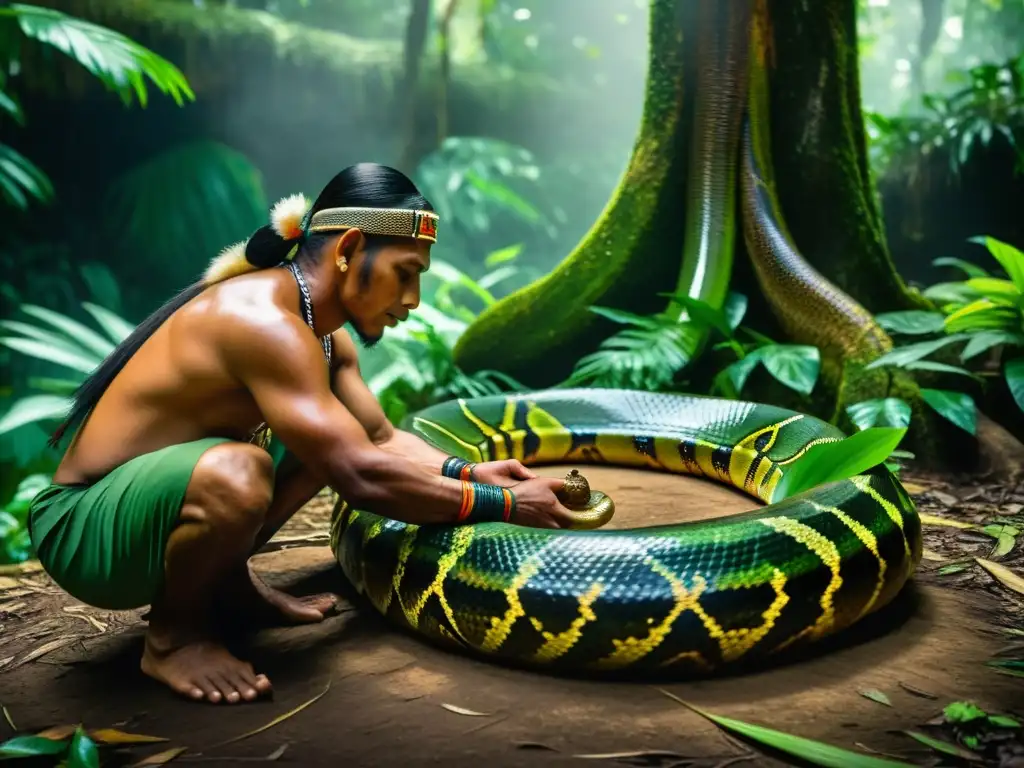
The anaconda's significance extends beyond creation and social order into the very cycle of life, death, and rebirth. This is most powerfully enacted in the Yuruparí initiation ritual for young boys.
Tukano - Indigenous Peoples in Brazil - PIB Socioambiental
Let's return to the resource on the Tukano people to see how the anaconda features in this crucial rite of passage.
Read the short section describing the Yuruparí rituals, which begins 'Like many initiation rites...'. Focus on the symbolic role the anaconda plays in the transformation of the initiates.
The imagery here is incredibly potent. The initiates are symbolically "swallowed" by the anaconda-ancestor, "digested" during their seclusion, and "vomited" back up as new beings. This ritual is a dramatic performance of death and rebirth, bringing the myth into the life of every man. It demonstrates a cyclical worldview where to become an adult, one must return to the ancestor and be reborn through its power.
Conclusion
Today we've explored the profound significance of the anaconda in Amazonian mythologies. We moved from the general concept of the anaconda as the river-creator to a detailed look at how this myth provides the entire framework for Tukano society and ritual life.
Key Takeaways:
- The Anaconda as Creator and Ancestor: In many Amazonian cosmologies, the anaconda is a primordial being that created the rivers and gave birth to humanity from its own body, which acted as a canoe.
- Myth as a Social Blueprint: The Tukano worldview shows how the anaconda myth is a system that defines territory, social hierarchy (head, body, tail of the snake), and identity.
- A Symbol of Transformation: The anaconda represents the cycle of life, death, and rebirth, a theme dramatically enacted in initiation rituals where boys are symbolically swallowed and reborn from the ancestor.
- A Figure of Immense Power: The anaconda embodies the life-giving, sacred, and dangerous power of the Amazon's aquatic world, demanding respect and balance.
Preview of the Next Lesson:
In our discussion of the Tukano, we touched upon the maloca, or communal longhouse, and its symbolic connection to the anaconda's body and the cosmos. In our next lesson, we will focus exclusively on this structure, exploring the cosmological significance of the 'maloca' in Amazonian cultures in greater detail. We will see how this single building serves as a model of the universe, a social hub, and a stage for ritual life.
Can't find a good explanation? Sign up and we'll make it for you
Sign up