
Introduction
Welcome! In our last lesson, we explored the U'wa people's profound concept of Ruwa, the world as a single living body. We saw how this belief directly shapes their role as sacred guardians, making their opposition to oil extraction an act of cosmic defense. This worldview provided a powerful example of a belief system where humanity's role is to maintain balance within a living planet.
Today, we remain in the vast Amazonian basin but turn our attention to the Tikuna (or Ticuna) people, one of the most numerous indigenous groups in the Brazilian Amazon, with significant populations in Colombia and Peru as well. Our goal is to recount the Tikuna creation myth of the brothers Yoi and Ipi.
This story offers a different, but equally compelling, narrative of creation. While the U'wa focus on the systemic nature of a pre-existing world, the Tikuna myth is a dynamic story of transformation—of darkness into light, of a tree into a river, and of fish into people. For someone with your background in storytelling and design, this myth is rich with dramatic scenes and powerful visual potential.
The World Born from a Tree
The Tikuna myth begins in darkness. The world is overshadowed by a single, colossal tree that blocks all light from the sky. Two divine brothers, Yoi and Ipi, decide this must change.
Let's start with a concise telling of this first act of creation.
Life in the Amazon River and Jungle of Puerto Nariño, Colombia
This brief excerpt from the travel blog 'Life in the Amazon River and Jungle' provides a clear and poetic summary of the first part of the Tikuna creation story.
Please read the short, italicized paragraph at the very beginning of the article, which recounts the myth of the Ceiba tree.
This version gives us the essential plot points: darkness, the giant Ceiba tree, the brothers Yoi and Ipi, and the dramatic transformation of the fallen tree into the Amazon River and its fish.
Another telling of the myth adds more narrative detail and characters, which are fantastic elements for visual interpretation.
The Ticuna Indians and their Messiah
Now, let's explore a more detailed version of this same event from the 'Tales Blog.' This account introduces other characters and obstacles, adding layers to the story.
Please read the first two paragraphs, from 'There was a time when the Earth was all darkness...' down to '...sun, sky and stars could finally be seen.' Notice the role of the sloth and the fire ants.
By combining these two accounts, we get a full picture of the creation of the world:
- The Problem: The world is trapped in darkness by a giant tree (called a Samaum or Ceiba).
- The Protagonists: The brothers Yoi (the primary actor) and Ipi (his helper).
- The Action: They first try to poke holes in the canopy, creating the stars. To fell the tree, they enlist the help of forest animals (like a woodpecker and fire ants) to overcome obstacles, such as a spying sloth and the tree's magical ability to heal itself.
- The Climax: The tree finally crashes down. Its massive trunk carves out the bed of the Amazon River, its branches become the tributaries, and its colorful leaves transform into the myriad species of fish.
This first part of the myth is a powerful origin story not just for light and the sky, but for the central feature of the Amazonian landscape: the river itself.
The People Fished from the River
With the world now filled with light, color, and a magnificent river teeming with fish, the stage is set for the arrival of humanity. The myth continues with Yoi performing another act of creation, this time establishing the Tikuna people.
The Ticuna Indians and their Messiah
Let's return to the 'Tales Blog' to read about the origin of the Tikuna people.
Please read the first paragraph of this section, starting with 'One day, seeing these colorful fish...' and ending with '...creating the first Ticuna Indians.'
This act is elegantly simple and profoundly symbolic. Yoi, seeing the beautiful fish in the waters of a specific stream (the Igarapé Eware), uses a cassava root as bait and begins to fish. As he pulls the fish from the water, he transforms them into the first Tikuna men and women.
This moment is a cornerstone of Tikuna identity, directly linking their ancestry to the river and the fish created from the world-tree.

Test your understanding!
From a design and storytelling perspective, the Tikuna creation myth is a story of transformation. Identify three key transformations in the myth. For each one, describe the "before" state and the "after" state. How might you visually represent one of these transformations in a single illustration?
Show answer
Here are the three central transformations:
-
The World's Illumination:
- Before: A dark world covered by the canopy of a single, giant tree.
- After: A world filled with light, a visible sky, sun, and stars.
- Visual Representation: You could illustrate the moment the tree is falling. On one side of the image, the remaining canopy still casts the world in shadow. On the other side, where the trunk has been cut, brilliant sunlight pours down for the first time, revealing the world below.
-
The River's Creation:
- Before: A colossal tree standing in the center of the world.
- After: The Amazon River, its tributaries, and its fish.
- Visual Representation: A powerful image could show the fallen tree from a bird's-eye view. The impression of its trunk in the earth is filling with water to become the main river, its branch impressions are becoming tributaries, and the scattered leaves are shimmering and turning into colorful fish in the water.
-
Humanity's Origin:
- Before: Fish swimming in the Igarapé Eware stream.
- After: The first Tikuna people living on the land.
- Visual Representation: You could show Yoi's fishing line being pulled from the water. At the water's surface, the line holds a fish, but as the figure emerges from the water, it transforms midway into a human, with the upper body of a person and the lower body still resembling a fish. This captures the exact moment of magical transformation.
The Myth in Living Culture
Like the U'wa's concept of Ruwa, the myth of Yoi and Ipi is not just an ancient story; it is a living part of Tikuna culture that informs their art and rituals. The characters and transformations from the myth are often represented in ceremonies. One of the most famous Tikuna ceremonies is the "Festa de Moça Nova," a female initiation ritual where participants wear intricate masks made of wood and bark cloth, often depicting mythological beings.
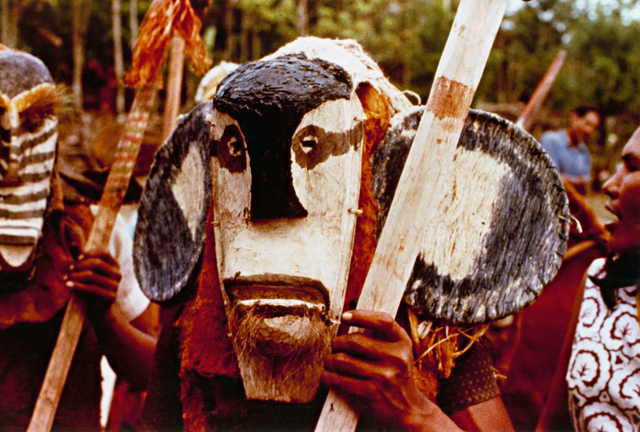
These masks and rituals are a powerful reminder that for the Tikuna, myth and reality are deeply intertwined. The stories are not just told; they are performed, embodied, and visually expressed, keeping the foundational truths of their culture alive for each new generation.
Conclusion
Today, we have delved into the Tikuna creation myth of Yoi and Ipi. This narrative provides a vivid, action-oriented account of the world's origin, contrasting with the more philosophical, systemic worldview of the U'wa we studied previously.
Key Takeaways:
- Creation from Darkness: The myth begins with the heroic act of felling a giant tree to bring light to the world.
- The River's Origin: The Amazon River and its fish are created directly from the fallen world-tree, establishing the river as a sacred, life-giving entity born from the very structure of the early world.
- Humanity from the Water: The Tikuna people are born from this sacred river, transformed from fish by the creator god Yoi. This myth roots their identity directly in the aquatic life of the Amazon.
- A Story of Transformation: The narrative is structured around a series of dramatic transformations, offering rich material for visual storytelling and illustration.
Preview of the Next Lesson:
In our next lesson, we will continue to explore Amazonian mythologies by focusing on a recurring and powerful figure: the anaconda. We will examine its significance as an ancestral, creative, and sometimes destructive force in the cosmologies of several different peoples in the region.
Can't find a good explanation? Sign up and we'll make it for you
Sign up