Hello! Welcome back to our module on Deal Sourcing and Screening.
In our last lesson, we laid the critical groundwork by defining your ideal startup profile and crafting an initial investment thesis. That thesis is your strategic compass, telling you what kind of company you're looking for. Now, we'll answer the next logical question: how do you find them?
Today’s lesson will guide you through developing a marketing and outreach plan to generate high-quality deal flow. A great thesis is only valuable if you have a system to attract startups that fit it. For a new, solo-led accelerator, moving from a passive "wait and see" approach to a proactive, multi-channel strategy is essential for building your brand and securing the best investment opportunities. This plan will be the engine that fills the top of your investment funnel.
1. The Foundations of Modern Deal Flow Generation
In the past, venture capital often relied on closed, personal networks. Today, the landscape is far more competitive. Successful investors understand that they can't just wait for deals to come to them; they need to build a system that both attracts and seeks out the best founders. This system is built on two pillars: inbound marketing and outbound outreach.
- Inbound Marketing: This is about making your firm a magnet for the right founders. It involves building your brand, establishing thought leadership, and creating content that pulls your target audience toward you.
- Outbound Outreach: This is the proactive hunt. It involves identifying specific startups that fit your thesis and reaching out to them directly with a compelling, value-driven message.
A robust deal flow strategy combines both. To understand why marketing has become so crucial for VCs, let's start with an overview.
Venture Capital Marketing: How the Best VC Firms Do It
The article 'Venture Capital Marketing: How the Best VC Firms Do It' from Everything Startups provides an excellent explanation of why a marketing mindset is essential for modern VCs. It covers the core goals: increasing brand awareness, attracting qualified leads, and establishing thought leadership.
Please read the introduction and the first three sections: 'Why Marketing Is Crucial for VC Firms,' 'Increasing Brand Awareness in a Competitive Industry,' 'Attracting Qualified Leads and Potential Investments,' and 'Establishing Thought Leadership and Credibility.' Pay attention to the examples of how firms like Sequoia and Andreessen Horowitz (a16z) proactively shape their deal flow.
As the article highlights, marketing allows you to control your narrative and differentiate your accelerator. For you, this means clearly communicating your AI focus and the unique value you bring as a consultant-turned-investor.
2. Building Your Inbound Engine: Becoming a Magnet for Deals
Your inbound strategy is a long-term investment in your brand. As a solo GP, your personal brand and your firm's brand are one and the same. The most effective way to build this brand is through content that demonstrates your expertise and helps your target founders.
Your 10 years in startup consulting are a huge asset here. You have a deep well of knowledge about the challenges pre-seed founders face. The goal is to package that knowledge into content that establishes you as a go-to expert.
The article we just looked at, "Venture Capital Marketing," details several effective content strategies.
Venture Capital Marketing: How the Best VC Firms Do It
Let's return to the 'Venture Capital Marketing' article to explore specific tactics for building your inbound engine. This will cover building a personal brand, using newsletters, and creating credible content.
Read the sections 'The Best Content Marketing Strategies for VC Firms' and 'Branding and Positioning in VC Marketing.' Notice how different firms use content and branding to attract specific types of founders (e.g., First Round's founder-centric blog, Root Ventures' technical 'vibe').
Based on this, here are the key channels to consider for your inbound plan:
- Personal Branding on LinkedIn/X (Twitter): This is your highest-leverage starting point. You can share insights from your consulting work, comment on news in the AI space, and celebrate wins from companies you've advised. Consistency is more important than volume. Your computer science background gives you the credibility to discuss technical AI topics, while your consulting experience allows you to provide practical business advice.
- A Niche Newsletter or Blog: Rather than a generic "fund updates" newsletter, create a resource for your target founders. A title like "AI Founder Playbook" or "The Pre-Seed AI Go-to-Market Guide" immediately signals value. You could write about topics like "How to Price Your AI SaaS Product" or "Finding Your First 10 Enterprise Customers for an AI Tool."
- Branding and Positioning: Your website and all communications should scream "AI-focused accelerator." As the article notes, your brand is a "vibe setter." Think about what aesthetic and language would appeal to the technical, ambitious founders you want to attract. Is it minimalist and data-driven? Or bold and focused on industry disruption?
You don't need to do everything at once. Pick one primary channel (e.g., LinkedIn) and one content format (e.g., a monthly blog post) to start.
3. Designing Your Outbound Strategy: The Proactive Hunt
While inbound marketing builds your pipeline over the long term, outbound outreach generates opportunities now. This involves identifying companies that fit your thesis and contacting them with a personalized, high-value message.
This is not about sending mass, generic emails. It's about surgical, thoughtful engagement.
Startup Outreach Guide for Investors: Strategies & Channels
The 'Startup Outreach Guide for Investors' by Qubit Capital provides a fantastic, practical playbook for outbound outreach. We'll focus on the core components: defining your target, using multiple channels, and crafting the perfect message.
First, quickly review the section 'Building Your Investment Thesis and Target Framework'—this should be familiar from our last lesson. Then, read 'The Multi-Channel Approach to Startup Discovery' to understand the different channels. Finally, focus deeply on 'Crafting Compelling Outreach Messages,' including the 'Message Framework Template,' 'Personalization at Scale,' and 'Common Messaging Mistakes to Avoid.' The examples here are excellent.
The key takeaway from this resource is that effective outreach leads with value, not an ask. Your message should prove you've done your homework and can offer something more than just capital.
Here's a breakdown of the process:
- Identify Targets: Use your thesis to find companies on platforms like LinkedIn, Crunchbase, or industry-specific lists. Look for signals that align with your criteria (e.g., a key technical hire, a product launch, a mention in a trade publication).
- Do Your Research: Before reaching out, spend 10 minutes understanding the company. Read the founder's recent blog post, look at their LinkedIn profile, and understand their product's positioning.
- Craft the Message: Use the framework from the Qubit Capital guide:
- Opening Hook: Reference something specific you found in your research.
- Ineffective: "I saw your company and was impressed."
- Effective: "I read your recent blog post on using LLMs for code documentation, and your API-first approach really stood out."
- Credibility Bridge: Connect their work to your experience.
- Effective: "In my work advising pre-seed startups, I helped a similar dev-tool company navigate their first enterprise sales, and I see parallels in the challenge you're tackling."
- Value Proposition: Offer something concrete and helpful.
- Effective: "I have a playbook on pricing for developer tools that might be useful, and I'd be happy to introduce you to the Head of Engineering at [relevant company] who is a potential customer."
- Clear, Low-Friction Next Step: Make it easy to say yes.
- Effective: "Would a 20-minute call next week work to discuss your GTM strategy? Happy to start by sharing that pricing playbook."
- Opening Hook: Reference something specific you found in your research.
Test your understanding!
Imagine you've identified a startup, "CodeGenius," that fits the thesis you drafted in our last lesson. CodeGenius has an AI tool that helps non-technical product managers write technical specifications. The founder recently wrote a LinkedIn post about the difficulty of selling to large enterprise tech teams.
Using the framework above, draft a short outreach email (Subject line + body) to the founder of CodeGenius.
Show answer
Here is one possible example. The key is the personalization and value-first offer.
Subject: Your LinkedIn post on enterprise sales
Hi [Founder Name],
I saw your recent post about the challenges of selling new dev tools into large enterprise teams. It's a problem I saw firsthand while helping two of my consulting clients reduce their sales cycle from 9 months to under 4.
Your approach at CodeGenius of empowering non-technical PMs is a brilliant solution to a major bottleneck. Based on my experience, the key will be getting buy-in from the engineering managers, not just the PMs.
I have a short framework on navigating enterprise procurement for dev tools that I think you'd find valuable. I can also introduce you to the VP of Product at [relevant tech company] who is actively looking for solutions like this.
Would you be open to a 20-minute chat next week to discuss your strategy?
Best,
[Your Name]
4. Creating Your Integrated Marketing & Outreach Plan
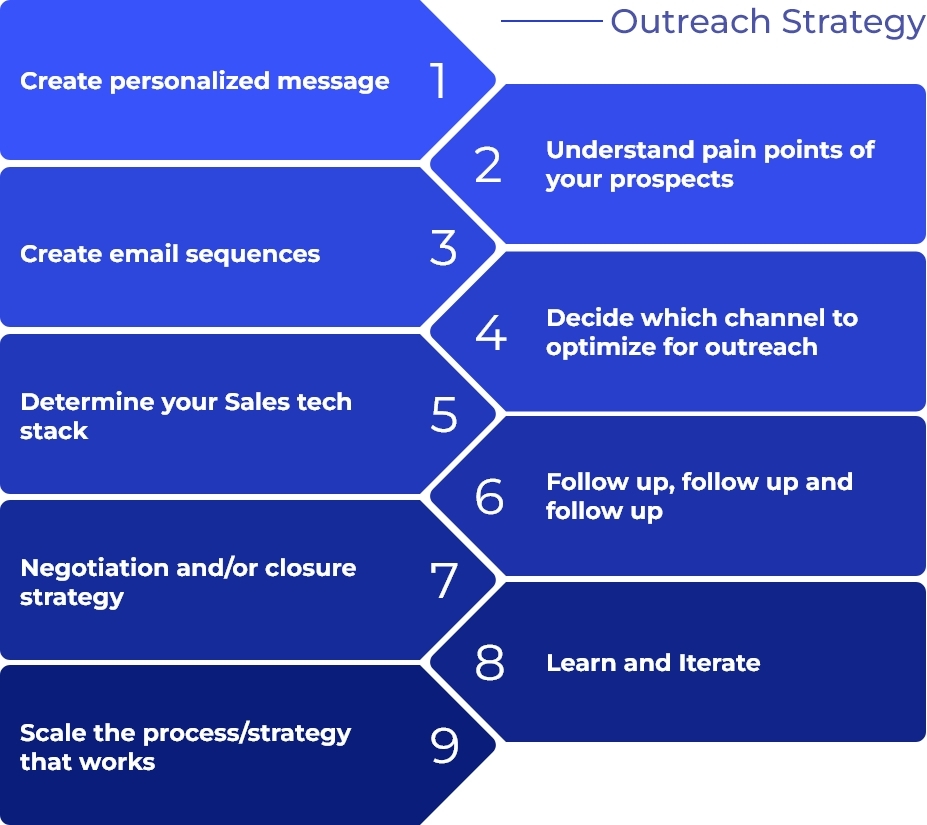
Now, let's pull these pieces into a simple, actionable plan. A good plan isn't a list of 20 things to do; it's a focused strategy with clear goals and metrics. You can use an infographic like the one below as a high-level guide for the entire process.
Here is a simple template for your initial 90-day plan:
Objective: Generate 10 high-quality, on-thesis applications per month.
Target Audience: (Reference your investment thesis from the previous lesson).
- Example: Pre-seed AI startups in North America building application-layer tools for non-technical enterprise users.
Inbound Channels & Cadence (Start with 1-2):
- LinkedIn: Post 2x per week. One post sharing a practical tip for founders, one post commenting on an AI industry trend.
- Newsletter: Publish one deep-dive article per month on a core challenge for pre-seed AI founders.
Outbound Channels & Cadence (Start with 1-2):
- Email Outreach: Identify and send personalized emails to 5 target companies per week.
- Networking: Attend one relevant virtual/local meetup per month (e.g., an AI developers meetup or a SaaS strategy group).
Key Metrics to Track:
- Inbound: LinkedIn post engagement (likes, comments), newsletter subscribers.
- Outbound: Email response rate (aim for >15%).
- Overall: Number of qualified applications received that cite your content or outreach.
This plan is manageable for a solo GP and focuses your efforts on the highest-impact activities.
Conclusion
In this lesson, we've designed the framework for actively and systematically generating deal flow for your accelerator. You now have a plan to move from being a passive recipient of opportunities to a proactive hunter of great companies.
Key Takeaways:
- Modern deal sourcing requires a dual strategy of inbound marketing (attracting deals) and outbound outreach (finding deals).
- Your most powerful marketing tool is your expertise. Use content (LinkedIn, blogs) to establish thought leadership and build a personal brand.
- Effective outbound outreach is personalized and value-driven. Always lead with how you can help, not what you want.
- Start with a focused, manageable plan. Consistency in a few channels is better than sporadic effort across many.
Preview of the next lesson:
You now have a plan to find startups. But how do you manage the process efficiently? And how can you leverage AI—a core part of your accelerator's identity—in your own operations? In our next lesson, we will evaluate and select AI-powered tools for deal sourcing and market mapping, giving you the tech stack to execute the plan you've just built.