Hello! Welcome back to our module on Deal Sourcing and Screening.
In our last lesson, you developed a marketing and outreach plan to start filling your deal flow pipeline. You now have a strategy for what you're looking for (your investment thesis) and how to find it (your inbound and outbound plan). The next logical step is to equip yourself with the right technology to execute that plan effectively.
Today, we will focus on how to evaluate and select AI-powered tools for deal sourcing and market mapping. As a solo General Partner launching an AI-focused accelerator, leveraging AI in your own operations is not just about efficiency—it's a core part of your brand and a critical competitive advantage. This lesson will provide a framework for building a lean, powerful tech stack to find the best startups without needing a large team.
1. The Shift to AI-Driven Venture Capital
Traditionally, deal sourcing relied on personal networks and manually searching through static databases like Crunchbase or PitchBook. While still useful, this approach is time-consuming and often reactive, dependent on public announcements like funding rounds. Today, the sheer volume of new companies makes this manual approach nearly impossible to scale for a solo investor.
This is where AI is fundamentally changing the game. We're entering an era sometimes called "VC 3.0," where data and AI are central to investment strategy. To get a high-level perspective on this transformation, let's start with a short video from NFX, a prominent seed-stage venture firm.
VC 3.0: How AI is Reshaping Venture Capital (What Founders Must Know)
The video 'VC 3.0: How AI is Reshaping Venture Capital' introduces how AI is set to transform the core functions of a venture fund. Pay close attention to the discussion on how sourcing will evolve.
Please watch the first clip from 00:15 to 00:50 for a general introduction. Then, watch the segment from 11:07 to 12:12, where the speaker specifically discusses how AI will impact deal sourcing and analysis.
As the video suggests, AI enables a shift from passive sourcing to proactive discovery. It allows investors to spot promising companies based on subtle digital signals before they are widely known. This is achieved through a more advanced approach than simple keyword searching.
2. Beyond Databases: The Power of Contextual AI
The most significant leap forward in deal sourcing technology is the move from static databases to what is known as "Contextual AI." Your computer science background will help you appreciate the distinction: this isn't just about better grep or keyword matching. It's about systems that understand relationships, intent, and strategic context.
To understand this concept in depth, we'll turn to an excellent article from FounderNest.
Beyond databases: The rise of contextual AI in technology ...
The article 'Beyond databases: The rise of contextual AI in technology scouting' explains the limitations of traditional scouting methods and details how contextual AI provides a more dynamic and intelligent alternative. This is a foundational concept for evaluating modern tools.
First, read the section 'Taking the traditional approach in technology scouting' to understand the limitations of static methods. Then, read 'The shift to contextual AI: What changes' to see how AI addresses these shortcomings. Focus on the five key transformations, from 'scanning to sense-making' to 'augmentation'.
As the article outlines, contextual AI transforms sourcing by:
- Going from Scanning to Sense-Making: Instead of just finding startups with the keyword "AI," it can answer a specific strategic question like, "Which startups are using transformer models to automate contract review for law firms in North America?"
- Fusing Cross-Domain Data: It connects signals from disparate sources—a patent filing, a key hire from a major tech company, a research paper, and a GitHub repository—to surface opportunities that would otherwise be invisible.
- Providing Real-Time Signals: The system constantly monitors data streams and alerts you to meaningful changes, such as a sudden increase in a startup's web traffic or a spike in job postings for engineering roles.
This "sense-making" capability is what allows you to find deals that perfectly match your investment thesis with high efficiency.
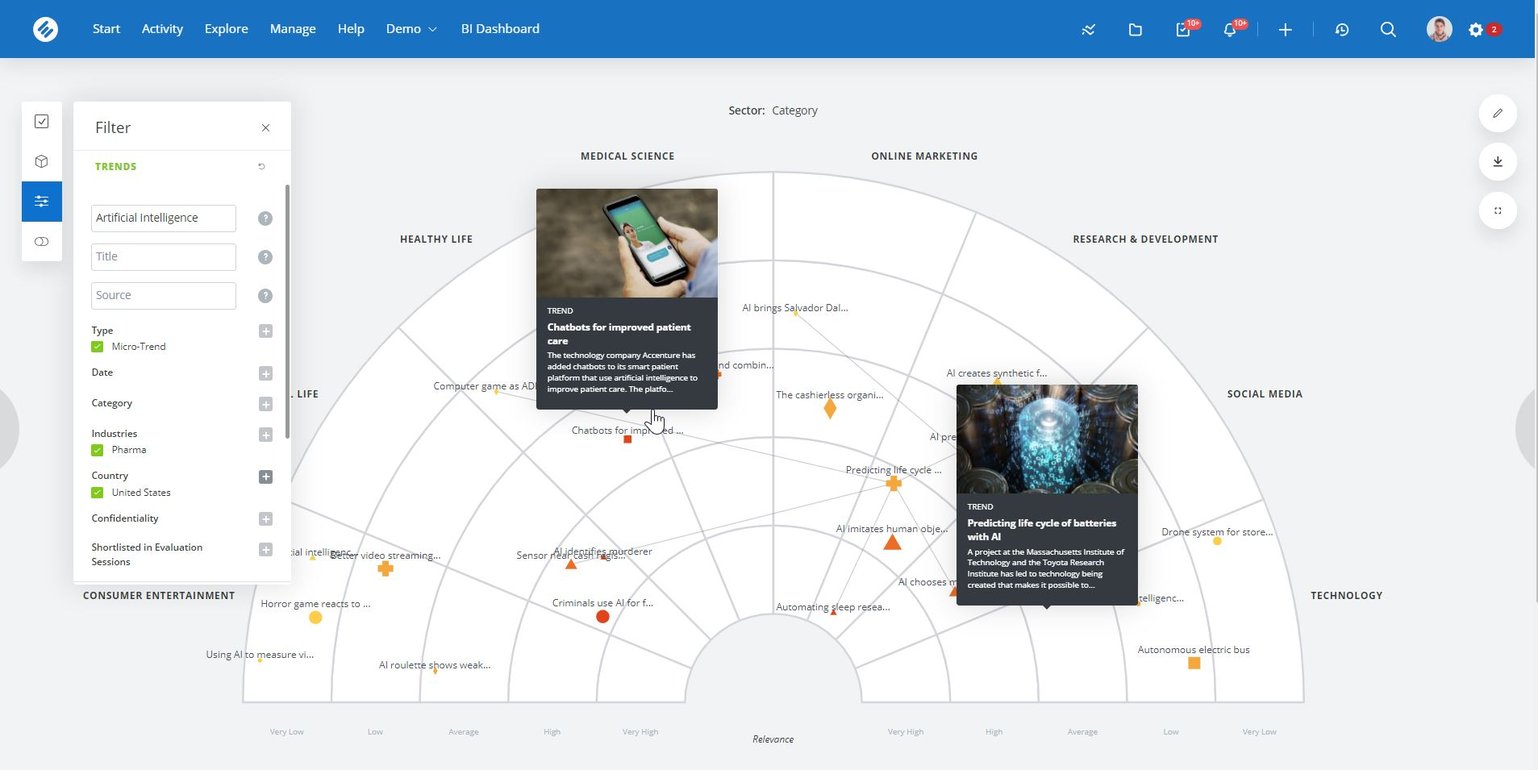
3. A Landscape of AI Tools for Venture Capital
Now that you understand the what and why, let's explore the landscape of available tools. The market for VC software is broad, but we can group tools into logical categories based on their function in your workflow. The following market map gives a sense of the ecosystem.
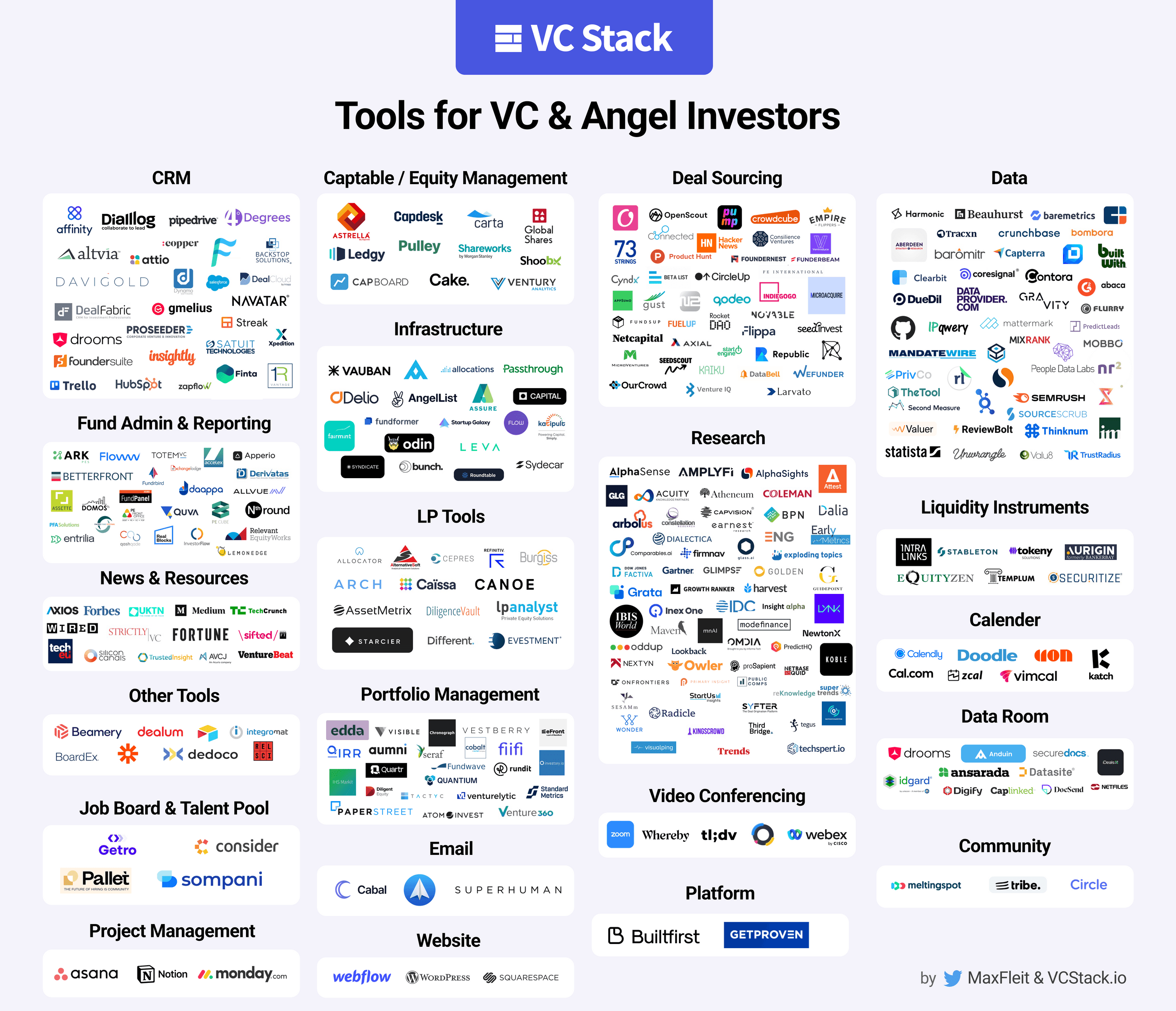
To get more specific, let's look at some of the key players and their applications.
10 AI Tools for Venture Capital Firms in 2025
The article '10 AI Tools for Venture Capital Firms in 2025' from Affinity provides a curated list of modern tools. It gives a practical overview of how firms are applying AI today.
First, read the section 'Key use cases for AI in venture capital' to see where AI fits into the investment process. Then, review the list in '10 AI tools being used in venture capital.' You don't need to memorize each one, but get a feel for the different types of tools available, from specialized sourcing platforms to AI-powered CRMs.
Based on this overview, we can group the tools into three main categories relevant to a solo GP's deal sourcing needs:
-
Deal Sourcing & Market Intelligence Platforms: These are specialized systems designed for discovery. They scrape and analyze vast amounts of data to help you find and track companies.
- Examples: Tracxn, Grata, TechScout, Quid.
- Use Case: You would use these to generate lists of companies that fit your thesis, map competitive landscapes, and set up alerts for market signals.
-
AI-Powered CRM (Customer Relationship Management): A CRM is your system of record for managing your network and deal pipeline. Modern, AI-powered CRMs automate data entry and surface relationship insights.
- Example: Affinity.
- Use Case: After identifying a company with a sourcing tool, you'd manage all interactions, notes, and next steps in your CRM. Affinity, for example, can automatically capture your email and calendar data to build relationship graphs, showing you the "warmest path" to an introduction.
-
Task-Specific Automation Tools: These are often general-purpose AI tools that can be adapted to supercharge specific parts of your workflow.
- Examples: ChatGPT (for analysis and summarization), Fireflies.ai or Affinity Notetaker (for meeting transcription and summaries), Merlin (for summarizing articles and web content).
- Use Case: You could use ChatGPT to generate a summary of a lengthy technical whitepaper from a target startup or use Fireflies.ai to automatically create action items from a founder call.
As a solo GP, you won't need a tool from every category on day one. The key is to start with a lean, effective stack.
4. A Framework for Selecting Your Tools
Given your background in consulting, you are well-versed in evaluating solutions against business requirements. You can apply a similar strategic lens here. When choosing tools for your accelerator, avoid chasing shiny objects and focus on what will deliver the most value for your specific strategy and constraints.
The FounderNest article we read earlier provides an excellent checklist for this.
Beyond databases: The rise of contextual AI in technology ...
Let's revisit the FounderNest article to extract a concrete evaluation framework. This will be your guide to making smart technology choices.
Read the sections 'How to build a contextual AI technology/startup scouting capability' and the FAQ question 'What should innovation leaders look for when picking a technology/startup scouting platform?'. Synthesize these points into a personal checklist.
Here is a practical framework for you to use, combining insights from the resources:
- Strategic Alignment:
- Question: Does this tool help me find companies that fit my specific investment thesis? Can I filter by niche technical criteria (e.g., specific AI models, data sources) and not just broad industry categories?
- Data Sources & Coverage:
- Question: What data does it ingest? Is it limited to news and funding, or does it include "under-the-radar" signals like patent filings, academic research, conference speakers, and developer activity?
- Core Functionality:
- Question: Does it offer true contextual search, or just keywords? Can I set up real-time alerts? Can it automatically generate a competitive landscape for a target company?
- Workflow & Integration (The "Human-in-the-Loop"):
- Question: How does this tool fit into my daily work? Does it integrate with my email and calendar? Does it allow me to easily export data or connect to a CRM? The goal is augmentation, not a "black box" you can't trust.
- Cost vs. Benefit for a Solo GP:
- Question: What is the ROI? A platform costing tens of thousands of dollars per year may not be justifiable initially. Is there a more affordable option or a combination of cheaper tools that can achieve 80% of the result?
This last point is crucial. The partner from Earlybird Ventures quoted in the Affinity article advised an "80/20 approach," favoring off-the-shelf tools and keeping the tech stack simple. For a solo GP, this means prioritizing a foundational tool and building from there.
Test your understanding!
Imagine your investment thesis is "AI-native tools that automate workflows for non-technical roles in the life sciences industry." You have a limited budget for your first year. Using the selection framework, which of these three options would you prioritize investing in first, and why?
A. A high-end market intelligence platform like Quid that provides deep, visual analysis of market trends.
B. An AI-powered CRM like Affinity that automates relationship tracking and data entry.
C. A subscription to general-purpose tools like ChatGPT Plus and a meeting transcriber like Fireflies.ai.
Show answer
The most strategic choice to prioritize is B) An AI-powered CRM like Affinity.
Justification:
As a solo GP, your network is your most critical asset. A CRM is the foundational system for managing relationships with founders, co-investors, and potential LPs. An AI-powered CRM saves hundreds of hours in manual data entry (a huge bottleneck for a solo operator) and provides immediate value by organizing your network and deal flow. While options A and C are valuable, they are supplements to this core system. You can perform basic market analysis manually or with cheaper tools initially, but a robust CRM is the essential backbone of a professional investment operation.
Conclusion
You now have a clear understanding of how AI is revolutionizing deal sourcing and a practical framework for selecting the right tools for your accelerator. You're ready to move beyond manual methods and build a technology-enabled system to find the best AI startups.
Key Takeaways:
- AI has shifted deal sourcing from reactive database searches to proactive, signal-based discovery.
- The key capability to look for in modern tools is "Contextual AI," which understands strategic intent, not just keywords.
- The tool landscape includes sourcing platforms, AI-CRMs, and task-specific automation tools.
- Your selection process should be guided by a framework focused on strategic alignment, data sources, functionality, workflow integration, and cost-benefit for a solo GP.
Preview of the next lesson:
Now that you have a plan and the tools to generate a robust pipeline of deals, the next challenge is managing the inflow. How do you quickly and systematically separate the signal from the noise? In our next lesson, we will design an initial screening process using an AI-assisted scoring rubric, allowing you to efficiently evaluate inbound opportunities at scale.