Hello! Welcome to the next lesson in our module on Deal Sourcing and Screening.
In the last lesson, we explored how to evaluate and select AI-powered tools to build a pipeline of potential investments. Now that you have a strategy for generating deal flow, the crucial next step is to manage it. As a solo GP, you'll need a system to efficiently sort through hundreds of applications to find the top 1-2% that truly merit a deep dive.
Today's lesson addresses this exact challenge. Our goal is to design an initial screening process using an AI-assisted scoring rubric. This isn't about replacing your judgment; it's about building a systematic, scalable process that frees you up to focus your time on the most promising founders. We'll cover the principles of building a good rubric and then detail a practical workflow for using AI to automate the most time-consuming parts of the evaluation.
1. From Deal Flow to Decision: The Role of the Screening Rubric
The first step in managing your deal flow is to create a structured evaluation framework. This is often called a scoring rubric or a scorecard. It's a standardized tool that allows you to assess every startup against the same set of predefined criteria, ensuring consistency and helping to mitigate unconscious bias.
The core idea is to move from a purely "gut feel" evaluation to a more disciplined, data-informed first pass. A good rubric helps you quickly answer the fundamental question: "Does this company clear the bar for a first meeting?"
To understand the core mechanics of how VCs approach this, let's start with a video that breaks down two foundational methods: the checklist and the scorecard.
Understanding Valuation In Venture Capital | Part#1| Comps, Checklists & Score Card
The video 'Understanding Valuation In Venture Capital' from Professor Claudia Zeisberger explains the logic behind early-stage evaluation. It will introduce you to the core concepts of using weighted criteria to assess startups, which is the foundation of our screening rubric.
Please watch the segment from 03:04 to 06:34. Pay close attention to how the 'checklist' method breaks a startup down into key measures (like team, idea, market), assigns a weight to each, and generates a score.
As the video illustrates, a rubric is essentially a structured checklist with two key components:
- Criteria: The categories you evaluate (e.g., Team, Market, Product).
- Weights: The relative importance you assign to each category, reflecting your investment thesis.
For a pre-seed or seed-stage accelerator, this initial screen is less about precise valuation and more about qualification and fit.
2. Designing Your AI-Assisted Scoring Rubric
Now, let's design a rubric tailored for your AI-focused accelerator. While every investor's rubric is unique, they generally cover a common set of dimensions. Modern AI-powered evaluation platforms have converged on a set of factors that are critical for assessing "investment readiness."
This article on AI-driven scoring provides an excellent, up-to-date framework.
The Involvement of AI in Startup Investment-Readiness ...
The article 'The Involvement of AI in Startup Investment-Readiness Scores' details the components of modern, AI-powered evaluation systems. We'll use this as a blueprint for our own rubric.
Read the section 'What an AI-Powered “Investment Readiness Score” Looks Like, Components & Mechanics.' Focus on the table that lists the different 'Dimensions' and what the AI evaluates for each. This will be the structure for our rubric.
Based on that framework and your specific goals, we can define the key categories for your screening rubric. Below is a template. For each category, I've included sub-criteria that you would score, typically on a 1-5 scale.
Your Accelerator's Screening Rubric Template
| Category (Weight) | Sub-Criterion | Description & What to Look For |
|---|---|---|
| Team & Founders (40%) | 1. Founder-Market Fit & Expertise 2. Technical Capability 3. Completeness & Grit |
Does the team have unique insight into the problem? For an AI startup, is there strong technical talent? Is the team complete enough to build the initial product? Look for evidence of resilience and past accomplishments. |
| Market & Opportunity (20%) | 1. Market Size (TAM) 2. Problem Urgency 3. Competitive Landscape |
Is the market large and growing? Is the problem they are solving a "hair-on-fire" issue for customers or a nice-to-have? Do they have a clear view of the competition and a differentiated approach? |
| Product & Traction (20%) | 1. Product Clarity & Vision 2. Early Traction/Validation 3. Defensibility |
Is the product offering clear? Is there any early evidence of product-market fit (e.g., pilot users, letters of intent, early revenue)? For an AI company, what is the moat? Is it proprietary data, a unique model, or a network effect? |
| Business Model & Financials (10%) | 1. Revenue Model Viability 2. Capital Efficiency |
Is the proposed business model scalable and logical? Have they been frugal with the capital they have (if any)? At this stage, it's more about the logic of the model than detailed financial projections. |
| Strategic Fit (10%) | 1. Alignment with Thesis 2. Coachability & Program Fit |
Does this startup align perfectly with your accelerator's AI focus? Do you believe you and your program can add significant value? Do the founders seem open to feedback and mentorship? This is a crucial, subjective filter. |
Notice the weights. At the pre-seed stage, the Team is often the most critical factor, hence the 40% weighting. You are betting on the people more than anything else. You can and should adjust these weights to reflect your personal investment philosophy.
3. The AI-Assisted Screening Workflow
With your rubric designed, the next question is how to apply it to hundreds of deals without spending all your time on data entry. This is where AI becomes your co-pilot.
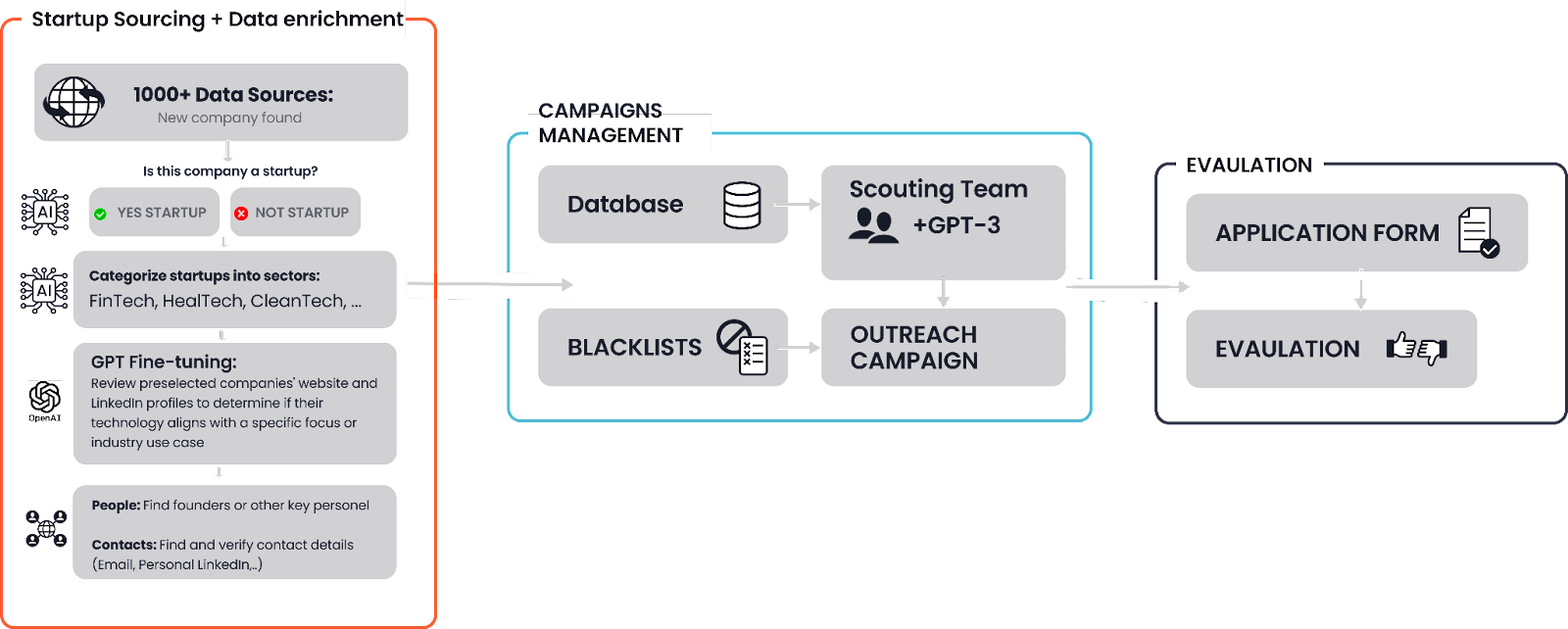
The goal is to automate the extraction and initial analysis of information from pitch decks and applications, presenting you with a pre-scored, ranked list for your final review. Your computer science background will help you appreciate the logic of this workflow.
Here’s a practical, step-by-step process for implementing an AI-assisted screen:
Step 1: Define Your Data Points
This is your rubric. You've already defined the information you need to find: founder names, market size claims, revenue numbers, key technology, etc.
Step 2: Data Extraction (The AI's First Job)
When a startup applies, they submit a pitch deck (usually a PDF) and fill out an application form. The first task for an AI tool is to ingest these documents and extract the raw text and data.
- Challenge: As you know, PDFs are notoriously difficult to parse, especially those with lots of images and charts.
- Solution: Modern AI tools and platforms (like the ones discussed in the previous lesson or dedicated pitch deck analysis tools) use Optical Character Recognition (OCR) and document layout analysis to convert the deck into structured data.
Step 3: Populating the Rubric (AI as an Analyst)
Once the data is extracted, you use a Large Language Model (LLM) to "read" the text and fill in your rubric. This is done through carefully crafted prompts.
For example, you could prompt the AI:
"Analyze the following text from a pitch deck. Identify the names of the founders and any information about their previous experience. Then, find any mention of the Total Addressable Market (TAM) and the figure provided. Finally, summarize the company's revenue model. Return the output in a JSON format."
The article below provides a fascinating, in-depth look at how one fund actually built this process. You don't need to replicate their code, but understanding their methodology is invaluable.
We tried using GenAI to screen pitch decks, here is how it ...
The article 'We tried using GenAI to screen pitch decks...' offers a real-world case study. It's a technical but highly practical guide to the nuts and bolts of creating an AI screening pipeline.
Read the 'ANNEX: A How-To Guide to screen decks with GenAI.' You can skim the Python code examples. Focus on the logical steps: defining the information to retrieve (Step 1), structuring the query to the LLM (Step 5.3), and getting the answer in a consistent format like JSON (Step 5.4). This demonstrates the core principles of automating rubric population.
Step 4: AI-Assisted Scoring & Human Review
With the rubric populated, the AI can assign an initial score based on rules you set (e.g., "If revenue > $0, score 3 for traction"). This produces a ranked list of all applicants.
This is where your work begins. You don't blindly trust the scores. You start by reviewing the top 10-20% of applicants. The AI has saved you from reading the 80% that were a clear non-fit, allowing you to apply your human judgment where it matters most. You can quickly scan the AI-populated rubric, verify the key data points, and override scores based on your own insights.
Remember the limitations. AI is a powerful filter, but it's not a decision-maker.
The Involvement of AI in Startup Investment-Readiness ...
Let's revisit the Equisy article to reinforce the proper role of AI in this process and its inherent limitations.
Read the sections 'But It’s Not Magic, Limits, Risks & What AI Can’t Capture (Yet)' and 'How to Use AI-Based Readiness Scores Wisely'. This will provide a crucial, balanced perspective on combining AI scale with human wisdom.
The key is that AI can't (yet) measure founder charisma, team chemistry, or the sheer force of will that often separates success from failure in early-stage ventures. Your job is to spot those intangible qualities in the startups the AI has flagged as promising.
Test your understanding!
You receive an application from a startup. The AI tool processes their pitch deck and populates your rubric, giving them a high score on Market & Opportunity (huge TAM) but a low score on Team (first-time founders with no industry experience).
How would you use this AI-assisted output to guide your next action? What's the "human-in-the-loop" step here?
Show answer
The AI has done its job perfectly by flagging a potential conflict: a great market but an inexperienced team.
Your next action is not to discard the application but to apply human judgment to this specific conflict. You would:
- Quickly verify the AI's findings: Scan the pitch deck yourself to confirm the founders' backgrounds and the market claims.
- Assess the nuance: Is their lack of experience a deal-breaker, or do they have some other quality (e.g., incredible technical insight, evidence of extreme resourcefulness) that the AI missed? A first-time founder who has spent years obsessed with the problem might be more valuable than an experienced founder who is just chasing a trend.
- Make a decision: Based on this nuanced review, you decide if it's worth a 30-minute introductory call. The AI provided the signal; you interpret it. This human review step is what prevents you from automatically filtering out potentially high-upside, non-obvious bets.
Conclusion
In this lesson, you've learned how to design a structured and scalable screening process for your accelerator. By combining a well-thought-out scoring rubric with the power of AI assistance, you can efficiently manage a high volume of deals while focusing your personal attention on the most promising opportunities.
Key Takeaways:
- A scoring rubric provides a consistent, disciplined framework for initial startup evaluation, based on weighted criteria like Team, Market, and Product.
- The AI-assisted workflow involves four main steps: defining data points (your rubric), automated data extraction from documents, AI-powered rubric population, and finally, human review of the top-ranked candidates.
- AI is a first-pass filter, not a final decision-maker. Its purpose is to handle the 80% of screening work that is repetitive, freeing you to apply your unique human judgment to the top 20% of opportunities.
- This process is iterative. Your rubric and your AI prompts will evolve and improve as you see more deals and refine your investment thesis.
Preview of the next lesson:
Once a startup passes your initial screen, what happens next? You need a system to manage the relationship, track your interactions, and move them through your deal pipeline. In our next lesson, we will address this by learning how to select and configure a CRM platform for managing deal flow from initial contact to decision.