
Hello!
In our last few lessons, you mastered the Connectionist Temporal Classification (CTC) framework, from its loss function to its specialized decoding algorithms. You learned that CTC's core strength—and weakness—is its conditional independence assumption, which allows for parallel predictions but ignores the dependencies between output characters.
Today, we'll explore a landmark alternative that directly addresses this limitation: the Listen, Attend, and Spell (LAS) architecture. This lesson will fulfill the learning outcome: Describe the Listen-Attend-Spell (LAS) architecture as an example of an attention-based encoder-decoder ASR model.
LAS was one of the first truly end-to-end neural models for speech recognition that moved away from CTC. Instead of using a blank token for alignment, it introduced the attention mechanism to ASR, a concept that has become the foundation of modern models like the Transformer and, by extension, Whisper. Understanding LAS is a critical step in tracing the lineage from classical ASR to the state-of-the-art systems you'll be building.
From Information Bottlenecks to Attention
The LAS model belongs to a family of models known as encoder-decoder or sequence-to-sequence (seq2seq) models. The basic idea is:
- An encoder network processes the entire input sequence (e.g., audio frames) and compresses it into a fixed-size representation, often called a "context vector."
- A decoder network takes this context vector and generates the output sequence (e.g., text) step by step.
This approach has a major flaw when dealing with long sequences like audio: the single, fixed-size context vector becomes an information bottleneck. It's incredibly difficult to cram all the necessary information from a 10-second audio clip into one vector.
The solution is attention. Instead of forcing the decoder to rely on a single summary, attention allows the decoder to "look back" at the encoder's output at every step of the generation process and focus on the most relevant parts of the audio for the specific character it's about to predict.
Attention for Neural Networks, Clearly Explained!!!
To build a strong intuition for why attention is so revolutionary for sequence-to-sequence tasks, please watch the following video from StatQuest. It explains the concept in the context of machine translation, but the principles are identical for speech recognition.
Watch from 01:01 to 15:01. Focus on understanding the problem with the single context vector (01:01 - 03:45) and how attention solves this by creating weighted context vectors for each decoding step (04:51 onwards).
Now that you have the general idea of attention, let's see how it's specifically implemented in the Listen, Attend, and Spell architecture.
The Listen, Attend, and Spell (LAS) Architecture
As its name suggests, the LAS model is composed of three key conceptual parts, which map to two main components: a Listener (encoder) and a Speller (decoder with an attention mechanism).

Let's dissect each component.
Lecture 12: End-to-End Models for Speech Processing
For a comprehensive overview, let's turn to a lecture from Stanford's course on speech processing. This will walk us through the high-level motivation and then the details of the LAS model.
First, watch the introduction from 00:54 to 01:54 and the motivation for end-to-end models from 07:13 to 11:50. This will set the stage by contrasting LAS with the older, modular ASR systems and CTC.
1. The Listener (Encoder)
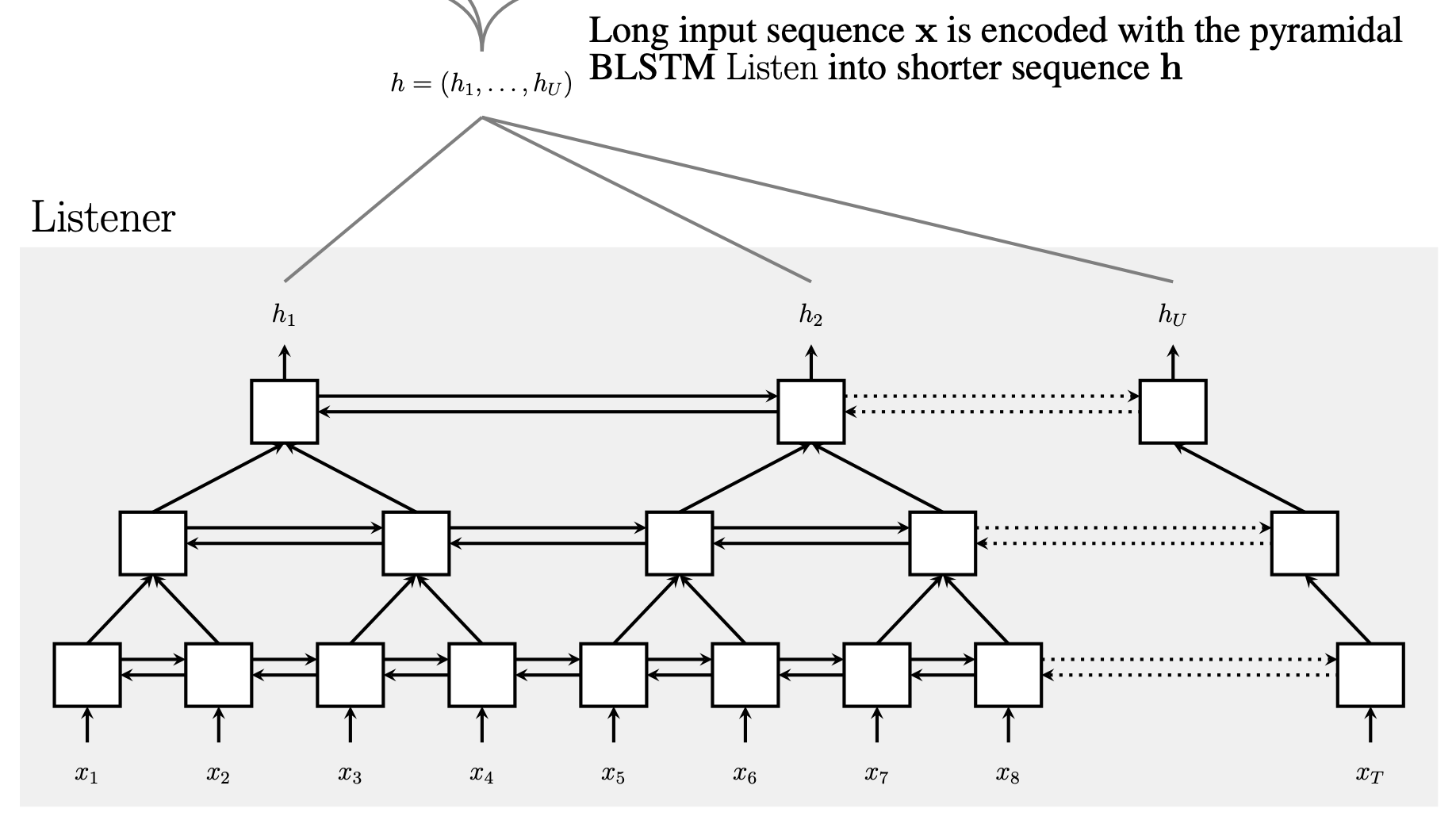
The Listener's job is to transform the raw input audio features (e.g., filter-bank spectra) into a higher-level, more abstract representation.
-
Core Component: It's typically built using a Bidirectional Long Short-Term Memory (BLSTM) network. The bidirectional nature allows it to process each time step with context from both the past and the future of the audio sequence, which is crucial for understanding phonemes.
-
The Pyramidal Structure (pBLSTM): ASR inputs are very long. A 10-second clip can have 1000 frames. Forcing the attention mechanism to sift through 1000 steps for every single output character is computationally expensive and makes it hard for the model to learn.
To solve this, LAS uses a pyramidal BLSTM (pBLSTM). In each successive layer of the encoder, it concatenates the outputs of adjacent time steps from the layer below. For example, it might combine outputs from time steps and to produce a single output at time step in the next layer. This effectively halves the sequence length at each pyramidal layer, reducing the temporal resolution and creating a much shorter, more compressed representation for the attention mechanism to work with.
Listen, Attend and Spell (Paper)
The original paper provides the most precise description of the Listener. Reading this short section will clarify the motivation and mechanics of the pBLSTM.
Read section 3.1, "Listen". Focus on understanding equation (5), which formally describes how the pBLSTM concatenates outputs to reduce the time resolution.
2. The Speller and the Attention Mechanism (Decoder)
The Speller is a decoder that generates the output transcript one character at a time. It is autoregressive, meaning its prediction for the current character depends on the characters it has already generated. This directly solves the conditional independence problem of CTC.
The Speller and the Attention mechanism are deeply intertwined. Let's walk through the process at a single decoding step :
-
Decoder State (): The Speller maintains a state in its own RNN (typically an LSTM). This state, , summarizes everything it has generated so far ().
-
Attention Calculation: The core "Attend" operation happens here.
- The decoder state acts as a query.
- This query is compared with every high-level feature vector from the Listener's output. This comparison produces a set of "energy" scores, .
- These scores are passed through a
softmaxfunction to create the attention weights, . These weights are a probability distribution across the encoded audio sequence, indicating which parts of the audio are most important for predicting the next character. - The context vector, , is calculated as the weighted sum of the Listener's features: . This vector captures the relevant acoustic information for the current decoding step.
-
Character Prediction: The Speller uses both its internal state and the acoustic context vector to predict the probability distribution for the next character, .
This entire process repeats until an <eos> (end-of-sentence) token is generated.
Lecture 12: End-to-End Models for Speech Processing
The Stanford lecture continues with a fantastic walkthrough of the LAS sequence-to-sequence model and the attention mechanism.
Please watch from 26:36 to 34:57. This segment explains how the sequence-to-sequence model works in speech and then provides a detailed, step-by-step breakdown of the attention calculation, including the query, energies, attention weights, and context vector.
For the formal mathematical definitions, we can again turn to the original paper.
Listen, Attend and Spell (Paper)
The following section of the LAS paper formalizes the concepts you just saw in the video.
Read the beginning of Section 3 and all of Section 3.2, "Attend and Spell". Pay close attention to equations (6) through (11), as they define the step-by-step process of updating the decoder state, computing the context vector, and generating the character distribution.
This attention process creates a dynamic and explicit alignment between the audio and the generated text. We can even visualize it:

An example of attention alignment from the original LAS paper for the utterance 'how much would a woodchuck chuck'. Each row is a character being output, and each column is a time step in the compressed audio representation. The bright spots show where the model 'attends' in the audio to produce a given character. Notice how the alignment moves monotonically forward through the audio as the text is generated.
Training and Decoding
-
Training: The entire LAS model is trained end-to-end using a standard cross-entropy loss, trying to maximize the probability of the correct sequence. A common technique used is teacher forcing, where the ground-truth previous character is fed into the decoder at each step during training. LAS often uses a variant called scheduled sampling, where it sometimes feeds its own previous prediction back in, making it more robust to errors during inference.
-
Decoding: Since the Speller is an autoregressive model, decoding is more straightforward than with CTC. We can use:
- Greedy Search: At each step, simply pick the character with the highest probability. Fast but suboptimal.
- Beam Search: Keep track of the
kmost likely partial transcripts at each step. This is the same beam search you are familiar with from other seq2seq tasks, not the specialized version with blank/non-blank probabilities required for CTC. This is a significant architectural simplification.
Lecture 12: End-to-End Models for Speech Processing
Finally, the Stanford lecture discusses some results and limitations of the LAS model.
Watch from 36:53 to 39:33 to see how the model can produce different valid transcriptions and from 40:43 to 43:37 to understand its performance and limitations, such as being an offline model (since the BLSTM needs the full utterance).
Conclusion
In this lesson, you've explored the Listen, Attend, and Spell (LAS) model, a pivotal architecture in the history of ASR.
Key Takeaways:
- Encoder-Decoder Structure: LAS uses a Listener (encoder) to process audio and a Speller (decoder) to generate text.
- Pyramidal Encoder: The Listener uses a pBLSTM to reduce the length of the audio sequence, making attention feasible and efficient.
- Attention-based Alignment: Instead of CTC's blank token, LAS uses an attention mechanism. The decoder queries the encoded audio at each step to create a context-specific vector for prediction.
- Autoregressive Decoding: The Speller generates text one character at a time, conditioning each prediction on previously generated characters. This overcomes CTC's conditional independence assumption.
- Architectural Contrast (LAS vs. CTC):
- Alignment: Attention vs. Blank Token.
- Output Dependency: Autoregressive vs. Conditional Independence.
- Decoding: Standard Beam Search vs. Specialized CTC Beam Search.
Preview of the Next Lesson:
LAS was a huge leap forward, but the recurrent components (LSTMs) still have challenges with parallelization and capturing extremely long-range dependencies. The next logical step in the evolution of these models was to ask: "Can we build a powerful sequence-to-sequence model using only attention, getting rid of recurrence altogether?" The answer is the Transformer, the architecture that underpins the Whisper model. In the next lesson, we will dissect the Whisper architecture and see how it builds upon the concepts pioneered by LAS.