
Hello!
In our previous lesson, we explored the Listen, Attend, and Spell (LAS) model, which introduced the powerful attention mechanism to ASR. We saw how its encoder-decoder structure allowed the model to learn an implicit alignment between audio and text, overcoming the conditional independence limitations of CTC. However, LAS, being based on LSTMs, is inherently sequential and thus difficult to parallelize, making it slow to train on massive datasets.
Today, we leap forward to a model that builds upon the same encoder-decoder principles but replaces the recurrent components with the highly parallelizable Transformer architecture: OpenAI's Whisper. This lesson will address the learning outcome: Describe the Whisper model architecture and its multitask, multilingual training strategy.
Whisper represents a paradigm shift in ASR, not just because of its architecture, but primarily due to its training methodology. It moves away from small, meticulously curated academic datasets and instead leverages the vast, messy, and diverse audio content of the internet. Understanding Whisper is essential for grasping the current state-of-the-art in robust speech recognition.
From Recurrence to Transformers in ASR
You've already studied the Transformer architecture in Module 4. Its core component, the self-attention mechanism, allows it to weigh the importance of all other parts of a sequence when processing a single part. For ASR, this means a Transformer encoder can consider the entire 30-second audio clip simultaneously to build a rich contextual representation, and a Transformer decoder can attend to the most relevant audio segments for each text token it generates. This completely replaces the sequential processing of LSTMs, enabling massive parallelization and the ability to capture extremely long-range dependencies more effectively.
The Whisper Architecture: A Standard Transformer at Scale
At its heart, the Whisper model is a standard encoder-decoder Transformer, very similar to the one proposed in the original "Attention Is All You Need" paper. The authors deliberately chose an off-the-shelf architecture to demonstrate that the model's remarkable performance comes not from novel architectural tweaks, but from the scale and nature of its training data.
Let's break down the components.
Robust Speech Recognition via Large-Scale Weak Supervision (Paper)
The original Whisper paper provides a concise description of the model's architecture. Reading this section will give you the formal details of each component.
Please read Section 2.2, "Model". This section details the input representation, the convolutional stem, the Transformer blocks, and the tokenizer.
Here is a summary of the key architectural points:
-
Audio Input Processing:
- All audio is resampled to 16,000 Hz and converted into an 80-channel log-Mel spectrogram. This is the input to the model.
- Crucially, the audio is always processed in 30-second segments. Shorter audio is padded with silence; longer audio is chunked.
-
The Encoder:
- The encoder starts with a small "stem" of two 1D convolutional layers. These layers act as a local feature extractor and also downsample the spectrogram, reducing the sequence length that the Transformer blocks need to process.
- Sinusoidal positional encodings are added to the output of the stem to give the model information about the order of the audio frames.
- This is followed by a standard stack of Transformer encoder blocks (self-attention and feed-forward layers).
-
The Decoder:
- The decoder is an autoregressive Transformer decoder that generates the text transcript one token at a time.
- It uses learned positional embeddings to understand the order of the text tokens it has generated so far.
- As in LAS, a cross-attention mechanism allows the decoder at each step to "look at" the encoder's output and focus on the most relevant audio features for predicting the next text token.
-
Model Sizes:
- Whisper comes in several sizes, from "tiny" (39M parameters) to "large" (1550M parameters). This allows for a trade-off between performance and computational requirements.

OpenAI Whisper: Robust Speech Recognition via Large-Scale Weak Supervision | Paper and Code
For a more dynamic explanation that connects the architecture to code, the following video provides a walkthrough of the model's implementation. Given your background in software development and PyTorch, this should provide a concrete understanding of the components.
Watch the segment from 28:52 to 33:05. The presenter steps through the PyTorch implementation of the Whisper model, showing the audio encoder (with its convolutional layers) and the text decoder (with its learned embeddings and cross-attention blocks).
The Training Strategy: Large-Scale Weak Supervision
The architecture may be standard, but Whisper's training strategy is what makes it revolutionary. It was trained on 680,000 hours of audio-transcription pairs collected from the internet. This approach is called large-scale weak supervision.
- Weak Supervision: Unlike traditional ASR datasets (like LibriSpeech) which are meticulously transcribed and cleaned ("gold standard"), the web-scraped data is noisy and of varying quality. The supervision (the text labels) is "weak".
- Large-Scale: By relaxing the quality requirement, the authors were able to gather a dataset orders of magnitude larger than previous supervised datasets.
This massive and diverse dataset is the key to Whisper's robustness. It has been exposed to a vast range of speakers, accents, languages, background noises, and recording conditions, forcing it to learn a generalized representation of speech.
OpenAI Whisper: Robust Speech Recognition via Large-Scale Weak Supervision | Paper and Code
The following video segment explains the context of Whisper's data strategy, contrasting it with previous unsupervised and supervised methods.
Watch from 07:30 to 11:17. This part discusses how Whisper closed the gap between small, high-quality supervised datasets and large unsupervised datasets by scaling up 'weakly supervised' training.
To handle the "weak" nature of the data, the OpenAI team developed several automated filtering heuristics to improve transcript quality, such as:
- Removing transcripts that were all uppercase or all lowercase (often a sign of machine generation).
- Using a language detector to ensure the spoken language matched the transcript language.
- Running an early version of Whisper on the data to find and manually inspect sources with high error rates.
The Multitask & Multilingual Format
Whisper isn't just a transcription model. It's a single model that can perform several tasks across many languages. This is the multitask, multilingual part of its training strategy.
- Multilingual: About a third of the training data is non-English, covering 96 other languages.
- Multitask: The model can perform:
- Language Identification
- Multilingual Transcription (audio in language X -> text in language X)
- Any-to-English Translation (audio in language X -> text in English)
- Voice Activity Detection (detecting segments with no speech)
How does a single model handle all this? The key is a clever use of special tokens that are prepended to the decoder's input sequence to "prompt" the model for a specific task.
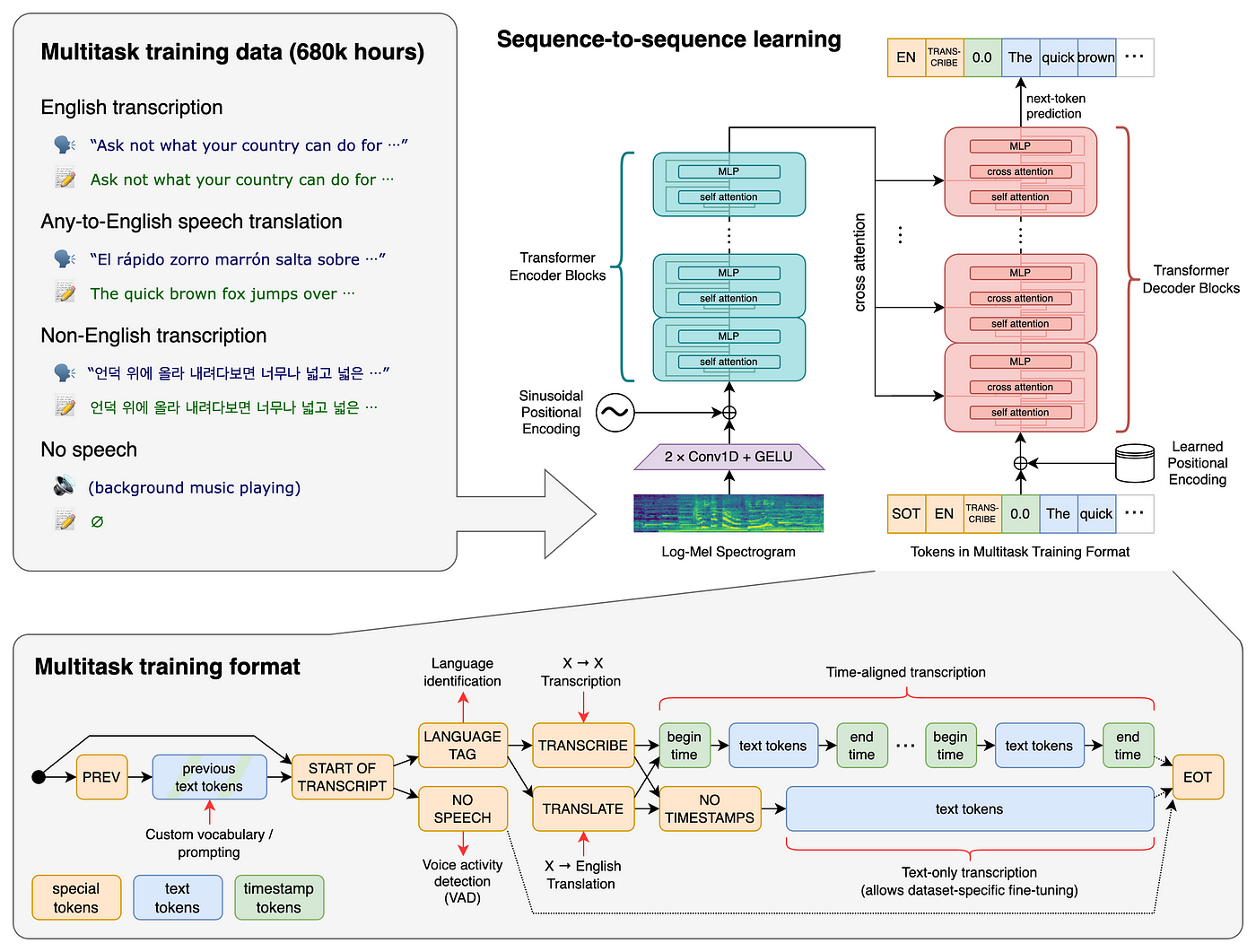
Let's break down the format for a standard transcription task:
<|startoftranscript|>: A token that always begins the sequence.- Language Token: A token indicating the language of the audio (e.g.,
<|en|>for English,<|hi|>for Hindi). The model is trained to predict this token first, effectively performing language identification. - Task Token: Either
<|transcribe|>or<|translate|>. This tells the model what to do with the audio. - Timestamp Control Token: The
<|notimestamps|>token tells the model to output only the plain text. If this is omitted, the model will interleave timestamp tokens (e.g.,<|0.00|>,<|5.32|>) with the text. - Output Text: The model then begins predicting the actual transcript.
<|endoftext|>: A token that signals the end of the transcription.
This elegant prompting mechanism allows one unified architecture to replace a complex pipeline of separate models for VAD, language ID, and ASR.
Whisper Paper Explained: Robust Speech Recognition via Large-Scale Weak Supervision
Let's watch a clear explanation of this multitask format and the special tokens.
Watch from 11:07 to 18:03. This is a crucial segment that walks through the different tasks Whisper can perform and explains how the sequence of special input tokens fed to the decoder specifies the task. It directly maps to the figure you just saw.
This joint training on multiple languages and tasks has a fascinating effect. For smaller models, it can lead to "negative transfer," where performance on one task (like English transcription) is slightly worse than an English-only model. However, for larger models, the effect is the opposite: positive transfer. The knowledge gained from other languages and tasks actually improves performance on English transcription.
OpenAI Whisper: Robust Speech Recognition via Large-Scale Weak Supervision | Paper and Code
This short clip visualizes the scaling effect and the positive transfer seen in larger models.
Watch from 25:39 to 26:33. Notice how the blue line (multilingual/multitask) starts off worse than the red line (English-only) for smaller models but overtakes it for larger models.
Conclusion
You have now dissected the Whisper model, a landmark achievement in automatic speech recognition. You've seen that while its architecture is a standard Transformer, its true power lies in its training paradigm.
Key Takeaways:
- Architecture: Whisper is a standard encoder-decoder Transformer that processes 30-second log-Mel spectrograms. Its encoder uses a convolutional stem for downsampling, and its decoder is autoregressive.
- Training Data: It was trained using large-scale weak supervision on 680,000 hours of diverse, noisy audio data from the web. This is the main reason for its exceptional robustness.
- Multitask & Multilingual Strategy: Whisper is a single model that performs transcription, translation, language identification, and more. This is achieved by prompting the decoder with a sequence of special tokens that specify the desired language and task.
- Zero-Shot Performance: The combination of a powerful architecture and a massive, diverse dataset gives Whisper incredible zero-shot generalization, allowing it to perform well on new datasets and domains without any specific fine-tuning.
Preview of the Next Lesson:
Whisper's zero-shot performance is impressive, but for specific domains or low-resource languages, its accuracy can be improved even further. In the next lesson, "Fine-tune a pretrained Whisper model on a custom speech dataset using the Hugging Face ecosystem," we will move from theory to practice. You will learn how to take a pre-trained Whisper checkpoint and adapt it to a new dataset, unlocking even higher performance for your specific ASR tasks.