
Hello! In the previous lesson, you practised solving quadratic equations by factorisation and the quadratic formula. Both methods required a reliable routine: identify the information, choose a valid method, and keep each algebraic step organised. We will use the same approach in geometry.
This lesson introduces similar triangles. You will learn how to prove that two triangles are similar using AA, SSS, or SAS, write the vertices in the correct corresponding order, and use that order to form side ratios and find missing lengths.
Similar means same shape, possibly a different size
Two triangles are similar when:
- their corresponding angles are congruent;
- their corresponding side lengths are proportional.
“Proportional” means every corresponding side has been enlarged or reduced by the same scale factor.
For example, a triangle with sides , , and is similar to one with sides , , and . Each side of the first triangle has been multiplied by .
Similarity is written using . For instance,
is not just a statement that the triangles are similar. The order gives essential information:
| Vertex in first triangle | Corresponding vertex in second triangle |
|---|---|
Therefore, the corresponding sides are:
So their ratios must satisfy
A pair of congruent triangles is a special case of similar triangles: its scale factor is , so corresponding sides are equal as well as corresponding angles.
Triangle Similarity - AA SSS SAS & AAA Postulates, Proving Similar Triangles, Two Column Proofs
Watch “Triangle Similarity - AA SSS SAS & AAA Postulates” by The Organic Chemistry Tutor for a compact introduction to all three criteria and two worked examples. Focus on the distinction between equal angles and proportional sides.
Watch AA similarity to see why two matching angle pairs are enough. Then watch SSS similarity and SAS similarity, noting exactly what information each rule requires. Continue with the SSS example and the SAS example; pause briefly before each conclusion and identify the criterion yourself.
The three similarity criteria
You do not need to know every angle and every side before deciding that triangles are similar. These three criteria are shortcuts that guarantee similarity.
AA similarity: two corresponding angles
AA stands for Angle-Angle.
If two angles of one triangle are congruent to two corresponding angles of another triangle, the triangles are similar.
Why are two enough? The angles inside every triangle total . Once two angles match, the third angle must also match.
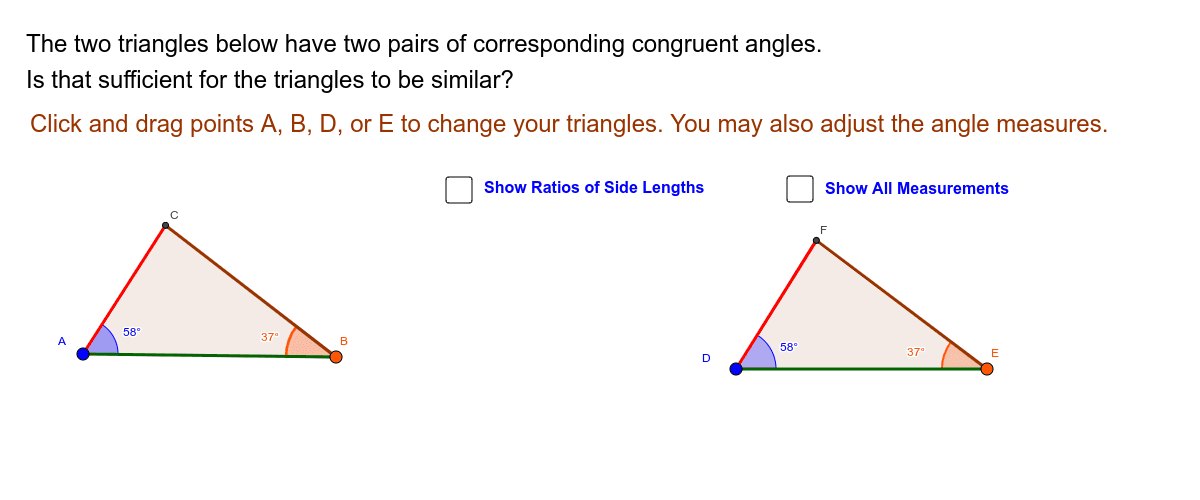
Suppose:
and
Then the remaining angles are both:
Therefore,
by AA similarity.
In diagram questions, the equal angles may be shown by:
- matching angle marks;
- equal given angle measures;
- vertical angles;
- angles formed by parallel lines.
You only need two corresponding pairs, though you may notice all three.
SSS similarity: three proportional side pairs
SSS stands for Side-Side-Side.
If all three pairs of corresponding sides are proportional, the triangles are similar.
Consider triangles with these side lengths:
Compare the corresponding sides:
All three ratios are equal. Hence,
by SSS similarity.
When the diagram does not already show corresponding angles, matching shortest side to shortest side, longest side to longest side, and middle-length side to middle-length side can help you identify the pairs. However, do not rely on how a triangle appears on the page; use its labelled lengths.
SAS similarity: two proportional sides and the included angle
SAS stands for Side-Angle-Side.
To use SAS similarity, you need:
- two pairs of corresponding sides that are proportional;
- the included angle between those sides to be congruent.
The included angle is the angle physically between the two sides being compared.

For example, suppose:
and
The angle lies between and , while angle lies between and . Now compare the sides:
The ratios match, and the included angles are congruent. Therefore,
by SAS similarity.
A frequent mistake is to use two proportional sides and an angle that is not between them. That information is called SSA, and it is not a general similarity criterion. For SAS, always trace the two sides to the angle between them.
Choosing the correct criterion
Before calculating anything, sort the information in the question.
| Information supplied | Valid criterion |
|---|---|
| Two corresponding angle pairs are congruent | AA |
| Three corresponding side pairs have equal ratios | SSS |
| Two corresponding side pairs have equal ratios, plus the included angle is congruent | SAS |
A useful written routine is:
- Identify the two triangles.
- Mark or list the information given.
- Check whether the information fits AA, SSS, or SAS exactly.
- Write the similarity statement in corresponding order.
- Use that statement to match sides before making a proportion.
The fourth step prevents many errors. For example, if you have proved
then the correspondence is:
Thus:
Writing would describe a different correspondence, so it would give incorrect side pairs even if the triangles really are similar.
3.6: Similar Triangles - Mathematics LibreTexts
Read “Similar Triangles” from Mathematics LibreTexts to reinforce the formal meaning of similarity, scale factor, and proportional corresponding sides. The examples show how a correct similarity statement becomes an equation for a missing side.
In “Definitions and Theorems,” read from the definition of similar triangles through “Similarity Conditions for Triangles.” Focus on the distinction between congruent and similar figures, then on how vertex order specifies correspondence. Next, in “Examples,” read Example 1 through Example 3. In Example 3, follow the ratio test and notice that all three ratios, not merely two, are required for SSS.
From a similarity statement to a missing side
Once similarity has been proved, the main payoff is that corresponding sides are proportional.
Suppose:
and you know:
Find .
Start with the similarity statement:
This tells you that corresponds to , and corresponds to . Use only those corresponding pairs:
Substitute the known values:
Cross-multiply:
The scale factor from the first triangle to the second is:
So the check is straightforward:
The answer fits the scale factor.
You could also set up the proportion in the reverse direction:
Both forms are correct. The important rule is to keep the ratio direction consistent: first-triangle side over second-triangle side throughout, or second-triangle side over first-triangle side throughout.
A clean exam-style conclusion
For a proof or a numerical question, organise your work so that the reason is visible:
Then, if a length is required:
This structure makes it clear that you did not assume the side proportion before proving similarity.
Common errors to avoid
- Using equal side lengths instead of proportional side lengths. Similar triangles can have different side lengths.
- Comparing non-corresponding sides. First establish the vertex correspondence.
- Changing ratio direction halfway through. If you begin with , keep first-triangle sides on top.
- Using only two side ratios for SSS. SSS requires all three pairs.
- Forgetting “included” in SAS. The congruent angle must lie between the proportional side pairs.
- Naming triangles in a random order. A similarity statement is a map of corresponding vertices, not just a label.
Key takeaways
Similarity is about same shape: corresponding angles are congruent and corresponding sides have one constant ratio.
- Use AA when two corresponding angle pairs are congruent.
- Use SSS when all three corresponding side pairs are proportional.
- Use SAS when two corresponding side pairs are proportional and their included angles are congruent.
- After proving similarity, use the vertex order in the similarity statement to write correct side proportions.
In the next lesson, you will move into coordinate geometry and use formulas to calculate the distance between points and the coordinates of a point that divides a line segment internally.
Can't find a good explanation? Sign up and we'll make it for you
Sign up