
Hello! In the previous lesson, you found the zeroes of quadratic polynomials by factorising and checked that their sum and product match the coefficients. This lesson uses the same foundation for a slightly different task: solving a quadratic equation.
A quadratic equation may be solved quickly by factorisation when it breaks neatly into brackets. When it does not, the quadratic formula gives a dependable method. By the end of this lesson, you should be able to choose an efficient method, carry it out carefully, and check your answers.
First make the equation equal to zero
A quadratic equation has the form
The right-hand side must be before you can use either factorisation or the quadratic formula.
For example, if you are given
move to the left:
Now it is in standard form, with
This “equal to zero” step matters because factorisation relies on the zero-product property:
means that
or
A product can equal zero only when at least one of its factors is zero.
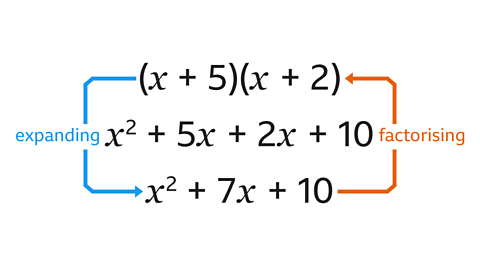
Method 1: Solve by factorisation
Use factorisation when the quadratic has factors you can identify without too much trial and error. It is usually the fastest method when the roots are integers or simple fractions.
Consider:
We want two numbers that:
- multiply to give ;
- add to give .
The pair is and . Therefore,
So the equation becomes
Set each factor equal to zero:
or
Hence,
Notice the sign change: the factor gives the solution , not .
Solving a quadratic by factoring | Quadratic equations | Algebra I | Khan Academy
Watch “Solving a quadratic by factoring” by Khan Academy for a compact demonstration of the factor-pair method and the zero-product property.
Watch the factor method. Follow how the two numbers must both add to the middle coefficient and multiply to the constant term. Pay particular attention to the point where each bracket is set equal to zero.
When the coefficient of is not 1
A common Class 10 form is
where is greater than . Use the same splitting-the-middle-term approach from the previous lesson.
Solve:
Here,
First calculate:
We need two numbers whose product is and whose sum is . They are and .
Split the middle term:
Factor by grouping:
Now solve each factor:
or
Therefore,
A quick check is to substitute either answer into the original equation. For ,
So the solution is confirmed.
Useful factorisation patterns
Before doing a full middle-term split, look for an easier structure.
| Pattern | Factorisation |
|---|---|
| Common factor | |
| Difference of squares | |
| Perfect-square trinomial |
For example,
Factor out the common factor:
Then use the difference of squares:
Since , the solutions come from the brackets:
When should you choose factorisation?
Factorisation is the best first choice when:
- the equation is already equal to zero;
- its coefficients are small integers;
- a common factor or a special pattern is visible;
- you can quickly find the needed factor pair.
For a quadratic of the form
test whether integer factors of can add to . For example,
has factor pairs of :
The negative pair and adds to , so factorisation is clearly efficient:
However, do not spend several minutes unsuccessfully guessing factors. That is when the quadratic formula is usually the better choice.
Method 2: Solve with the quadratic formula
The quadratic formula works for every quadratic equation in standard form:
The formula is
The symbol means you calculate two cases:
and
The formula may look longer than factorisation, but it is systematic: identify , , and , substitute carefully, simplify, then calculate both values.
A quadratic that does not factor neatly
Solve:
First identify the coefficients:
Substitute into the formula. Put negative coefficients in brackets; this habit prevents sign errors.
Simplify inside the square root first:
Since is not a perfect square, this is already an exact answer:
This is an example where factorisation over integers would not work, but the formula gives the answers directly.
How To Solve Quadratic Equations By Factoring - Quick & Simple! | Algebra Online Course
Watch the quadratic-formula section of “How To Solve Quadratic Equations By Factoring - Quick & Simple!” by The Organic Chemistry Tutor. It shows the full substitution process and confirms that the formula and factorisation produce the same roots when both methods are possible.
Watch formula setup for the formula, coefficient identification, and a complete example. Then watch second example to see how the method handles a quadratic with a larger leading coefficient. In both, track the signs of b and c, and keep the full numerator over 2a.
The most common quadratic-formula errors
Most mistakes occur during substitution, not because the formula itself is difficult.
1. Forgetting that the formula begins with
If
then
Write the value of in brackets:
rather than trying to handle the signs mentally.
2. Squaring a negative coefficient incorrectly
If
then
not .
3. Leaving out brackets around a negative
For
the expression becomes
The two negative signs make this part positive.
4. Dividing only one part of the numerator
This is incorrect:
The entire numerator must be divided by :
5. Giving only one answer
The requires two calculations unless the square-root part is . If the two results match, there is one repeated solution.
A practical decision routine
When you meet a quadratic equation, use this order.
- Rearrange and simplify until one side is zero.
- Look for an obvious common factor or special pattern.
- Try factorisation briefly. If the factor pairs are clear, complete the solution by setting each bracket equal to zero.
- Use the quadratic formula if the factorisation is not apparent or if it produces awkward values.
- Check by substituting each solution into the original equation, especially when signs or fractions are involved.
This is not a rule that factorisation is “better” than the formula. The methods have different strengths:
| Situation | Efficient method |
|---|---|
| Factorisation | |
| Difference of squares | |
| Common factor, then difference of squares | |
| Quadratic formula | |
| A factor pair is not quickly visible | Quadratic formula |
One final note: the quantity
under the square root helps determine what kind of solutions are possible. You will study it formally as the discriminant in a later module. For now, if it is negative, there are no real-number solutions; if it is zero, the two formula calculations give the same answer.
Exam-answer structure
Keep your written work easy to follow.
For factorisation:
For the formula:
Then substitute one line at a time. Clear working earns marks even if an arithmetic slip occurs later.
You can now solve a quadratic equation in two complementary ways:
- Factorisation is fast when the expression breaks into useful factors.
- The quadratic formula is reliable when factorisation is difficult or impossible over integers.
Always begin by writing the equation in the form
and always finish by stating both solutions clearly. In the next lesson, you will leave algebra briefly and use similarity criteria—AA, SAS, and SSS—to establish proportional side relationships in triangles.
Can't find a good explanation? Sign up and we'll make it for you
Sign up