
Hello! In the last lesson, you used similarity to match corresponding parts of triangles and set up proportions carefully. Coordinate geometry uses the same habits—identify what corresponds, preserve signs, and check whether an answer makes sense—but now the information is given as coordinate pairs.
In this lesson, you will learn two core tools:
- the distance formula, for the straight-line distance between two points;
- the internal section formula, for locating a point that divides a line segment in a stated ratio.
Both are built from ideas you already know: Pythagoras’ theorem and proportional division.
1. Distance on the coordinate plane
A point such as has a horizontal position and a vertical position . For two points,
and
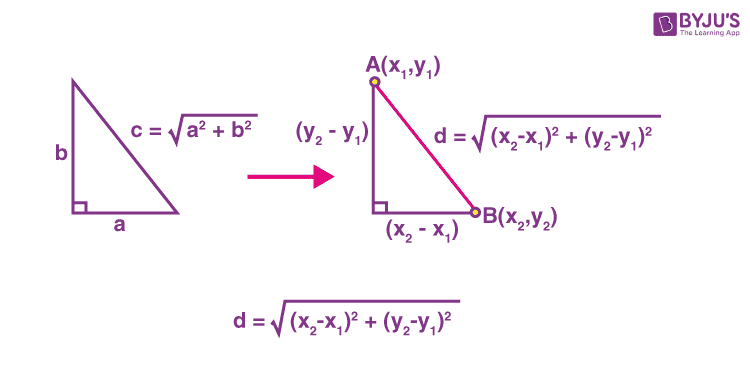
the direct segment is usually diagonal. We cannot find its length by simply subtracting coordinates. Instead, form a right triangle by moving horizontally and vertically between the points.
The horizontal leg has length equal to the change in :
The vertical leg has length equal to the change in :
The segment is the hypotenuse. By Pythagoras’ theorem,
Taking the positive square root gives the distance formula:
Distance cannot be negative, so we always use the non-negative square root.
Distance formula | Analytic geometry | Geometry | Khan Academy
Watch “Distance formula” by Khan Academy to see the distance formula built directly from a right triangle rather than treated as a rule to memorise.
Watch the setup to see the two points plotted. Then watch the right triangle, focusing on why the horizontal and vertical changes are its legs. Finish with the calculation, where Pythagoras’ theorem gives the distance.
A worked example
Find the distance between
and
Keep the coordinates paired correctly:
Now substitute, using parentheses around negative numbers:
Notice that the vertical change was negative because the second point lies lower. That is not a problem: squaring makes each leg length contribute positively.
When points are on the same horizontal or vertical line
If both points have the same -coordinate, the segment is horizontal. For example, the distance from
to
is simply
The distance formula still works:
So the formula is reliable in every case; it just becomes simpler when one coordinate does not change.
A dependable distance routine
For an exam question, use this structure:
- Write each point with its - and -coordinates clearly matched.
- Subtract the two -coordinates.
- Subtract the two -coordinates.
- Square both differences.
- Add them, then take the positive square root.
- Simplify the square root exactly when possible. Use a decimal only if the question asks for an approximation.
The most common mistakes are:
- subtracting an -coordinate from a -coordinate;
- forgetting parentheses, especially in expressions such as ;
- writing . The square root must cover the entire sum;
- giving a negative value for a distance.
2. Dividing a line segment internally
Now consider a point that lies between endpoints and . This is what internally means.
Suppose
and
and point divides the segment in the ratio
For example, a ratio of means that the segment is split into five equal parts in total: accounts for two parts and accounts for three. Point is therefore of the way from to .
The coordinates of are given by the internal section formula:
The order is important:
The coefficient multiplies the coordinates of , the opposite endpoint. The coefficient multiplies the coordinates of .

This “opposite endpoint” pattern can seem strange at first, but it makes sense. If is large compared with , then must be closer to , so 's coordinates should have the stronger influence.
Section Formula | Coordinate Geometry | TG Grade 10 | Math | Khan Academy
Watch “Section Formula” by Khan Academy India - English for a visual introduction to a point dividing a segment and a concise summary of the coordinate formula.
Watch the segment setup to establish what an internal ratio describes. Then skip to the formula summary and compare the formula with the ratio labels AP:PB=m:n.
Understanding the formula by moving along the segment
There is a useful way to check the section formula. If
then the whole segment has equal parts. The fraction of the journey from to that reaches is
So we can start at , find the change from to , and take that fraction of the change:
These expressions simplify to the section formula. This interpretation is especially helpful for checking whether your point is in a sensible location.
3. Applying the internal section formula
Let
and
Find the coordinates of if
Here,
Substitute into the section formula:
Now simplify the -coordinate:
Then simplify the -coordinate:
Therefore,
Check the answer
The ratio means should be of the way from toward .
From to , the coordinate changes are:
and
Taking of each change gives:
Starting at :
This confirms that
Because , point should be closer to , and is indeed closer to than to .
4. The midpoint: an important special case
A midpoint divides a segment into two equal lengths, so its ratio is
Put and into the internal section formula:
So the midpoint is found by averaging the two -coordinates and averaging the two -coordinates.
For the endpoints
and
the midpoint is
The midpoint should lie halfway between the endpoint coordinates. Here, is halfway between and , while is halfway between and .
5. Choosing and checking the correct method
Use this quick guide.
| If the question asks for… | Use… |
|---|---|
| The length of the segment joining two points | Distance formula |
| The point halfway between two endpoints | Midpoint formula |
| A point that splits a segment in a ratio such as or | Internal section formula |
For the section formula, make these checks before finalising your answer:
- Is the point internal? Its coordinates should lie between the corresponding endpoint coordinates.
- Is it closer to the correct endpoint? In , is close to , because is the shorter piece.
- Did you multiply each endpoint by the correct ratio part? For , pair with and with .
- Did you preserve negative signs? Write parentheses when substituting a negative coordinate.
Key takeaways
The distance formula is Pythagoras’ theorem applied to the horizontal and vertical coordinate changes:
For a point that divides internally in the ratio
use:
The midpoint is the special case:
Next, the course moves to trigonometry, beginning with the standard values of trigonometric ratios and the reference triangles that explain them.
Can't find a good explanation? Sign up and we'll make it for you
Sign up