
Hello! The previous lesson developed two coordinate-geometry tools: the distance formula from Pythagoras’ theorem, and the section formula for dividing a segment in a ratio. Pythagoras’ theorem returns again here, but now it helps build two right triangles whose side ratios give exact trigonometric values.
This begins the trigonometry-and-circles module. First, you will establish the values of sine, cosine, and tangent at , , and . Those exact values will be essential in the next lesson, where you turn heights-and-distances diagrams into trigonometric equations.
By the end of this lesson, you should be able to draw the correct reference triangle, identify the opposite, adjacent, and hypotenuse sides relative to a chosen angle, and evaluate the three trig ratios without a calculator.
1. Trigonometric ratios depend on the chosen angle
For an acute angle in a right triangle:
The mnemonic SOH CAH TOA helps you recall these definitions.
The hypotenuse is always the side opposite the right angle, and it is the longest side. The labels opposite and adjacent, however, depend on which acute angle you are using:
- the opposite side is across from the chosen angle;
- the adjacent side touches the chosen angle but is not the hypotenuse.
This last point is especially important in a -- triangle. The same two legs are present whether you are evaluating or , but their roles swap.
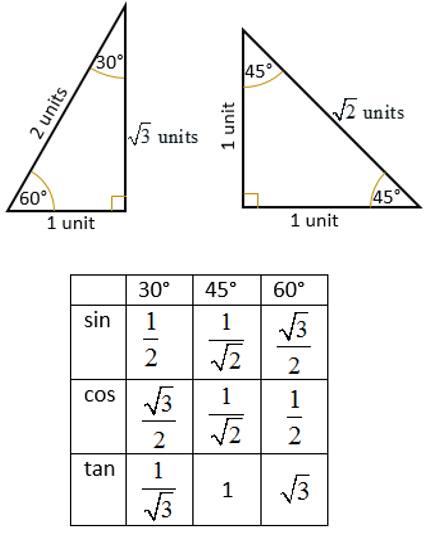
The image is useful as a final check, but aim to understand where the side lengths come from. If you can rebuild the triangles, you do not need to rely on a memorised table.
Trigonometric Ratios of Special Angles 30°, 45° and 60°
Watch Trigonometric Ratios of Special Angles 30°, 45° and 60° from Guru Tutor. It derives both reference triangles using Pythagoras’ theorem, then uses SOH CAH TOA to calculate every value in this lesson.
Begin with the triangle derivations. Notice why equal legs give two 45^\circ angles, and how bisecting an equilateral triangle produces the 30^\circ-60^\circ-90^\circ triangle. Then watch the ratio calculations. Pause before each new angle and identify opposite, adjacent, and hypotenuse for yourself.
2. The two reference triangles
The -- triangle
A right triangle with two equal acute angles has angles:
Because equal angles have equal opposite sides, its two legs are equal. Choose each leg to have length . Pythagoras gives the hypotenuse :
So the side ratio is:
where is the hypotenuse.
The -- triangle
This triangle can be made by drawing an altitude through the middle of an equilateral triangle of side length . The altitude divides the equilateral triangle into two congruent right triangles.
Each right triangle has:
- hypotenuse , inherited from one side of the equilateral triangle;
- short leg , because the base has been split into two equal halves;
- one angle of and one of .
Use Pythagoras to calculate the remaining leg :
So the side ratio is:
The short leg, length , is opposite . The longer leg, length , is opposite . The side of length is the hypotenuse.
Trig ratios of special triangles (article) | Khan Academy
Read Khan Academy’s Trig ratios of special triangles to reinforce the two side ratios and see how they produce the standard trig-value table.
In the section “The special triangles,” focus on the 30^\circ-60^\circ-90^\circ side relationship, then compare it with the 45^\circ-45^\circ-90^\circ diagram immediately below. Next, go to “A summary” near the end and inspect the completed table. Before treating it as something to memorise, trace each entry back to opposite, adjacent, and hypotenuse.
3. Evaluating the ratios
Values for
Use the -- triangle. Relative to the angle:
- opposite side: ;
- adjacent side: ;
- hypotenuse: .
Therefore,
It is conventional to rationalise the denominator:
Thus,
Values for
Stay with the same triangle, but now view it from the angle. The hypotenuse is still , but the two legs exchange roles:
- opposite side: ;
- adjacent side: ;
- hypotenuse: .
So,
Notice the pattern:
and
This happens because and are complementary angles: together they make .
Values for
In a -- triangle, either leg can be opposite or adjacent because the legs are both . The hypotenuse is .
Rationalising each gives:
For tangent:
Here is the full table in exact form:
| Angle | |||
|---|---|---|---|
A useful way to rebuild the sine values is:
Cosine uses exactly the same values in reverse order:
Finally, if you forget a tangent value, use:
For example:
4. Using the values accurately
In a question asking you to evaluate, give the exact value unless it explicitly asks for a decimal approximation.
Example 1: A single ratio
Evaluate:
From the table, or from the -- triangle:
A decimal such as is only an approximation, while is exact.
Example 2: Combining two standard values
Evaluate:
Substitute the standard values:
Therefore,
Example 3: A product involving tangent
Evaluate:
This result also makes sense from the unreduced forms:
and
Their product is .
Common errors to avoid
- Using the hypotenuse as the adjacent side. The hypotenuse is never called adjacent in SOH CAH TOA.
- Putting opposite . In the -- triangle, the shortest side is opposite the smallest angle, .
- Forgetting that side labels depend on the chosen angle. When switching from to , opposite and adjacent switch.
- Giving approximations when exact values are expected. Prefer , not .
- Writing . The correct exact value is .
Key takeaways
The two reference triangles are enough to evaluate the main standard acute angles:
Use SOH CAH TOA with respect to the selected angle:
Rather than trying to memorise nine disconnected answers, rebuild them from the reference triangles. In the next lesson, you will use these ratios in labelled heights-and-distances diagrams, where deciding which sides are opposite and adjacent becomes the key first step.
Can't find a good explanation? Sign up and we'll make it for you
Sign up