
Hello! This first module is a balanced revision of core Class 10 mathematics ideas, beginning with polynomials. In this lesson, you will learn how to find the zeroes of a quadratic polynomial and then verify that those zeroes match the polynomial’s coefficients. This is a common board-exam format: find, show, and conclude clearly.
By the end, you should be able to work confidently with a quadratic polynomial in the form
and verify the two key relationships:
Here, and are the zeroes.
Zeroes: where a polynomial becomes zero
A zero of a polynomial is a value of for which
For example, consider
If , then
So is a zero. Likewise, is also a zero.
Graphically, zeroes are the -coordinates where the graph meets the -axis, because every point on the -axis has .
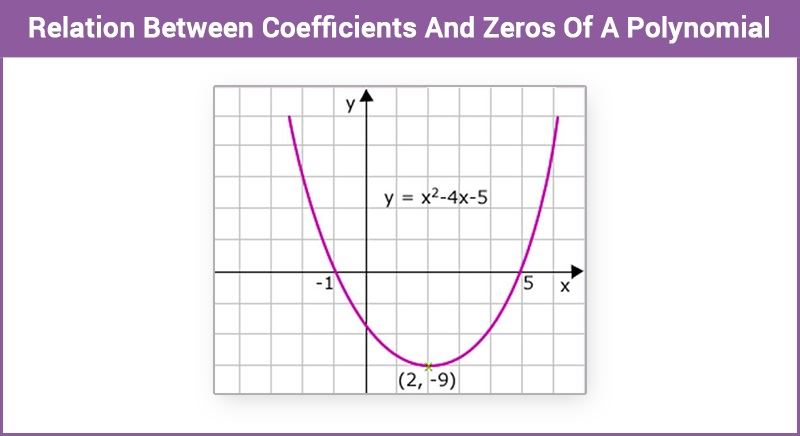
A quadratic polynomial can have at most two zeroes. On a graph, it may:
- cross the -axis twice, giving two distinct zeroes;
- touch the -axis once, giving two equal zeroes; or
- not meet the -axis in the real plane.
For the questions in this lesson, factorisation will let us identify the zeroes directly.
Polynomials L-2 | Relationship Between Zeroes & Coefficients of Polynomials | Prodigy - CBSE 10 Math
Watch “Polynomials L-2: Relationship Between Zeroes & Coefficients of Polynomials” from Vedantu 9&10 English. It gives a visual introduction to zeroes, then derives the two relationships you need and applies them in an example.
Begin with the introduction for a quick reminder that the degree of a polynomial limits its possible number of zeroes. Then watch the derivation, focusing on how factors involving the zeroes are expanded and compared with ax^2+bx+c. Finish with the worked example, noting the separate checks for the sum and product of the zeroes.
Finding zeroes by factorisation
To find the zeroes of a polynomial, first write the polynomial equal to zero and factorise it. Then use the zero-product property:
If a product of two factors is zero, at least one factor must be zero.
Take the polynomial
We need to solve
Splitting the middle term
For a quadratic , find two numbers whose:
- product is ;
- sum is .
Here,
So we need two numbers with product
and sum . The numbers are and .
Split the middle term:
Group the terms:
Factor out the common bracket:
Now set each factor equal to zero.
From
we get
From
we get
Therefore, the zeroes are
You can always check a result by substituting a zero back into the original polynomial. For example,
So is confirmed as a zero.
A useful sign reminder
If a factor is , then its zero is not . Set it equal to zero:
so
The sign changes when you solve the factor equation.
Why zeroes are related to coefficients
Suppose a quadratic polynomial has zeroes and . Its factors must be
and
Therefore, a quadratic with these zeroes can be written as
where is the coefficient of .
Expand the brackets:
But the same polynomial is also written in standard form:
Compare the coefficients of matching terms:
| Term | From the zeroes | From standard form |
|---|---|---|
| term | ||
| term | ||
| Constant term |
So,
Dividing by gives
Also,
Dividing by gives
These are not two unrelated formulas to memorise. They come from the fact that a quadratic can be expressed both through its coefficients and through its zeroes.
The verification format to use in an exam
Return to the polynomial
We found its zeroes:
Identify the coefficients carefully:
1. Verify the sum of zeroes
Calculate the left-hand side using the zeroes:
Now calculate the right-hand side using coefficients:
Therefore,
2. Verify the product of zeroes
Calculate the left-hand side:
Now use the coefficients:
Therefore,
Both relations have been verified.
A compact answer template
For any exam question of this type, organise your work like this:
- Write .
- Factorise.
- State the zeroes clearly.
- Identify , , and , including their signs.
- Calculate and compare it with .
- Calculate and compare it with .
- Write: Hence, the relationship between zeroes and coefficients is verified.
Reading a graph and checking the coefficients
Look again at the graphed polynomial:
The graph shows the zeroes:
The coefficients are
Check the sum:
Check the product:
So the graph, the factorisation
and the coefficient relationships all describe the same polynomial.
Common errors to avoid
Forgetting the negative sign in the sum formula.
The sum is
not . If , then .
Ignoring the leading coefficient.
For , the product is not simply . It is
Using the wrong numbers while splitting the middle term.
The two numbers must multiply to , not just .
Not treating an absent term as zero.
For
the coefficient of is
Listing factors rather than zeroes.
If the factor is , write the zero as
not merely .
You have now connected three views of the same idea: a zero as an input making , an -intercept on a graph, and a value encoded in the coefficients of a quadratic polynomial.
The key facts to retain are:
and, when factorisation is possible, the zeroes come from setting each factor equal to zero. In the next lesson, you will build on this by deciding when factorisation is efficient and when the quadratic formula is the better way to solve a quadratic equation.
Can't find a good explanation? Sign up and we'll make it for you
Sign up