
Hello! Welcome to your third lesson.
In our last session, we drew the crucial distinction between deductive and inductive arguments, focusing on whether an argument's conclusion is intended to be a certainty or a probability. You learned the specific vocabulary—valid/sound for deduction, strong/cogent for induction—used to evaluate them.
Today, we take a practical leap forward. Philosophical arguments are rarely presented in a neat, numbered list. Instead, they are woven into dense prose. This lesson tackles the fundamental skill of a philosophical reader: learning how to dissect a text to find the argument within. Our learning outcome is to identify the conclusion and premises in a passage of philosophical text.
This skill is the bridge between passively reading philosophy and actively engaging with it. It's the first step in the "rigorous, text-driven approach" you're aiming for, allowing you to move from understanding abstract concepts to analyzing how a philosopher actually builds their case.
What Is an Argument? The Hunt for Support
At its core, philosophy is the practice of making and assessing arguments. But what are the components we are looking for? An argument consists of:
- Premises: The statements that provide reasons or evidence.
- Conclusion: The main claim that the premises are intended to support.
The fundamental relationship to look for is one of support. When you read a philosophical text, your primary task is to figure out which claims are being used to support which other claims.
To get a quick overview of these core concepts, let's start with a short video.
1.1 Basic Concepts: Arguments, Premises, & Conclusions
This clip from Mark Thorsby's lecture on logic clearly defines what an argument is and its constituent parts: premises and conclusions.
Please watch from 03:59 to 05:02. Focus on the simple definitions of premise as 'evidence' and conclusion as the 'claim' you are meant to believe.
This idea of a support structure is central to philosophical reading. Unlike some literary texts where symbolism might be key, in philosophy, the argumentative structure is paramount.
This next video, from Jeffrey Kaplan's 'How to Read Philosophy,' effectively illustrates this concept of support using an example from Descartes. It explains what 'support' literally means in a logical context.
Watch from 01:54 to 06:07. Pay attention to how one of Descartes' claims is meant to serve as a reason to believe the other, and what it means for one claim to make another more plausible or true.
A Systematic Approach to Finding Arguments
Identifying premises and conclusions is not a matter of guesswork; it's a systematic process. The following flowchart gives a high-level view of the analysis you'll learn to perform.
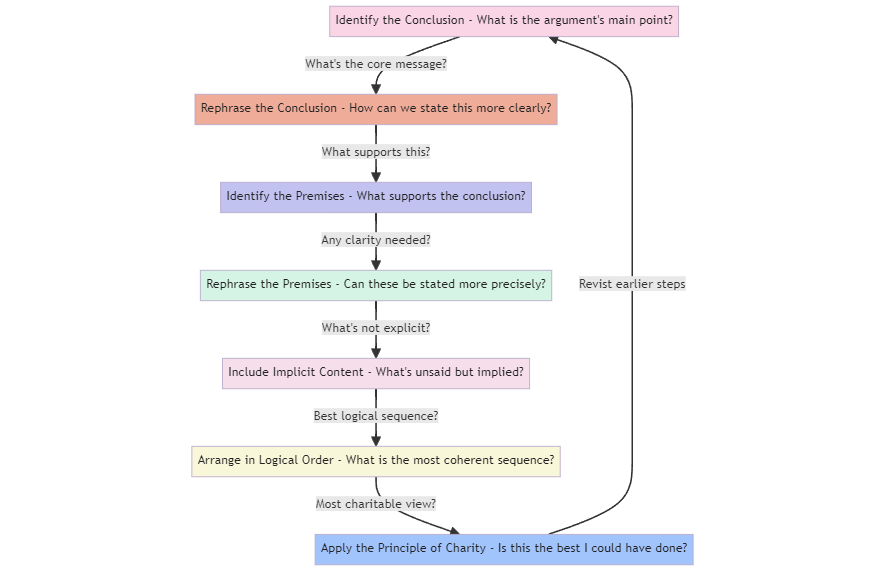
Let's break this process down into concrete steps.
Step 1: Find the Conclusion First
The most important step is to identify the author's main point. This is the anchor for the entire argument. Before you try to figure out the reasons, you must know what they are reasons for.
To find the conclusion, ask yourself:
- What is the single main point the author is trying to convince me of?
- What is the ultimate "takeaway" of this passage?
As the resource from Lander University's philosophy department notes, the conclusion is often the first or last sentence in a paragraph, but it can appear anywhere. Finding it requires you to understand the author's overall intention in the passage.
Step 2: Use Indicator Words as Clues
Philosophers often use "signpost" words that signal the structure of their arguments. Learning to spot these words will make your work much easier. They fall into two categories: premise indicators and conclusion indicators.

To see how these work in practice, let's turn back to our video resources.
1.1 Basic Concepts: Arguments, Premises, & Conclusions
These clips provide a walkthrough of how to use indicator words to find the conclusion and premises, followed by several worked examples.
Please watch from 20:23 to 28:01. The first two parts discuss conclusion and premise indicators. The third part applies these techniques to several sample arguments. Notice how the presenter combines looking for indicators with asking 'what's the takeaway?'
A Crucial Caution: Indicator words are powerful clues, but they are not foolproof. The word "because," for example, can introduce a reason (premise) or a cause (explanation). Context is everything. As the Lander University resource Diagramming Arguments warns, you should not rely on these words in a "mechanical" way. Always read for the overall meaning of the passage to confirm the logical relationships.
Step 3: Identify the Premises
Once you have a candidate for the conclusion, your next step is to identify the premises. Ask yourself:
- What reasons does the author give to justify this conclusion?
- Why should I believe this is true?
The sentences that answer these questions are the premises of the argument.
Putting It All Together: Reconstructing an Argument
Now, let's apply this systematic approach to a genuine piece of philosophical writing. We will work through a famous passage by the 18th-century philosopher David Hume.
The following resource from The University of North Carolina's Writing Center provides an excellent, step-by-step reconstruction of Hume's argument. It models exactly the kind of careful, text-focused analysis you are learning to perform.
Philosophy - The Writing Center
This guide from the UNC Writing Center will walk you through the process of extracting an argument from a challenging philosophical text. It is a perfect model for the skills we are developing today.
First, read the short passage from David Hume. Then, carefully read the section that breaks down the argument reconstruction into seven steps, starting with 'Step 1: Reread the passage...' and ending with 'Step 7: Summarize the argument...'. Pay close attention to how they identify the conclusion (Step 2) and then work backward to find the premises and unspoken assumptions (Steps 3-6).
This worked example demonstrates the process in action:
- Read and Understand: They start by ensuring they understand the vocabulary and main ideas.
- Find the Conclusion: They identify Hume's main point—that 'viciousness' (wrongness) is a feeling in us, not a property of the action itself. Note that this is not the first or last sentence.
- Identify Premises: They then look for the reasons Hume gives. They find two main lines of evidence: (a) when we look at a vicious act, we don't see any "matter of fact" called "vice," only actions and motivations; and (b) when we look inside ourselves, we do find a "sentiment of disapprobation."
- Organize: Finally, they organize these pieces into a clear, logical structure.
This is the core activity of philosophical analysis.
Practice
Let's try a short exercise. Read the following passage and identify the conclusion and the premise(s). Use the techniques we've discussed: first find the main takeaway, then find the reasons offered for it.
The soul must be immortal. For all things that are destroyed are destroyed by their opposite evil. Sickness is the evil of the body, and it can destroy it. But injustice, the evil of the soul, does not destroy the soul. Therefore, the soul cannot be destroyed.
Click to see the analysis
- Conclusion: "The soul must be immortal" (or its restatement, "Therefore, the soul cannot be destroyed"). The word "Therefore" is a strong conclusion indicator. The entire passage is structured to convince you of this one point.
- Premise 1: "All things that are destroyed are destroyed by their opposite evil."
- Premise 2: "Sickness is the evil of the body, and it can destroy it." (This serves as an example to clarify Premise 1).
- Premise 3: "But injustice, the evil of the soul, does not destroy the soul."
The argument's logic is that since the soul's specific "evil" (injustice) doesn't destroy it, and things can only be destroyed by their specific evil, it follows that the soul cannot be destroyed at all.
Conclusion
Today, you've acquired a foundational skill for active philosophical reading. Instead of seeing a block of text, you can now begin to see the logical skeleton that holds it together.
Key Takeaways:
- An argument consists of premises (reasons) that provide support for a conclusion (the main point).
- The first and most important step in analyzing an argument is to identify the conclusion. Ask, "What is the author's main takeaway?"
- Indicator words like "therefore," "since," "because," and "hence" are valuable clues to an argument's structure.
- Once the conclusion is identified, the premises are the answers to the question, "What reasons does the author provide to believe this conclusion?"
In our next lesson, we will build directly on this skill. Now that you can identify the parts of an argument, you will learn how to reconstruct a philosopher's argument in standard form from a prose passage. This involves taking the premises and conclusion you've identified and organizing them into a numbered list, making the logical structure perfectly clear and ready for evaluation.
Can't find a good explanation? Sign up and we'll make it for you
Sign up