
Hello! Welcome to your second lesson.
In our first session, we created a map of philosophy by defining its main branches. You'll recall we identified logic as the essential toolkit for philosophical inquiry—the study of how we reason. Today, we'll begin to master that toolkit.
This lesson addresses our next learning outcome: to distinguish between deductive and inductive arguments. These are the two fundamental ways we construct arguments and make inferences. Understanding this distinction is the bedrock of the rigorous argument analysis you're looking for in this course. It's the first major step in moving from knowing what philosophers talk about to understanding how they build their cases.
Introduction to Inference: Deduction and Induction
At its heart, an argument is a set of claims (premises) intended to provide reasons for believing another claim (the conclusion). The logical move from premises to a conclusion is called an inference. The crucial difference between deduction and induction lies in the nature of this inference—specifically, in the strength of the connection between the premises and the conclusion.
To get a clear overview of this distinction, let's watch a video that introduces the core concepts.
Deductive and Inductive Inference
This video, from Professor Daniel Bonevac, provides a clear and concise introduction to deductive and inductive inference. It will define the core concepts of validity, strength, and the crucial difference in the 'guarantee' each type of argument offers.
Please watch the following three segments: The introduction (00:00 - 00:43) which defines inference. The section on deductive inference (00:43 - 02:13), focusing on the concept of a 'guarantee'. The section on inductive inference (07:48 - 10:02), focusing on 'strength' and 'plausibility'.
The video introduces the fundamental contrast:
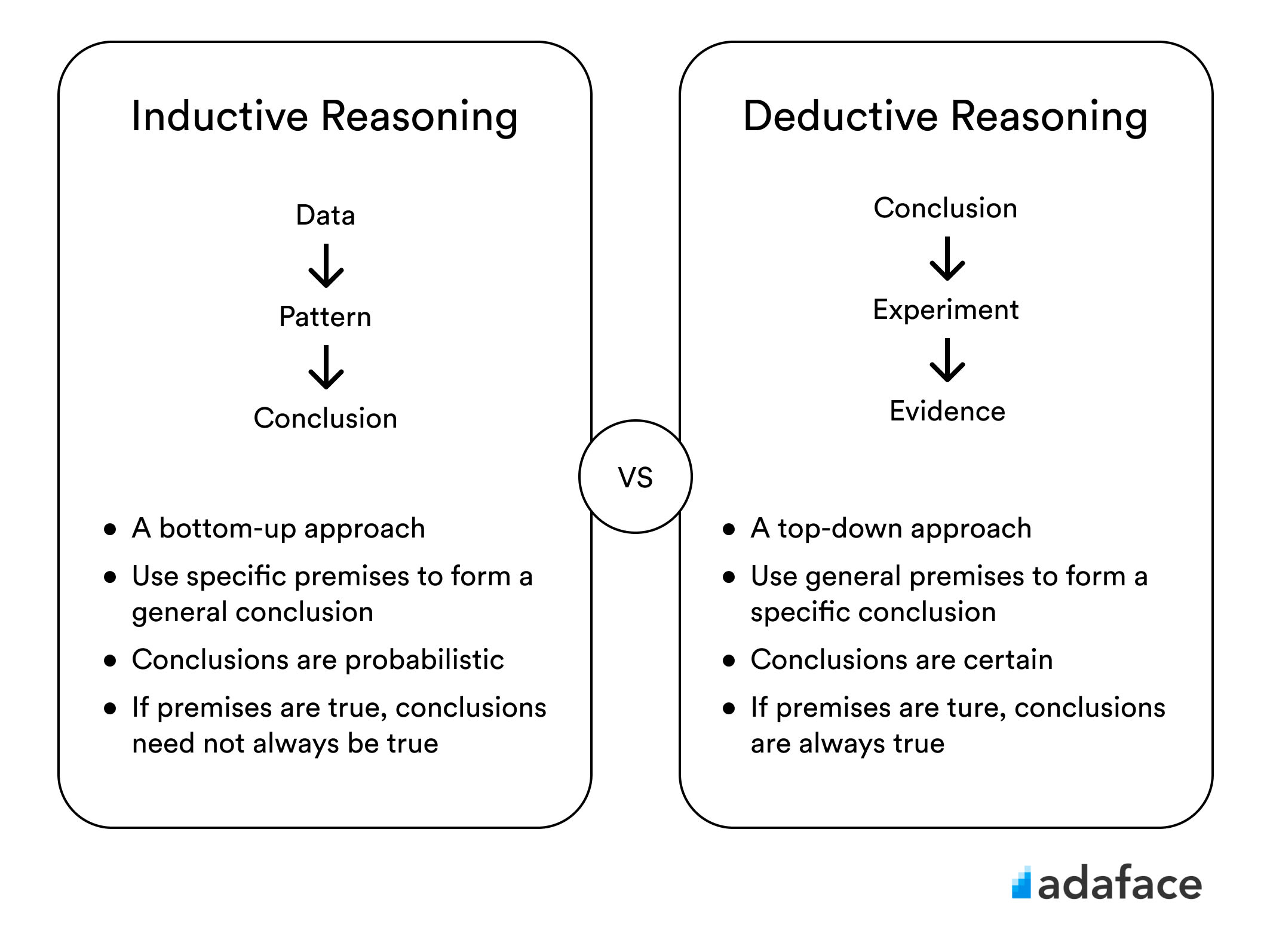
- Deductive arguments aim for certainty. If the premises are true, the conclusion is guaranteed to be true.
- Inductive arguments aim for probability. If the premises are true, the conclusion is likely or plausible, but not guaranteed.
Let's now formalize these ideas with a more detailed text.
Deep Dive: Defining the Two Types of Arguments
The following reading from an open-source logic textbook will help us develop a precise vocabulary for evaluating arguments. As we will see, philosophers don't just say an argument is "good" or "bad"; they use specific terms to diagnose exactly how an argument succeeds or fails.
Evaluating Arguments – Introduction to Philosophy: Logic
This reading from 'Introduction to Philosophy: Logic' formally defines deductive and inductive arguments and introduces the critical evaluative terms you'll need: valid/sound for deductive arguments, and strong/cogent for inductive arguments.
Please read the sections titled 'Deductive Arguments' and 'Inductive Arguments'. Pay close attention to the table that summarizes the different terms used for evaluation.
Let's break down the key takeaways from that reading.
Deductive Arguments: Validity and Soundness
A deductive argument attempts to provide a conclusion that follows with logical necessity.
-
Validity: An argument is valid if its structure is such that if the premises were true, the conclusion must be true. Validity is about the logical form, not the actual truth of the premises.
- Valid Argument (with false premise):
- All cats are reptiles.
- Emmett is a cat.
- Therefore, Emmett is a reptile.
(The reasoning is perfect, but premise 1 is false, so the conclusion is false.)
- Valid Argument (with false premise):
-
Soundness: An argument is sound if it is valid AND all of its premises are actually true. A sound argument guarantees a true conclusion. This is the gold standard for deductive reasoning.
- Sound Argument:
- All human beings are mortal.
- Socrates is a human being.
- Therefore, Socrates is mortal.
- Sound Argument:
Inductive Arguments: Strength and Cogency
An inductive argument uses evidence to make its conclusion probable.
-
Strength: An argument is strong if its premises provide good evidence for the conclusion, making it very likely to be true. Strength is a matter of degree.
- Strong Argument:
- Every swan ever observed has been white.
- Therefore, the next swan we see will be white.
(The evidence is compelling, but it doesn't offer a 100% guarantee.)
- Strong Argument:
-
Cogency: An argument is cogent if it is strong AND all of its premises are actually true.
- Cogent Argument:
- The sun has risen in the east every morning of recorded human history. (True premise)
- Therefore, the sun will rise in the east tomorrow morning. (Strong inference)
- Cogent Argument:
This table from the reading is an excellent summary:
| Quality of Inference | Deductive | Inductive |
|---|---|---|
| Bad inference | Invalid | Weak |
| Good inference | Valid | Strong |
| Good inference + true premises | Sound | Cogent |
Going Deeper: Types of Induction and a Common Pitfall
Now that we have the core definitions, let's expand our understanding of induction and correct a common oversimplification.
Varieties of Inductive Reasoning
Induction isn't just about simple generalization. It comes in many forms that we use constantly in science, medicine, and everyday life.
Deductive and Inductive Inference
Let's return to the first video to explore the rich variety of inductive arguments. This will show you that induction is more than just generalizing from examples.
Watch the segment from 10:02 to 22:31. As you watch, notice how different forms of reasoning—like causal inference, analogy, and inference to the best explanation—all fall under the umbrella of induction because their conclusions are probabilistic, not certain.
Debunking a Common Myth: General vs. Specific
You may have heard that deductive arguments go from general to specific, while inductive arguments go from specific to general. The "Socrates" and "swan" examples seem to support this. However, this is a misleading oversimplification. A rigorous, university-level understanding requires us to discard this rule.
Deductive and Inductive Arguments
This text specifically addresses and corrects the myth that deduction is always 'general-to-specific' and induction is 'specific-to-general' by providing clear counterexamples.
Read the section titled '2. Specificity and Generality of Statements Do Not Always Distinguish Deductive Arguments from Inductive Arguments'. Focus on understanding the counterexamples provided.
The key insight is this: the defining feature is always the inferential claim. Does the argument claim the conclusion is guaranteed (deductive) or just well-supported (inductive)? The direction of reasoning (general to specific or vice versa) is irrelevant to this fundamental distinction.
Practice
Let's put this knowledge into practice. Consider the following arguments from the exercises in the "Evaluating Arguments" reading. For each one, decide whether it is deductive or inductive, and explain why.
Argument 1:
- All flamingos are pink birds.
- All flamingos are fire breathing creatures.
- Therefore, some pink birds are fire breathing creatures.
Click to see the analysis
This is a **deductive** argument. It is not trying to say this is *probably* the case; it's asserting that *if* you accept the two premises, the conclusion necessarily follows. The structure is one of logical certainty. (In this case, the argument is valid, but unsound because premise 2 is false).Argument 2:
- Every Friday so far this year the cafeteria has served fish and chips.
- If the cafeteria's serving fish and chips and I want fish and chips then I should bring in £4.
- If the cafeteria isn’t serving fish and chips then I shouldn’t bring in £4.
- I always want fish and chips.
- Therefore, I should bring in £4 next Friday.
Click to see the analysis
This is primarily an **inductive** argument. The entire conclusion rests on the inference from past Fridays (premise 1) to a future Friday. Even with the other premises, the conclusion is only probable. There is no guarantee that the pattern will continue. The kitchen could change the menu.Conclusion
In this lesson, we have established the crucial distinction between the two major types of arguments.
Key Takeaways:
- Deductive arguments aim for necessity. Their conclusions are guaranteed if the premises are true. They are evaluated as valid (correct form) and sound (valid form with true premises).
- Inductive arguments aim for probability. Their conclusions are made likely by the premises, but not guaranteed. They are evaluated as strong (premises provide good support) and cogent (strong argument with true premises).
- The defining feature is the strength of the inferential link between premises and conclusion, not whether the reasoning moves from general to specific claims.
This distinction is the first and most important tool in your logical toolkit. Being able to identify what an argument is trying to do (guarantee or just persuade) is the first step to evaluating whether it succeeds.
In our next lesson, we will build directly on this skill. Now that you can distinguish argument types, you will learn to identify the conclusion and premises in a passage of philosophical text. This will move us from analyzing clean, pre-packaged arguments to extracting them from the complex prose you'll encounter in your readings.
Can't find a good explanation? Sign up and we'll make it for you
Sign up