
Welcome back!
In our last lesson, we established the fundamental difference between direct (invasive) and indirect (non-invasive) blood pressure measurement. We learned that while invasive methods are the "gold standard" for accuracy in critical care, non-invasive methods are overwhelmingly used for routine monitoring due to their safety and simplicity.
Today, we'll dive deep into the two primary non-invasive techniques. This lesson is designed to help you explain the principles of auscultatory and oscillometric blood pressure devices. We will dissect how each method works, what it actually measures, and what its inherent strengths and weaknesses are. Understanding these principles is essential for both your university exams and for critically evaluating the data from any automated blood pressure device, including wearables relevant to your work at Neuraease.
1. The Auscultatory Method: Listening for Blood Flow
The auscultatory method is the classic technique used by clinicians with a stethoscope and a manual blood pressure cuff (sphygmomanometer). The principle is based on listening for specific sounds generated by turbulent blood flow as pressure is released from the cuff.
For a fun and intuitive introduction to how this was developed and how it works, let's start with a short video.
Just what is a sphygmomanometer? - Bang Goes the Theory - BBC
This clip from the BBC's 'Bang Goes the Theory' demonstrates the invention of the sphygmomanometer and clearly explains the concept of using sounds to determine blood pressure.
Watch from 01:04 to 03:43. Pay close attention to: How the return of a pulse corresponds to the systolic pressure. The discovery by Dr. Korotkoff: listening for the tapping sounds and their disappearance to find both systolic and diastolic pressure.
As the video explained, the key is listening for Korotkoff sounds. Here is the step-by-step process:
- Occlusion: An inflatable cuff is placed around the upper arm and inflated to a pressure high enough to completely stop blood flow in the brachial artery. At this point, no sound is heard through the stethoscope placed over the artery.
- Deflation: The pressure in the cuff is slowly released at a rate of 2-3 mmHg per second.
- Systolic Pressure: When the cuff pressure drops to just below the patient's systolic pressure, small spurts of blood are forced through the partially compressed artery with each heartbeat. This creates turbulence and a distinct "tapping" sound. The pressure at which the very first of these sounds is heard is recorded as the Systolic Blood Pressure (SBP).
- Diastolic Pressure: As the cuff continues to deflate, the sounds change in quality and then disappear altogether when the cuff pressure drops below the diastolic pressure. At this point, the artery is no longer compressed, blood flow becomes smooth (laminar), and the turbulence stops. The pressure at which the last sound is heard is recorded as the Diastolic Blood Pressure (DBP).
The image below provides a great visual summary of this process.

To solidify this, let's turn to a more formal description.
Automated 'oscillometric' blood pressure measuring devices
The paper 'Automated 'oscillometric' blood pressure measuring devices' provides a concise and accurate description of the manual auscultatory method, which serves as the reference standard for automated devices.
Please read the section titled 'Auscultatory method using a mercury sphygmomanometer: how does it work, what does it measure?'. Focus on the description of Korotkoff phases I and V, which define systolic and diastolic pressure.
In summary, the auscultatory method directly determines SBP and DBP by linking them to specific auditory events.
2. The Oscillometric Method: Measuring Pressure Pulses
The vast majority of automated blood pressure monitors, from hospital-grade machines to at-home devices, use the oscillometric method. Instead of listening for sounds, these devices measure pressure oscillations within the cuff itself.
The principle is as follows:
- As with the auscultatory method, the cuff inflates to occlude the artery and then slowly deflates.
- The pulsating artery exerts a pressure wave against the cuff. A sensitive pressure transducer inside the monitor detects these small pressure oscillations.
- The device records the amplitude of these oscillations at each step of cuff deflation. The amplitudes start small, increase to a maximum, and then decrease again.
- An algorithm analyzes this "envelope" of oscillation amplitudes to determine the blood pressure.
This process is visualized perfectly in the following diagram.
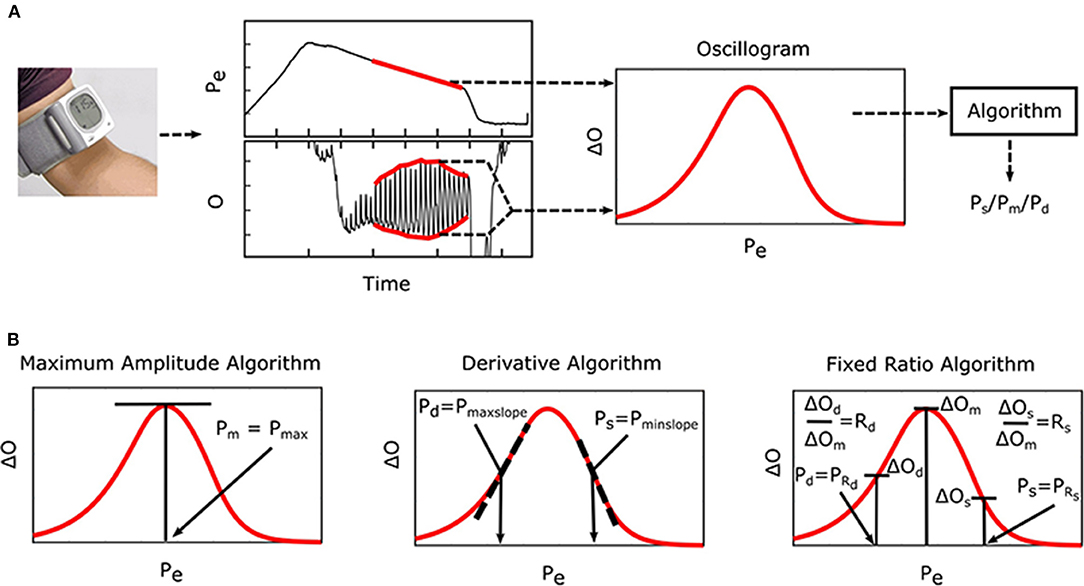
The Crucial Distinction: What Is Actually Measured?
Here lies the most important concept of the oscillometric method:
- The cuff pressure at which the oscillations reach their maximum amplitude corresponds directly to the Mean Arterial Pressure (MAP). The MAP is the only value that is truly measured by the device.
- Systolic and Diastolic pressures are not directly measured. Instead, they are estimated or calculated by a proprietary algorithm. This algorithm typically identifies SBP and DBP at points on the rising and falling parts of the oscillation envelope that correspond to a certain percentage (a "fixed ratio") of the maximum amplitude.
Let's watch a video that drives this point home from a clinical perspective.
Blood Pressure Measurements in the ICU: Trust ONLY the MAP in Oscillometric Devices!
The video 'Blood Pressure Measurements in the ICU' powerfully explains why the MAP from an oscillometric device is the most reliable number. It clearly distinguishes between what is measured and what is calculated.
Watch from 04:28 to 08:27. Focus on: The explanation of oscillometric technology: the machine detects the maximum amplitude of oscillations, which is the MAP. The origin of SBP and DBP: they are generated by a computer algorithm, not directly measured, making them less reliable than the MAP.
To get a more detailed technical explanation and understand the practical challenges, the following document is excellent.
Noninvasive blood pressure principles
This application note from Philips, 'Noninvasive blood pressure principles,' offers a clear, practical summary of the oscillometric method and its limitations.
Please read the first two sections: 'Principle of oscillometric blood pressure management' and 'Key differences between oscillometric and auscultatory methods'. This will crystallize your understanding of the oscillation envelope and the empirical nature of SBP/DBP estimation.
Because the SBP and DBP are algorithm-dependent, different devices can give slightly different readings on the same person at the same time. The quality of the measurement is also highly susceptible to artifacts from patient motion, irregular heartbeats (arrhythmias), or an improperly sized cuff, which can distort the oscillation envelope and make it difficult for the algorithm to interpret.
3. Direct Comparison: Auscultatory vs. Oscillometric
Let's summarize the core differences. This is a key comparison for your exams.
| Feature | Auscultatory Method | Oscillometric Method |
|---|---|---|
| Signal Detected | Korotkoff sounds (auditory) | Pressure oscillations in the cuff (mechanical) |
| What is Measured? | Directly measures Systolic (SBP) and Diastolic (DBP). | Directly measures Mean Arterial Pressure (MAP). |
| How SBP/DBP are Found | SBP = First sound heard DBP = Last sound heard | SBP & DBP are estimated by an algorithm from the oscillation envelope. |
| Operator Skill | Requires a trained user with good hearing. | Automated; minimal user skill required. |
| Susceptibility | Observer bias, ambient noise, poor hearing. | Patient motion, arrhythmias, algorithm limitations, wrong cuff size. |
| Primary Use | Clinical standard for manual measurement. | Automated monitoring in hospitals, clinics, and at home. |
Test your understanding!
You are testing a new wearable for Neuraease that includes a blood pressure function.
The device gives a reading of 140/90 mmHg, with a calculated MAP of 107 mmHg.
To verify, you immediately take a manual measurement with a stethoscope and sphygmomanometer and get a reading of 132/86 mmHg.
- Which value from the automated device (140, 90, or 107) is the most direct measurement, and why?
- Based on the principles we've discussed, why is it plausible for the SBP/DBP values to differ between the two methods, even when taken moments apart?
- What is a common source of error in the manual measurement that could have contributed to the discrepancy?
Show answer
- The MAP of 107 mmHg is the most direct measurement from the automated device. The oscillometric principle is based on finding the cuff pressure that corresponds to the maximum amplitude of arterial oscillations, which is the MAP. The systolic (140) and diastolic (90) values are estimations calculated from that measurement by the device's proprietary algorithm.
- The SBP/DBP values can differ because the two methods determine them in fundamentally different ways. The manual (auscultatory) method identifies SBP/DBP based on the audible appearance and disappearance of Korotkoff sounds. The automated (oscillometric) method estimates SBP/DBP using a mathematical formula based on the shape of the pressure oscillation envelope. Since this formula is an approximation, it can easily differ from the auditory-based measurement.
- A common source of error in the manual measurement is the cuff deflation rate. If the pressure is released too quickly (> 3 mmHg/sec), the observer may miss the true first or last Korotkoff sound, typically leading to an underestimation of systolic pressure and an overestimation of diastolic pressure.
Conclusion
In this lesson, we have dissected the two foundational methods of non-invasive blood pressure measurement. You are now equipped to explain the distinct principles behind them, a key competency in biomedical instrumentation.
Key Takeaways:
- Auscultatory Method: Uses a stethoscope to listen for Korotkoff sounds. It directly determines Systolic (first sound) and Diastolic (last sound) pressures. It is the manual reference standard but requires a skilled operator.
- Oscillometric Method: Uses a pressure sensor to detect oscillations in the cuff. It directly measures Mean Arterial Pressure (MAP) at the point of maximum oscillation. SBP and DBP are then estimated by a proprietary algorithm.
- The fundamental difference—what is directly measured versus what is estimated—is the main reason for discrepancies between manual and automated blood pressure readings.
Preview of the Next Lesson:
Having now covered the common non-invasive techniques, our next lesson will focus on direct (invasive) blood pressure measurement. We will examine the design, setup, and principles of catheter-transducer systems used for continuous hemodynamic monitoring in critical care settings. This will complete our comprehensive look at how this vital sign is measured across different clinical contexts.
Can't find a good explanation? Sign up and we'll make it for you
Sign up