
Hello! Welcome back to our exploration of the science of dreaming.
In our last lesson, we examined the Activation-Synthesis Hypothesis, a "bottom-up" theory that explains the mechanism of dreaming: our higher brain creating stories from random neural signals fired from the brainstem. We learned that while the initial trigger for a dream might be random, the way our brain synthesizes that story is deeply personal.
Today, we shift our focus from "how" we dream to "what dreams are for." We will investigate a powerful functional theory that frames dreaming not as a byproduct of neural noise, but as a vital, evolved survival tool. This lesson directly addresses the learning outcome: Explain the threat simulation theory of dreaming. We'll explore its evolutionary logic, the evidence supporting it, and its core propositions.
What is the Threat Simulation Theory (TST)?
The Threat Simulation Theory (TST), developed by Finnish neuroscientist Antti Revonsuo, proposes that the primary function of dreaming is to serve as a biological defense mechanism. In essence, your brain uses the offline state of sleep to run a sophisticated virtual reality simulator.
The core idea is that dreaming allows us to:
- Simulate threatening events from our ancestral past (like being chased by a predator) and our modern lives (like failing an exam or missing a flight).
- Rehearse our perceptual and behavioral responses to these threats (e.g., recognizing danger, escaping, fighting back).
- Do all of this in a perfectly safe environment—our sleeping mind—where failure has no real-world consequences.
Let's start with a short video that introduces this concept.
The Strange Science of Why We Dream
This clip from the Be Smart YouTube channel provides a quick and clear summary of the Threat Simulation Theory and its evolutionary significance.
Please watch the segment from 09:17 to 10:23. Focus on how the video explains the purpose of replaying our worst fears and memories in dreams.
The Flight Simulator Analogy
The most powerful analogy for TST, one used by Revonsuo himself, is that of a flight simulator for pilots. We don't wait for a real engine to fail mid-flight to see how a pilot reacts. Instead, we have them practice emergency scenarios hundreds of times in a safe, simulated environment. By repeatedly facing these simulated threats, their recognition of danger and their avoidance skills become faster and more automatic.
TST suggests our brains do the same thing every night. They throw us into simulated threatening situations, preparing us to react more effectively if we ever face a similar danger in our waking lives.
The Evolutionary Argument and the "Negativity Bias"
To truly understand this theory, we need to consider it from an evolutionary perspective—a perspective that was central to Revonsuo's thinking.
Algo Podcast | Episode 30 | Antti Revonsuo | Foundations of Consciousness
There is no better way to understand this theory than to hear from its creator. In this interview, Professor Antti Revonsuo explains the reasoning that led him to develop the Threat Simulation Theory.
Please watch the segment from 54:00 to 1:08:46. As you watch, pay close attention to his answers to these key questions: Why does the brain spend metabolic energy on dreaming instead of just shutting down? What is the 'negativity bias' in dream content (e.g., nightmares, recurring bad dreams)? What are some of the universal, threatening dream themes found across cultures? How does the 'flight simulator' analogy work in detail? Why is it crucial that we don't know we are in a simulation while we are dreaming?
As you heard from Professor Revonsuo, the evidence for TST doesn't come from a single experiment, but from analyzing the statistical properties of large collections of dream reports. The key findings that support the theory are:
- Prevalence of Negative Emotions: Across cultures, negative emotions like fear and anger are far more common in dreams than positive ones.
- Universal Threatening Themes: Dreams of being chased, attacked, falling, being trapped, or failing at a task are remarkably common around the world. These themes mirror ancestral and modern survival challenges.
- Trauma and Nightmares: People who experience life-threatening trauma almost inevitably suffer from nightmares that replay the event or similar threatening scenarios. This suggests the threat-simulation system is kicked into high gear when it's most needed.
Test your understanding!
A student repeatedly dreams that they show up for a final exam completely unprepared. How would the Threat Simulation Theory interpret this dream? Is it a prediction that they will fail?
Show answer
According to TST, this dream is not a prediction of the future. Instead, it's a simulation of a potential modern-day threat to one's social standing and future success. By repeatedly running this stressful simulation, the brain is 'practicing' the scenario, potentially motivating the student in their waking life to study more diligently to avoid the 'threat' from becoming a reality. It's a fire drill for a high-stakes academic event.
Empirical Evidence and Key Propositions
To be a robust scientific theory, TST must be testable. Revonsuo broke his theory down into six core propositions that could be empirically investigated. Let's look at some of the evidence.
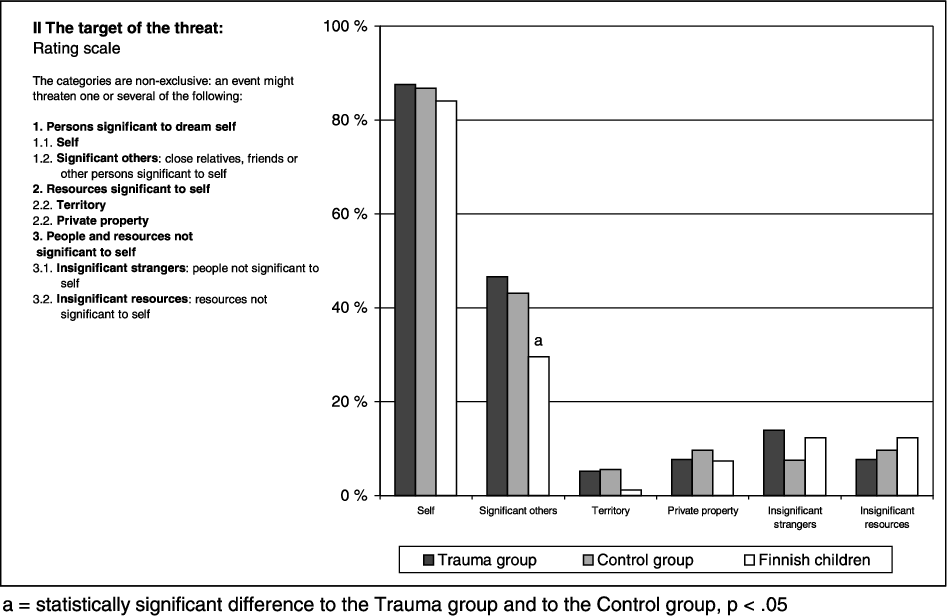
One of the theory's central claims is that the dream-self is the primary target of the threats. The chart below, from a study on dream content, provides strong visual support for this.
To go deeper, we'll turn to a resource that summarizes the key evidence and the theory's formal propositions.
The Wikipedia article on Antti Revonsuo provides a concise and structured overview of the Threat Simulation Theory, its testable propositions, and the evidence for and against it.
Please read two parts of this article. Start with the section titled 'Threat Simulation Theory.' Focus on the initial summary and the mention of fear and anger as common dream emotions. Then, skip down to the section that begins 'Revonsuo outlines six “empirically testable” propositions' and read through the descriptions of all six propositions. This will give you a formal understanding of the theory's structure.
The six propositions you just read form the backbone of the theory:
- Organized World Simulation: Dreams aren't random noise; they are structured simulations of a world.
- Bias Towards Threat: This simulated world is not a neutral copy of reality; it's heavily biased towards threatening situations.
- Activation by Real Threats: The system is activated by real-life experiences, especially traumatic ones.
- Realistic Simulation: The simulation is so realistic (we believe it's real while it's happening) that it leads to authentic practice of our avoidance skills.
- Implicit Learning: The skills learned are procedural and implicit. We get better at threat avoidance even if we don't remember the dream.
- Evolutionary Adaptation: This entire system was selected for during human evolution because it conferred a survival advantage.
Nuances and Criticisms
No scientific theory is without its challenges. It's important to note that while much evidence supports TST, some studies have produced conflicting results.
For example, as discussed in the sleepeducation.org article "Survivor: Reinterpreting dreams with the Threat Simulation Theory," a study comparing people in a high-crime area of South Africa with those in a low-crime area in Wales found that the group experiencing more real-world threats did not necessarily report more threat dreams.
The main weakness, as acknowledged by supporters, is that we can't go back in time to get direct evidence that this system actually increased survival rates in our ancestors. We are inferring its function based on the content of modern dreams. Nonetheless, it remains one of the most compelling and empirically supported functional theories of dreaming.
Conclusion
Today, we moved from the mechanics of dream creation to the evolutionary purpose of dreaming. The Threat Simulation Theory offers a powerful explanation for the often negative and frightening nature of our dream worlds.
Key Takeaways:
- The Threat Simulation Theory (TST) proposes that dreaming is an evolved biological function that allows us to rehearse threat perception and avoidance in a safe, simulated environment.
- The theory is supported by the "negativity bias" of dream content, where emotions like fear and anger, and themes of being attacked or failing, are statistically common across cultures.
- The analogy of a "flight simulator" is key: dreams are practice sessions for real-world dangers.
- The simulation feels real because we lose our waking self-awareness, which makes the rehearsal of our fight-or-flight responses more authentic and effective.
- The theory is built on several testable propositions and is supported by dream content analysis, though like any scientific theory, it faces ongoing testing and debate.
Preview of the Next Lesson:
While TST provides a compelling reason for why we dream about scary things, what about the emotional aftermath? In our next lesson, we will explore the Emotional Regulation Theory of Dreaming. This theory suggests that dreaming, particularly REM sleep dreaming, helps us to process difficult emotional experiences and reduce their intensity, a function that may work hand-in-hand with threat simulation.