
Hello! Welcome back to our module on the science of dreaming.
In our last lesson, we established a foundational understanding of when we dream (most vividly in REM sleep) and explored three leading theories for why we dream: emotional regulation, memory consolidation, and the activation-synthesis hypothesis. You'll recall that we briefly introduced activation-synthesis as a "bottom-up" neurological theory, where dreams are the brain's attempt to make sense of its own random signals.
Today, we will perform a deep dive into this influential idea, fully addressing the learning outcome: Describe the activation-synthesis hypothesis of dreaming. We'll examine its core principles, the scientific evidence that gave rise to it, and how the theory has evolved over time. This is a crucial step in understanding the mechanics of how your brain constructs the often bizarre and fascinating world of dreams.
The Core Idea: Activation + Synthesis
The activation-synthesis hypothesis, first proposed by Harvard psychiatrists J. Allan Hobson and Robert McCarley in 1977, was a radical departure from the prevailing psychological theories of the time (like Freud's). It suggested that the primary motivation for dreaming is not psychological, but physiological.
The name itself provides a perfect summary of the two-step process:
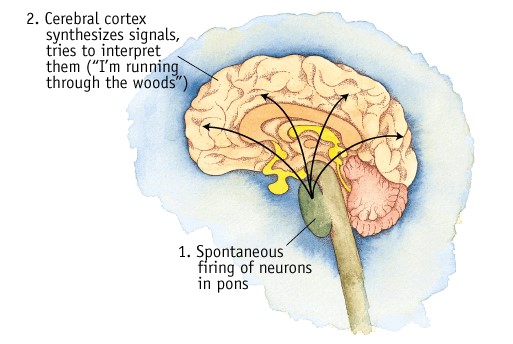
- Activation: During REM sleep, circuits in the brainstem, specifically in a region called the pons, become active. They fire off a volley of random electrical signals up to the higher, more sophisticated parts of the brain (the forebrain or cerebral cortex). These signals are not carrying meaningful information from the outside world; they are essentially neural static.
- Synthesis: The cerebral cortex, which is the "thinking" part of your brain, is bombarded with these chaotic signals. Its job is to interpret information and find patterns. So, it does its best to weave these random signals into a coherent narrative, pulling from your existing memories, emotions, and experiences to create a story. This story is the dream.
To start, let's watch two short videos that provide a clear and concise overview of this core concept.
Dreaming: Freud, Activation-Synthesis, & Information Processing (Intro Psych Tutorial #107)
This first video from PsychExamReview gives a very direct explanation of the two-step process and why it accounts for the bizarre nature of dreams.
Please watch from 03:33 to 05:15. Focus on the distinction between the 'activation' and 'synthesis' steps.
Dream theories Freud, activation synthesis hypothesis | MCAT | Khan Academy
Next, this video from Khan Academy reinforces the idea, using helpful visuals to show where the signals originate and how the cortex interprets them.
Please watch from 02:13 to 04:07. Pay attention to the role of the brainstem and the frontal cortex in this process.
The diagram below provides a simple visual summary of the entire process.
The Scientific Evidence: "Unromancing the Dream"
Hobson and McCarley didn't just propose this idea in a vacuum. It was based on a wealth of neurophysiological evidence from animal studies and observations of human sleep. Their theory was revolutionary because it was grounded in the physical brain, aligning with your interest in the scientific experiments behind our understanding of sleep.
The following article, 'Unromancing the Dream,' provides an accessible summary of the key evidence and arguments from Hobson and McCarley's original 1977 paper. It explains how they built their case against older psychological theories.
Please read the first four pages of the document, up to the section titled 'IMPLICATIONS AND RECENT APPLICATIONS.' Focus on these key points: The main proposition: The idea that REM sleep causes dreaming, not the other way around. The experimental evidence: Note the findings from research on cats and the identification of the pontine brain stem as the 'dream state generator.' Physiological explanations for dream characteristics: Understand how the theory explains why dreams are bizarre and why they are so easily forgotten.
As you read, you uncovered the key evidence that supports the hypothesis:
- A Pre-Programmed Clock: REM sleep occurs at regular, predictable intervals every night. This suggests it's controlled by a biological clock, not by the random psychological needs or unconscious wishes of the dreamer.
- The Dream Generator: Animal studies allowed researchers to pinpoint the source of REM sleep activation to the pontine brain stem. Stimulating this area triggered REM sleep, while inhibiting it prevented it. This provided a physical location for the "activation" process.
- Motor Inhibition: During REM sleep, your voluntary muscles are paralyzed by a signal originating in the brainstem. This explains why you don't act out your dreams. However, the brain's motor cortex is still active, which could account for dream sensations like running in slow motion or being unable to move.
- A New Reason for Forgetting: Rather than Freud's idea of "repression," this theory proposes a simple chemical reason for poor dream recall. During REM sleep, the brain's chemistry is not optimized for converting short-term experiences into long-term memories.
Test your understanding!
According to the original activation-synthesis hypothesis, why are dreams often illogical and bizarre?
Show answer
Because the raw input for the dream—the neural signals from the brainstem—is completely random and chaotic. The higher brain (cortex) is essentially "making the best of a bad job" by trying to force these meaningless signals into a semi-coherent narrative. The resulting story is often strange and disjointed because the underlying data makes no logical sense.
Evolution of the Theory: The AIM Model
Science is a process of refinement. The original activation-synthesis hypothesis has been updated by Hobson himself to reflect new discoveries. The modern version is known as the AIM Model, which provides a more nuanced way to map conscious states.
AIM is a three-dimensional model that describes the state of your brain at any given moment:
- A (Activation): The overall level of neural activity or energy in the brain. This is high during waking and also high during REM sleep, but low during NREM sleep.
- I (Input-Output Gating): Whether the brain is processing information from the outside world (external input) and sending commands to the body (motor output). The "gate" is open when you're awake (high I) but closed when you're dreaming (low I).
- M (Modulation): The specific mix of neurotransmitters in the brain. This is the chemical ratio of aminergic neurotransmitters (like serotonin and norepinephrine, dominant in waking) versus cholinergic neurotransmitters (like acetylcholine, dominant in REM sleep).
Using this model, we can map different states of consciousness:
- Waking: High A, High I, High M (Aminergic)
- NREM Sleep: Low A, Low-ish I, Mixed M
- REM Sleep (Dreaming): High A, Low I, Low M (Cholinergic)
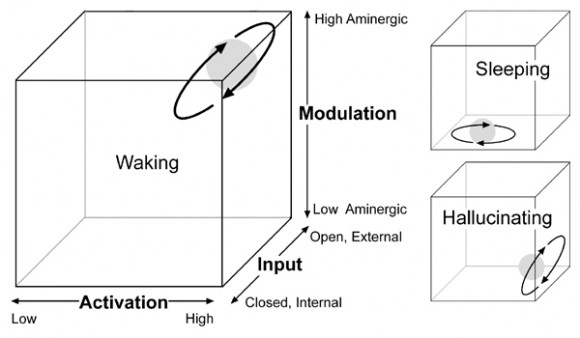
This model helps explain that dreaming isn't just an "on/off" phenomenon but a specific state within a larger "state-space" of consciousness, defined by measurable brain properties.
So, Are Dreams Meaningless?
A common takeaway from the activation-synthesis hypothesis is that dreams are meaningless, random noise. However, this is an oversimplification, and even Hobson himself rejected this conclusion.
While the activation (the initial spark) is random, the synthesis is anything but.
Think of it this way: Imagine giving a painter a random collection of paint splatters on a canvas. The splatters themselves are meaningless. But the image the painter creates from those splatters will be deeply personal, drawing on their memories, skills, emotions, and current preoccupations.
In the same way, when your brain synthesizes a story from random neural signals, the narrative it constructs is a reflection of you. The themes, people, and emotions that emerge are drawn from your own mental landscape. Therefore, while the dream may not have a hidden symbolic message as Freud suggested, analyzing its content can still reveal deep insights into your current concerns, fears, and hopes.
As Hobson stated, the process reveals "our current preoccupations, our remote memories, our feelings, and our beliefs. That's all."
Conclusion
In this lesson, we have taken a deep dive into one of the most important neurobiological theories of dreaming.
Key Takeaways:
- The Activation-Synthesis Hypothesis posits that dreams are the result of the cerebral cortex trying to make sense of random electrical signals originating in the brainstem during REM sleep.
- The process involves two steps: random neural Activation from the pons and the brain's creative Synthesis of these signals into a narrative.
- This theory is supported by evidence of a biological "clock" for REM sleep and the identification of the pontine brainstem as the "dream state generator." It provides physiological explanations for why dreams are bizarre and easily forgotten.
- The theory has evolved into the AIM Model, which maps conscious states based on Activation, Input-Output Gating, and chemical Modulation.
- While the trigger for dreams may be random, the synthesis process is highly personal, meaning that dream content can still offer valuable insights into our own minds.
Preview of the Next Lesson:
The activation-synthesis hypothesis gives us a powerful mechanistic explanation for how dreams are generated. But what if dreams also have a functional purpose? In our next lesson, we will explore the Threat Simulation Theory, which argues that dreaming evolved as a vital survival mechanism to help us rehearse for and cope with real-world dangers.