
Welcome back! In our last lesson, we established a scientific framework for comparing sleep and meditation. We learned that while they are both restorative, they are fundamentally different states: sleep is an unconscious process for biological maintenance, while meditation is a conscious practice for mental and physiological regulation.
Now, we shift our perspective from the "what" of science to the "why" of philosophy. This lesson addresses a question that is central to your spiritual goal: What is the nature of consciousness in sleep versus meditation from a Jain philosophical perspective? Understanding this distinction is the key to appreciating why Jain thinkers, including Acharya Mahapragya, place such a profound emphasis on conscious awareness over passive rest.
1. The Jain Definition of Consciousness: Beyond Mere Awareness
In everyday language, we often use "consciousness" to mean being awake and aware. From a Jain perspective, this is only a partial understanding. The first and most critical point is that in Jainism, consciousness, known as chetana (चेतना), is not a temporary state but the eternal, intrinsic, and defining attribute of the soul, or jiva (जीव).
To understand this foundational concept, let's explore a short but crucial excerpt from the provided reading.
Philosophy of Mind: A Jain Perspective
This text, from the paper 'Philosophy of Mind: A Jain Perspective', clarifies the fundamental Jain view of consciousness ('chetana') as an inseparable property of the soul, which exists even in states where awareness is absent.
Please read the final section of the paper, titled 'A Jain Theory of Consciousness'. You can find this by searching for the heading near the end of the document. Focus on the distinction between 'chetana' and the Western philosophical concept of consciousness as 'awareness'. Pay close attention to the statement that 'Chetana, being property of the soul, is always present and manifests explicitly in the conscious state and implicitly in the unconscious or coma state.'
As the reading highlights, chetana is the very essence of life. It doesn't disappear when you sleep or are in a coma; it is always present. What changes is its manifestation, which is called upayoga (उपयोग).
Therefore, the difference between sleep and meditation isn't about the presence or absence of consciousness, but about the quality and clarity of its manifestation.
- Chetana (Consciousness): The soul's inherent, ever-present quality of being sentient.
- Upayoga (Manifestation): The active expression of consciousness, such as knowing, perceiving, and feeling.
With this framework, we can now analyze what happens to the manifestation of consciousness in both sleep and meditation.
2. Consciousness During Sleep: Obscured by Karma
From a Jain standpoint, sleep is not merely a biological necessity; it is a state directly caused by the influence of karma. Specifically, it is triggered by the rise of perception-obscuring karma (Darshanavaraniya karma), which has five subtypes related to sleep.
When this karma becomes active, the soul's ability to perceive clearly is clouded. Think of it like a dense fog rolling in, obscuring your vision. The landscape (your true conscious nature) is still there, but your ability to see it is severely limited.
During this state:
- Consciousness is Passive and Distorted: Your upayoga is minimal. The soul does not acquire new, clear knowledge. Instead, the mind is passively driven by stored memories, latent instincts, and the coloring of our psycho-spiritual dispositions (leshyas).
- Karmic Accumulation Continues: Because the mind is not guided by awareness, it remains susceptible to passions like anger, ego, and greed, even in dreams. This lack of conscious control means that mental and emotional activities during sleep can lead to the binding of new karma (bandha).
To delve deeper into this model of the mind, let's examine how Jain thought categorizes our mental states.
Soul-Mind-Body Interaction Model of Human Performance
The paper 'Soul-Mind-Body Interaction Model of Human Performance' provides a detailed Jain framework for the mind. This section distinguishes between the conscious, subconscious, and unconscious mind, which is key to understanding what is 'online' during sleep.
Please read the section titled 'Conscious, Subconscious and Unconscious Mind'. You can find this about two-thirds of the way through the document. Focus on the definitions of: Conscious mind (Chetan manah): What we are actively aware of. Unconscious mind (Achetan manah): The instincts, urges, and past-life memories that influence us without our awareness. Note how this part of the mind is determinant of our irrational behavior.
Based on this reading, we can say that during conventional sleep, the Conscious Mind is offline. We are primarily under the influence of the Unconscious Mind, a repository of deep-seated karmic imprints and instincts. This makes sleep a spiritually precarious state, where we are not in control and are subject to the automatic play of our karmic baggage.
3. Consciousness During Meditation: Cultivated and Purified
Meditation, particularly Preksha Dhyaan, represents the polar opposite of the sleep state. It is the active, deliberate effort—purusharth (पुरुषार्थ)—to cut through the karmic fog and allow consciousness to manifest with clarity.
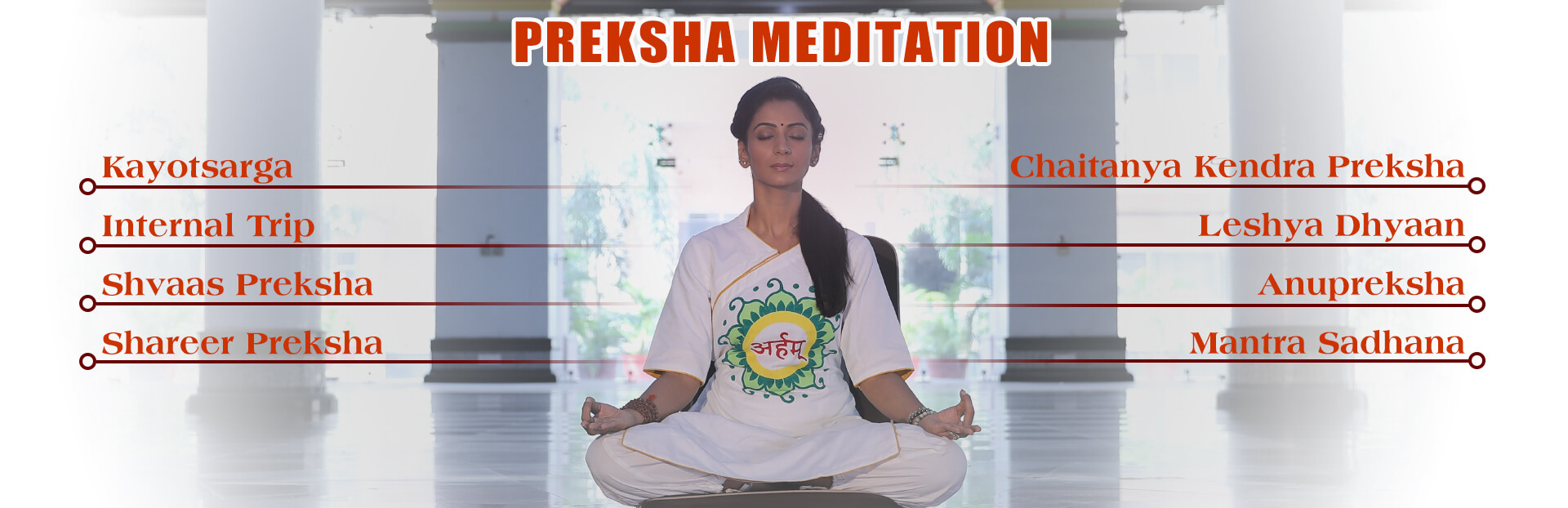
During meditation:
- Consciousness is Active and Clear: Your upayoga is intentionally directed. You practice being a detached observer (preksha) of your own mental and physical processes. You are not trying to stop thoughts or feelings, but to perceive them without attachment or aversion.
- Karmic Accumulation is Halted: By maintaining a state of equanimity and awareness, you break the cycle of reaction. When a passion (kashaya) arises, you observe it instead of identifying with it. This prevents the binding of new karma. Furthermore, this state of purified consciousness creates the conditions for the shedding of old karma (nirjara).
In the framework we just read, meditation is an exercise in empowering the Conscious Mind (Chetan manah). It is the practice of wresting control away from the automatic, unconscious drivers of our behavior and placing it in the hands of our discerning, aware self.
Test your understanding!
During a dream, you feel a strong surge of anger toward someone. From a Jain perspective, why might this experience lead to the binding of karma? How would the experience of a similar surge of anger during a meditation session be different?
Show answer
In the dream, your consciousness is obscured and passive. You lack the awareness to observe the anger with detachment. You identify with the anger, and this emotional reaction (bhava) becomes the basis for new karmic bondage.
During meditation, the goal is to be a detached observer. When the surge of anger arises, you would notice it as a mental event ("There is anger") without becoming the anger itself. By perceiving it with equanimity, you do not react and therefore do not bind new karma. This conscious observation helps purify the underlying disposition that caused the anger to arise.
4. A Comparative Summary
Let's summarize the profound philosophical differences between the nature of consciousness in sleep and meditation.
| Feature | Consciousness in Sleep | Consciousness in Meditation |
|---|---|---|
| Primary Cause | Rise of perception-obscuring karma. | Deliberate effort (purusharth) to achieve clarity. |
| State of Consciousness (Upayoga) | Obscured, passive, distorted, minimal manifestation. | Clear, active, purified, heightened manifestation. |
| Role of the Mind | Dominated by unconscious instincts and karmic imprints. | Guided by conscious awareness and detachment. |
| Karmic Implication | High potential for new karmic bondage (bandha). | Halting of new bondage; facilitates shedding of old karma (nirjara). |
| Spiritual Value | Biologically necessary but spiritually passive or even negative. | A primary and powerful tool for spiritual purification and liberation. |
Conclusion
In this lesson, we have moved beyond the scientific view to the Jain philosophical understanding of consciousness in sleep and meditation. This perspective reveals why the distinction between conscious and unconscious rest is not trivial—it is the difference between being passively subject to karma and actively working toward liberation.
Key Takeaways:
- In Jainism, consciousness (chetana) is an eternal property of the soul (jiva), but its manifestation (upayoga) can be obscured by karma.
- Sleep is a state where consciousness is obscured and passive. The mind is driven by unconscious karmic forces, making it a state where new karma can be bound.
- Meditation is the practice of actively purifying and clarifying the manifestation of consciousness. It is a state of aware observation that halts the binding of new karma and promotes spiritual progress.
- Therefore, from a spiritual standpoint, meditation is fundamentally superior to sleep because it transforms rest from a passive, risky state into an active, purifying practice.
Preview of the Next Lesson:
We have now compared sleep and meditation through both a scientific lens (what they do) and a philosophical lens (what they mean). In the next lesson, we will bridge these two worlds by exploring the subjective experience. We will describe the key phenomenological differences between being in a sleep state and a meditative state—that is, what it actually feels like to be in each one, connecting the abstract principles to your personal practice.