
Welcome back. In our last lesson, we explored the profound philosophical differences between sleep and meditation from a Jain perspective. We established that while sleep is a state of obscured, passive consciousness driven by karma, meditation is an active, purifying practice that empowers the conscious mind.
Today, we will build on that foundation by exploring the experiential dimension of these states. The goal of this lesson is to describe the key phenomenological differences between being in a sleep state and a meditative state. "Phenomenology" is simply the study of subjective experience—in other words, we're going to explore what it actually feels like to be in each state.
Understanding this difference in subjective quality is a vital step toward your goal of integrating conscious awareness into periods of rest.
The Core Experiential Distinction
Before we dive into the details, let's start with a simple visual overview. The following infographic captures the high-level differences between meditation and sleep from a modern, secular viewpoint.
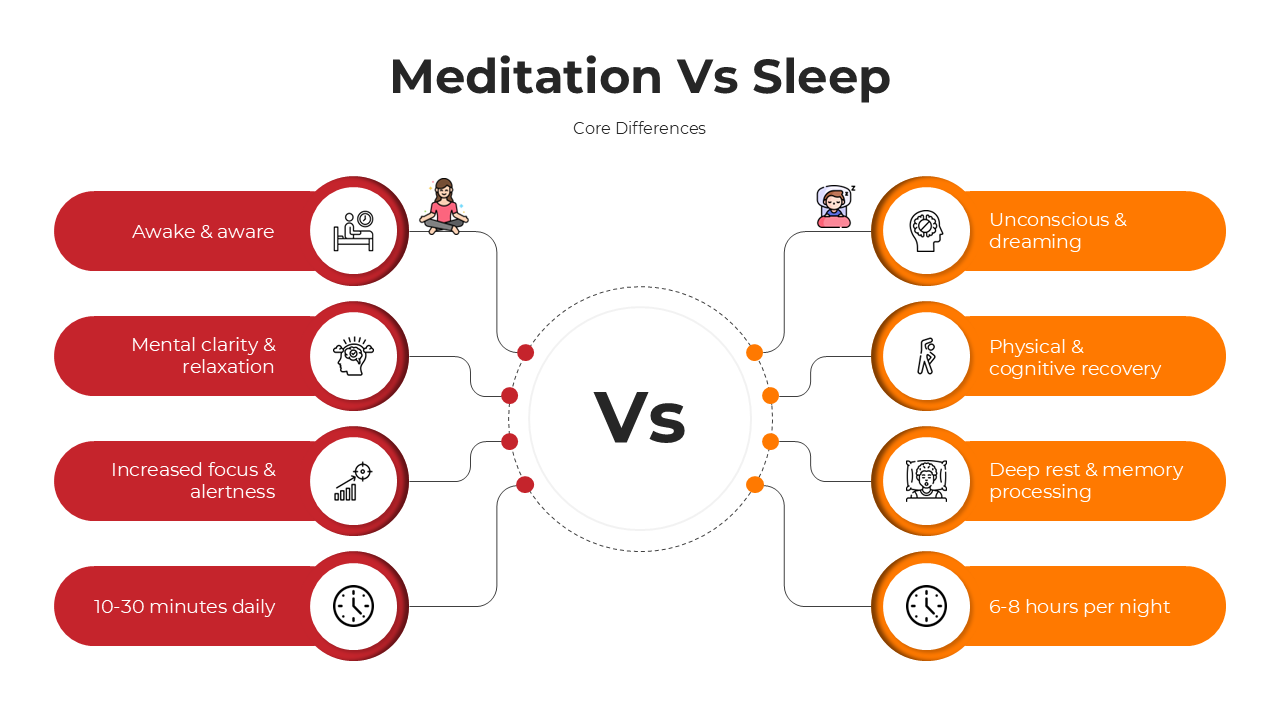
As you can see, the central difference revolves around awareness. Meditation is defined by its presence; sleep is defined by its absence. Let's unpack what this means for the texture of your inner world in each state.
1. The Phenomenology of a Meditative State: Conscious Rest
To understand the feeling of a meditative state, we will focus on Kayotsarga (कायोटसर्ग), or "total relaxation with self-awareness." This is a foundational practice in Preksha Dhyaan and a perfect example of what Acharya Mahapragya calls "conscious rest."
The following reading provides a scientific framing for Kayotsarga and explicitly compares its effects to sleep.
4.7. Modern Scientific Elements
This text, 'Modern Scientific Elements' from an essay on Preksha Meditation, discusses how Acharya Mahapragya integrated scientific concepts into meditation. It provides a detailed description of Kayotsarga and its benefits.
Please read the section titled 'Kāyotsarga'. You can find it about halfway through the text. Focus on the description of the practice and its comparison to both Western relaxation techniques and sleep. Pay special attention to the line defining relaxation as 'Shutting off the current (nerve impulses) by conscious voluntary action' and the claim that 'half an hour of kāyotsarga equals to the benefits of 3 hours of sleep.'
Based on this text and the principles of Preksha Dhyaan, we can describe the phenomenology of Kayotsarga as follows:
- Awareness: Your awareness is present, stable, and directed. You are not unconscious; you are an active, detached observer (preksha). You systematically travel your consciousness through your body, perceiving each part without judgment.
- Agency & Control: You are in full control. The relaxation is a "conscious voluntary action." You are intentionally and willfully letting go of physical tension. This is the opposite of the involuntary loss of muscle tone in sleep.
- Sense of Self: Your sense of self is that of a witness. There is a clear distinction between "you" (the observer) and "the body" (the object of observation). This practice is a direct exercise in experiencing the Jain concept of the soul (jiva) as separate from the physical body.
- Mental Activity: The mind is intentionally quieted. While thoughts may arise, the practice is to let them pass without engagement, maintaining focus on the perception of the body. The goal is a state of mental stillness alongside physical relaxation.
- Sensory Experience: You are perceiving real sensations from your body—tension, relaxation, warmth, coolness—but with an attitude of equanimity. You are not reacting to them, merely noting their presence.
In summary, the meditative state of Kayotsarga is an experience of profound rest where consciousness remains online, active, and in control. It feels like being a silent watchman in a completely still house.
2. The Phenomenology of Sleep: Unconscious Rest (and its Fringes)
Characterizing the experience of sleep is more complex, because for most of it, we are by definition not experiencing anything consciously. However, to make a meaningful comparison with meditation, we can look at the fringes of sleep where minimal consciousness can occur—states like lucid dreamless sleep, sometimes called "objectless awareness."
Recent scientific research has begun to systematically study what these states actually feel like. Let's explore a fascinating paper that interviewed people about their experience of a "nothingness phase" during sleep.
Nothingness Is All There Is: An Exploration of Objectless ...
The following is not a video but an in-depth scientific article titled 'Nothingness Is All There Is: An Exploration of Objectless ...'. This paper provides one of the most detailed phenomenological breakdowns of what it feels like to be in a state of minimal consciousness during sleep. It's a technical resource, so we will focus only on the key findings that describe the subjective experience.
You don't need to read the entire paper. Instead, I'll guide you through the key tables and concepts from the 'Results' section. Sense of Self: Skim the section titled 'Sense of Self' and look at Table 2. Notice how the self is described as 'bodiless awareness' or a 'sphere of light'. It's a minimal, often disembodied sense of self. Sensations: Skim the section on 'Sensations' and look at Table 7. Note the prevalence of 'Non-modal sensations'—sensations that aren't tied to a specific sense, like a 'tapping' felt inside the chest or a 'buzzing' sound that isn't heard. Also, note the common 'Absence' of normal bodily sensations. Visuals & Agency: Briefly look at Table 8 ('Visual Experience') to see how this state is characterized by an absence of imagery (blackness/whiteness) or simple flashes of light. Also, look at Table 5 ('Agency and Attitude') and see how 'Lost control' is a common theme, even when there's an intention to remain aware. Awareness: Finally, read the short section at the end of the Discussion titled 'Awareness of One’s Awareness'. Focus on the participant's quote: '...there's an awareness. But there's nothing to be aware of...'.
This research gives us a vocabulary to describe the phenomenology of these minimal sleep-consciousness states:
- Awareness: The awareness is described as "wide, unfocused" or an "awareness of nothing." It's passive and lacks a clear object, unlike the directed focus in meditation. It's an awareness that you are, but not necessarily an awareness of anything specific.
- Agency & Control: There is a pronounced feeling of passivity or lost control. Even if one enters this state with an intention (e.g., from a lucid dream), the ability to direct the experience is minimal. One is a recipient of the experience, not its director.
- Sense of Self: The self is often described as minimal, distorted, or bodiless. It may feel like a point of view with no form, or it might merge with the experience itself (e.g., "I was the void"). The clear observer/observed distinction of meditation is absent.
- Mental Activity: Thoughts are often absent or not attended to. It is a state of mental emptiness, but an unintentional one.
- Sensory Experience: Normal sensory input is gone. The experience is dominated by an absence of vision and bodily feeling, sometimes replaced by strange "non-modal" sensations like buzzing, pulsing, or vibrations that don't have a clear sensory origin.
In short, even in the most "conscious" forms of deep sleep, the experience is passive, disembodied, and uncontrolled. It feels less like a watchman and more like being a floating mote of dust in an empty, dark, and silent room.
Test your understanding!
Imagine you are practicing Kayotsarga and you feel a pain in your knee. Now, imagine you are in a "nothingness" sleep state and you experience a strange pulsing sensation in your chest. Based on this lesson, what is the key phenomenological difference in how you would experience your "self" in relation to these two sensations?
Show answer
In Kayotsarga, your sense of self is that of a detached observer. You would perceive the pain in your knee as an object of your awareness: "There is a sensation of pain in the knee." The "I" who is observing is distinct from the sensation being observed.
In the "nothingness" sleep state, the sense of self is minimal and often merged with the experience. You might not experience the pulsing as an external object, but rather the pulsing is the experience. The distinction between the "I" and the sensation is blurred or absent. The experience is happening to you or as you, rather than you observing it.
3. A Comparative Summary of Experience
Let's bring these two descriptions together into a direct comparison. This table summarizes the key phenomenological—or experiential—differences.
| Phenomenological Dimension | Meditative State (e.g., Kayotsarga) | Sleep State (e.g., "Nothingness Phase") |
|---|---|---|
| Awareness | Active & Directed: A stable, focused observer. | Passive & Unfocused: A minimal, objectless awareness. |
| Agency | Voluntary & Controlled: You are intentionally directing the state. | Involuntary & Passive: The state happens to you; control is lost. |
| Sense of Self | Witness/Observer: Clear distinction between self and body/mind. | Minimal/Bodiless: Self is distorted, disembodied, or merged with the experience. |
| Sensory Experience | Perception with Equanimity: Observing real bodily sensations without reaction. | Absence & Distortion: Lack of normal senses, replaced by non-modal or simple sensations (light, sound). |
| Mental Activity | Intentionally Quieted: Thoughts are observed and allowed to pass. | Unintentionally Empty: A state of cognitive emptiness, not quietness. |
This table makes the distinction clear. While both states can involve a lack of thought and deep physical rest, the quality and nature of the consciousness within them are fundamentally different. One is a state of masterful, intentional observation; the other is a state of passive, minimal being.
Conclusion
In this lesson, we have moved from the philosophical to the experiential. We've described what it feels like to be in a meditative state versus a sleep state, highlighting the profound differences in awareness, agency, and the sense of self.
Key Takeaways:
- Meditation feels active: It is an experience of being a present, stable, and intentional observer of your own inner world. You are in control.
- Sleep feels passive: Even in its most lucid, content-less forms, it is an experience of minimal, bodiless being where you have little to no agency. The experience happens to you.
- The meditative state cultivates a clear sense of a witness self, distinct from the objects of perception, aligning with the Jain goal of realizing the soul's true nature.
- The sleep state involves a dissolved or distorted sense of self, reflecting the obscured nature of consciousness under the influence of karma.
Preview of the Next Lesson:
We have now established that sleep and meditation are different scientifically, philosophically, and phenomenologically. The next logical question is: why does this matter for your spiritual practice? In our next lesson, we will explore Acharya Mahapragya's teaching on why meditation is superior to sleep for spiritual progress, connecting these experiential differences directly to the ultimate goal of purifying the mind and shedding karma.