
Hello! Welcome to the first lesson of our new module, "Sleep and Meditation: A Comparative Analysis."
In the previous module, we delved deep into the philosophy and practice of Preksha Dhyaan, culminating in an understanding of how it aims to transform your deepest mental dispositions (adhyavasaya). You now have a framework for understanding how conscious awareness can purify the mind from a Jain perspective.
Now, we begin the great synthesis that lies at the heart of your goal for this course. We will start by placing sleep and meditation side-by-side and examining them through the lens of modern science. Our learning outcome for this lesson is to: Compare the purpose and function of sleep versus meditation from a scientific perspective. We will investigate what these states do for the brain and body, establishing a scientific foundation that will be indispensable as we later explore the possibility of integrating conscious meditative practices into the state of rest.
1. The Language of the Brain: Understanding Brainwaves
To compare two different states of consciousness like sleep and meditation, scientists need a common, measurable language. One of the most powerful tools they use is electroencephalography (EEG), which measures the brain's electrical activity in the form of brainwaves.
Brainwaves, or neural oscillations, are the synchronized, rhythmic firing of large groups of neurons. They are categorized by their frequency (how fast they oscillate) and are associated with different mental states.
To get a clear overview of what brainwaves are and the main types scientists study, please watch the following short video.
What Do Different Brainwaves Mean?
This video from SciShow Psych, titled 'What Do Different Brainwaves Mean?', provides an excellent introduction to the concept of brainwaves, how they are measured, and the five main types associated with different states of consciousness.
Please watch from the beginning until the timestamp 02:05. Focus on: What brainwaves represent (synchronized neural activity). The names of the five main wave types: Delta, Theta, Alpha, Beta, and Gamma. The general state each wave is associated with (e.g., deep sleep, relaxation, active thinking).
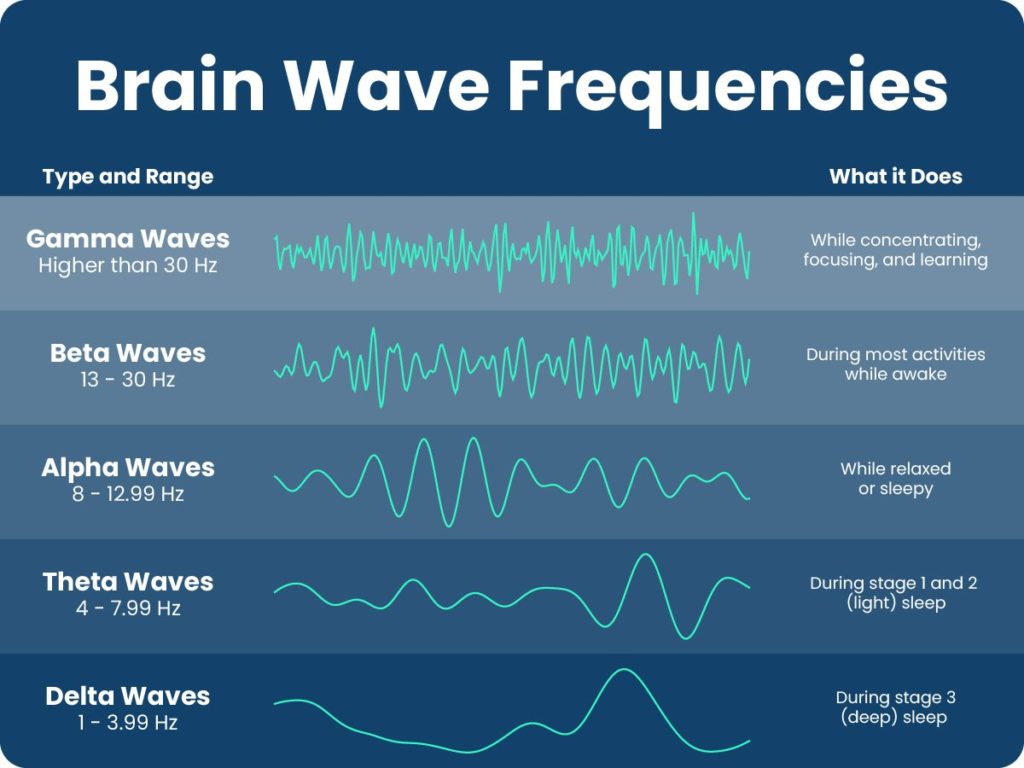
To summarize the key points from the video, brainwaves are generally categorized as follows:
- Gamma (>35 Hz): Intense focus, concentration, learning.
- Beta (12-35 Hz): Awake, alert, active thinking, problem-solving.
- Alpha (8-12 Hz): Awake but relaxed, calm, closing your eyes.
- Theta (4-8 Hz): Light sleep, deep relaxation, meditation, daydreaming.
- Delta (0.5-4 Hz): Deep, dreamless sleep.
The image below provides a great visual summary of these brainwave types and the states they correspond to. Notice the clear difference in frequency and the states associated with each wave.
With this "language" of brainwaves, we can now more precisely compare the neurophysiology of sleep and meditation.
2. The Scientific Purpose of Sleep: An Essential Unconscious State
As we covered in our third module, "Functions and Benefits of Sleep," sleep is not merely a passive period of inactivity. It is a fundamental, unconscious biological process that is absolutely essential for our survival and well-being. While you sleep, your brain and body are hard at work performing critical maintenance tasks.
Let's briefly recap the core functions of sleep:
- Brain Waste Clearance: During deep sleep (characterized by Delta waves), the brain's glymphatic system becomes highly active, flushing out metabolic byproducts and toxins, including proteins like beta-amyloid, which are linked to neurodegenerative diseases.
- Memory Consolidation: Sleep helps strengthen, restructure, and integrate new memories, moving them from short-term to long-term storage.
- Physical Restoration: The body engages in cellular repair, muscle growth, and protein synthesis. Key hormones like Growth Hormone are primarily released during deep sleep.
- Hormonal and Metabolic Regulation: Sleep regulates hormones that control appetite (ghrelin and leptin), stress (cortisol), and overall metabolic health.
- Emotional Regulation: REM sleep, in particular, helps process emotional experiences, stripping away the intense feeling from memories, which helps you cope with difficult events.
In essence, sleep is a non-negotiable state of unconscious restoration. Your conscious mind is offline, allowing the brain and body to perform these vital housekeeping functions.
3. The Scientific Purpose of Meditation: Conscious Deep Rest
Now, let's turn to meditation. From a scientific perspective, many meditative practices can be categorized under the modern term Non-Sleep Deep Rest (NSDR). This refers to any practice that intentionally guides you into a state of profound relaxation while you remain conscious and aware.
The techniques you've practiced, such as Kayotsarga (relaxation with self-awareness) and Shwas Preksha (breath perception), are perfect examples of practices that induce this state.
The following article provides a comprehensive overview of NSDR, its benefits, and how it compares to sleep.
Non-Sleep Deep Rest (NSDR): Exploring a World Beyond ...
This article from PositivePsychology.com, 'Non-Sleep Deep Rest (NSDR)', clearly defines this state, outlines its scientifically-backed benefits, and directly addresses the question of whether it can replace sleep.
Please read the following sections: 'What Is Non-Sleep Deep Rest (NSDR)?' - Note the key distinctions from sleep (active vs. passive, conscious vs. unconscious) and the different brainwaves involved (Alpha/Theta vs. Delta). 'A Note About Yoga Nidra' - This helps contextualize NSDR as a broader, secular term for practices like Yoga Nidra or, in our case, Preksha Dhyaan. 'Research and Non-Sleep Deep Rest Studies' and '5 Benefits of NSDR' - Focus on the functions of meditation: stress reduction, cognitive enhancement, and physiological benefits. 'Frequently Asked Questions' - Pay special attention to the question, 'Can non-sleep deep rest replace sleep?'.
As the article explains, meditation or NSDR is an active, conscious process. The brain is dominated by Alpha and Theta waves, indicating a state of wakeful relaxation, not the deep unconsciousness of Delta-wave sleep.
The primary functions of this state include:
- Stress Reduction: Actively downregulates the sympathetic (fight-or-flight) nervous system and reduces levels of the stress hormone cortisol.
- Enhanced Cognitive Function: Improves attention, focus, and working memory.
- Increased Psychological Well-being: Alleviates symptoms of anxiety and depression.
- Physiological Regulation: Can lower blood pressure and heart rate.
The crucial takeaway here, as stated in the article, is that NSDR is not a replacement for sleep. It is a complementary practice that offers its own unique set of benefits, primarily centered on conscious mental and physiological regulation.
Test your understanding!
Imagine you are feeling mentally exhausted and unfocused after a long morning of work. Based on their primary functions, would a 20-minute nap or a 20-minute meditation session be more appropriate? What would be the key difference in the restorative experience?
Show answer
A nap would involve entering light sleep (Theta waves) and potentially deep sleep (Delta waves), helping with some level of memory consolidation and physical rest. You would emerge from an unconscious state.
A 20-minute meditation session (NSDR) would keep you conscious while guiding you into a state of deep relaxation (Alpha and Theta waves). Its primary benefit would be to reduce mental fatigue and stress, lower cortisol, and restore focus and mental clarity.
While both can feel refreshing, the nap is geared more toward unconscious physiological restoration, while the meditation is a tool for conscious mental restoration and stress reduction. In this scenario of mental fog, meditation would be particularly effective at clearing the mind and improving focus for the afternoon.
4. An Overlap in Function: Brain Cleaning During Meditation
While sleep and meditation are distinct states with different primary functions, recent science has uncovered a fascinating area of overlap. One of the most critical functions of deep sleep is the clearing of waste from the brain via the glymphatic system. Remarkably, studies now suggest that meditation may be able to contribute to this same process.
A recent study provides compelling evidence for this connection.
Study finds that meditation may help stimulate the brain's ...
This news article from Vanderbilt University Medical Center, 'Study finds that meditation may help stimulate the brain’s waste removal system...', details groundbreaking research showing a direct functional overlap between meditation and sleep.
Please read the full article. Focus on how focused-attention meditation was found to affect the circulation of cerebrospinal fluid (CSF), mirroring patterns seen during sleep. Note the important finding that this effect was tied specifically to the meditative state, not just changes in breathing.
This research is incredibly significant. It suggests that the conscious state of meditation can trigger a restorative physiological process—enhanced brain-cleaning—that was once thought to be exclusive to the unconscious state of sleep. This doesn't mean meditation can replace the full scope of glymphatic clearance that occurs over a whole night, but it does show that a meditative state can do more than just relax you; it can actively contribute to the brain's physical maintenance.
5. Comparing the States: A Summary
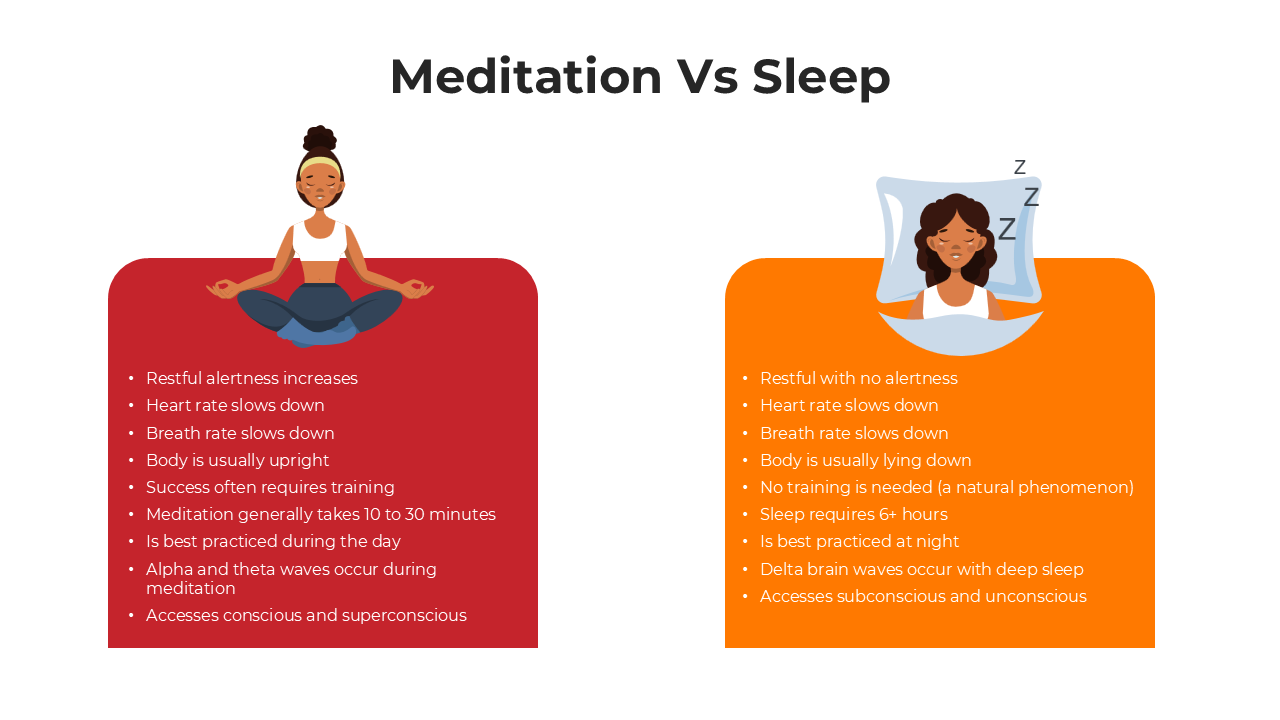
We have seen that sleep is an essential, unconscious state for deep physical and neurological restoration, while meditation is a conscious, active practice for mental and physiological regulation. While they are not interchangeable, they are complementary and share some similar restorative goals.
The image below provides a useful, high-level comparison of the two states.
Conclusion
In this lesson, we established a scientific basis for comparing sleep and meditation. We've seen that they are distinct states, identifiable by different brainwave patterns and serving different primary functions.
Key Takeaways:
- Sleep is an unconscious, passive state dominated by Delta waves in its deepest stages. Its non-negotiable functions include large-scale brain waste clearance, memory consolidation, and physical restoration.
- Meditation (as NSDR) is a conscious, active practice characterized by Alpha and Theta waves. Its primary functions are stress reduction, emotional regulation, and enhanced focus.
- Meditation is a complement to sleep, not a replacement. Each state provides unique and essential benefits.
- There is an exciting, scientifically-validated overlap in function. Focused-attention meditation can stimulate the brain's waste removal system (CSF flow), a key restorative process also central to deep sleep.
This scientific comparison is the first pillar of our investigation. We've defined what these states are and what they do for the body and brain.
Preview of the Next Lesson:
Now that we have this scientific foundation, we will build our second pillar: the philosophical perspective. In our next lesson, we will ask: What is the nature of consciousness in sleep versus meditation from a Jain philosophical perspective? We will explore why, for a spiritual practitioner, the distinction between conscious and unconscious rest is of paramount importance.