
Welcome back. Last lesson was about collecting like terms: only terms with the same variable part can be combined, and the sign belongs to the term. That skill now becomes the finishing step after you work with brackets.
This lesson covers two opposite moves:
- Expanding: multiplying a factor into a single bracket.
- Factorising: taking a common factor out of an expression and putting it in front of a bracket.
Allow about 40 minutes. By the end, you should be able to expand single brackets accurately, handle negative signs, factorise a linear expression using its highest common factor, and check your own answer.
Brackets mean multiplication
When a number or term is immediately next to a bracket, it multiplies every term inside the bracket. This is called the distributive law.
For example,
means three lots of the whole expression . So the must multiply both and :
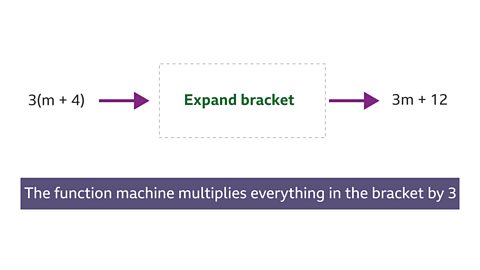
A common wrong answer is:
This misses the multiplication . A useful phrase to remember is: multiply every term, not just the first one.
Watch the opening of Cognito’s GCSE Maths – How to Expand Single Brackets. It first explains why brackets represent repeated groups, then gives the quicker multiplication method.
GCSE Maths - How to Expand Single Brackets (2026/27 exams)
Watch “GCSE Maths - How to Expand Single Brackets” by Cognito to connect the rule with repeated addition before using the faster exam method.
Watch the repeated groups explanation: three copies of the same bracket give the same result as distributing the 3. Then watch the quick method, focusing on how the outside factor is multiplied by each term inside the bracket.
The fast written method is:
- Identify the factor directly in front of the bracket.
- Multiply it by the first term inside.
- Multiply it by the next term inside.
- Write the results with their correct signs.
For instance,
gives two separate products:
and
Therefore,
The bracket has disappeared, but the value of the expression has not changed. These two expressions are equivalent.
Expand first, then simplify
Sometimes there are terms outside the bracket as well. They do not vanish or get multiplied unless they are directly attached to the bracket.
Consider:
Only the multiplies the bracket:
Now use the skill from the previous lesson: collect like terms.
So the simplified expression is:
The full working is:
Keep these stages separate in your written work:
- Expansion removes the bracket.
- Simplification collects like terms afterwards.
That separation protects marks. If you try to do both in one rushed jump, it is much easier to lose a sign.
The BBC Bitesize article Multiplying brackets provides a clear visual version of this method, including the important difference between a number multiplying a bracket and a plus or minus sign before one.
Multiplying brackets - KS3 Maths - BBC Bitesize
Read BBC Bitesize’s explanation to reinforce the “multiply every term” rule and to see how signs in front of a bracket work.
In the section “Expanding a single bracket”, read the core rule. Then, in “Examples”, follow Example 1, beginning with the calculation involving 5 and ending when the two equivalent expressions are stated; use the worked expansion to see each product separately. Still in “Examples”, read the addition-and-subtraction case beginning “If there is an addition or subtraction symbol between a term and a bracket”. Follow the sign explanation carefully. Focus on why a minus before a bracket acts like multiplying every term inside by -1.
Negative signs: the bracket affects every term
Negative signs are where many otherwise correct expansions go wrong.
If the outside factor is negative, use the normal sign rules:
- positive multiplied by negative gives negative
- negative multiplied by negative gives positive
For example:
The first product is:
The second product is:
So,
The final matters. The two negatives multiply to make a positive.
There is a closely related situation where a bracket has a plus or minus sign in front of it, rather than a number such as or .
With a plus:
the bracket is effectively multiplied by , so its signs stay the same:
With a minus:
the bracket is effectively multiplied by , so every sign inside changes:
and then:
Do not write
The final term must become , because subtracting a negative is adding.
A useful way to make this less mysterious is to show the hidden multiplier:
Factorising: reversing an expansion
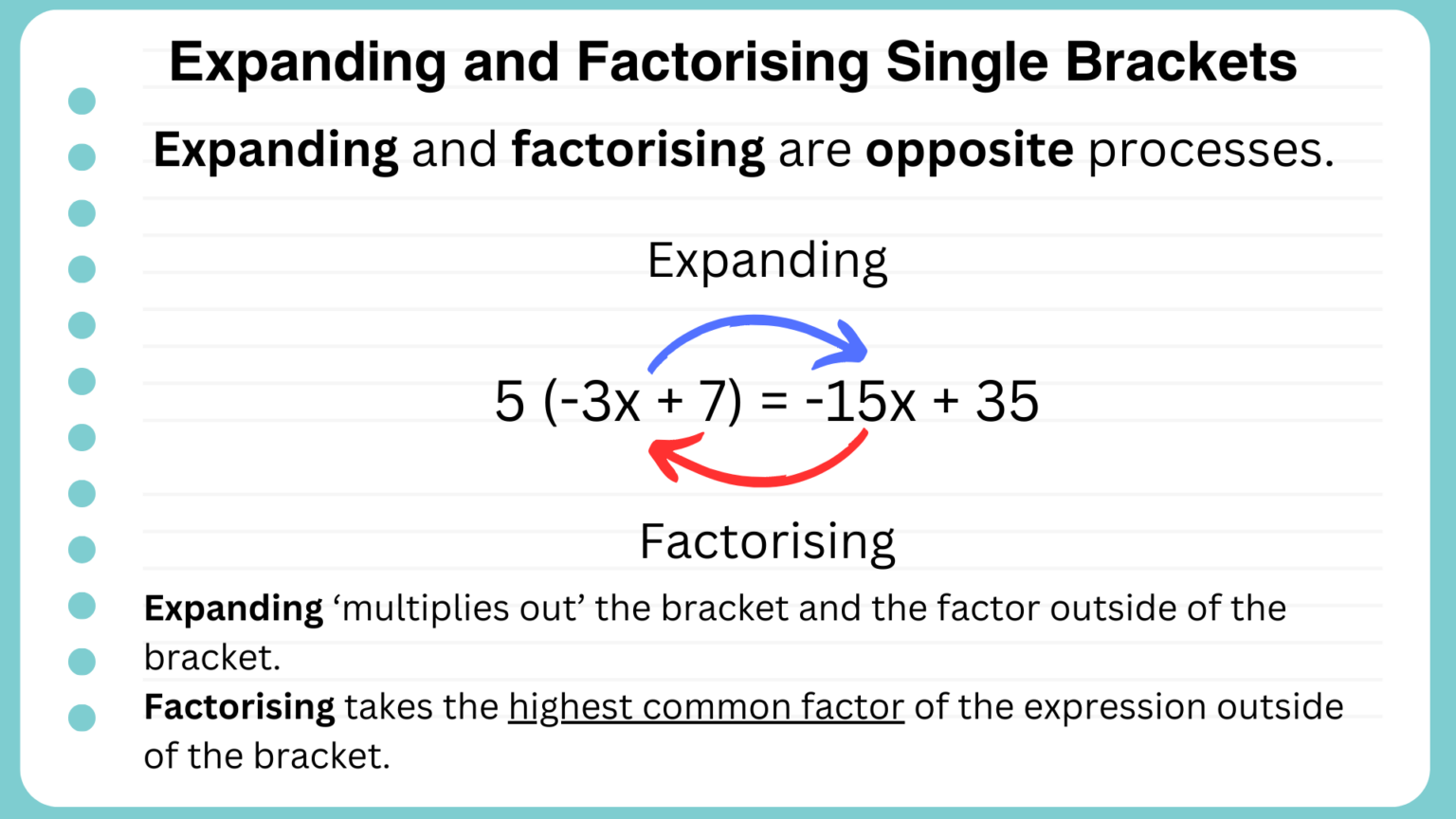
Factorising is the reverse of expanding. Instead of multiplying out a bracket, you find something every term has in common and take it outside a bracket.
For a linear expression such as
both terms are divisible by . The number is the highest common factor, or HCF, of the coefficients and .
Start by writing the HCF outside an empty bracket:
Then ask: “What must multiply by to make each original term?”
So:
You can immediately check it by expanding:
That returns you to the original expression, so the factorisation is correct.
Here is the same method with subtraction:
The HCF of and is . Divide each term by :
Therefore,
The negative sign stays with the . Check:
When factorising, choose the largest common factor unless the question tells you otherwise. Although this is true,
it is not fully factorised, because both terms inside the bracket still have a factor of . The cleaner final answer is:
If the coefficients have no common factor greater than , the expression cannot be factorised further using a whole-number HCF. For example, is already factorised in this sense.
A reliable exam routine
In a mock, first decide which direction the question wants.
| If you see... | Your move |
|---|---|
| A factor directly next to a bracket, such as | Expand: multiply the factor by every term inside. |
| An expression without brackets, such as | Factorise: find the HCF and divide every term by it. |
| Extra terms outside a bracket | Expand the bracket first, then collect like terms. |
| A minus before a bracket | Treat it as multiplication by : change every sign inside. |
Consider this complete example:
First expand the bracket:
Then collect like terms:
So:
That final answer can itself be factorised because and share a factor of :
All three expressions have the same value:
A fast check is to expand your factorised answer back out. A second check, if you are unsure about signs, is to substitute an easy number such as into both forms and make sure they match.
Key takeaways
- A number or term touching a bracket multiplies every term inside it.
- Expand by writing each multiplication separately before simplifying.
- A minus before a bracket changes the sign of every term inside.
- After expanding, collect like terms just as in the previous lesson.
- Factorising reverses expansion: take out the highest common factor, then divide each term by it to fill the bracket.
- Expanding your factorised answer is a quick and reliable check.
Next, you will use expansion in a more exam-style setting: solving linear equations with brackets and unknowns on both sides. The essential first step will be the one you have practised here—remove the brackets accurately before solving.
Can't find a good explanation? Sign up and we'll make it for you
Sign up