
Good to see you again. In the previous lesson, you expanded single brackets by multiplying every term inside and then collected like terms. Now we use those same skills to solve full equations—especially ones where appears on both sides of the equals sign.
Allow about 40 minutes. By the end, you should be able to expand brackets, simplify each side, get all the -terms onto one side without breaking the equation’s balance, and check your answer in the original equation.
An equation is a balance
An equals sign means the two sides have exactly the same value. Think of it as a balanced scale: if you do something to the left side, you must do the same thing to the right side.
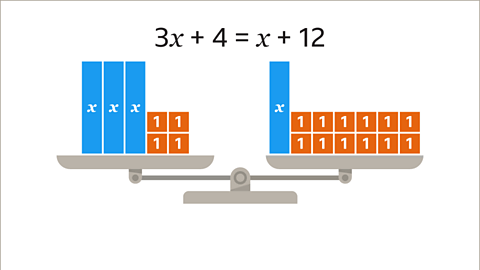
For the equation in the image,
we want on just one side. There is one on the right, so subtract from both sides:
Now remove the by subtracting from both sides:
Finally, divide both sides by :
The crucial idea is not “moving terms across and changing signs.” That shortcut can be useful later, but it causes mistakes if you do not understand it. What is really happening is that you are applying the same operation to both sides of a balanced equation.
The full routine: brackets first, then solve
When an equation has brackets and unknowns on both sides, use this order:
- Expand every bracket.
- Simplify each side by collecting like terms.
- Remove an -term from one side by adding or subtracting the same -term on both sides.
- Remove the remaining number term.
- Divide by the coefficient of .
- Check your answer in the original equation.
The first two steps come directly from the previous lesson. Only after the brackets are gone should you start solving.
Watch Maths Genie’s Solving equations with an unknown on both sides. The selected example combines the two skills: expanding brackets accurately, then eliminating an unknown term from one side.
Solving equations with an unknown on both sides
Maths Genie’s video shows the complete method on an equation with brackets and an unknown on both sides, including a result that is a fraction or decimal.
Watch the bracket example. Notice the order: expand both brackets first, remove the smaller variable term from both sides, then use inverse operations to isolate the variable.
Worked example: brackets on both sides
Solve:
1. Expand both brackets
On the left, multiply by both terms. On the right, multiply by both terms:
2. Simplify each side
The right side has two number terms:
At this point, the brackets have gone and each side is as simple as possible.
3. Put all -terms on one side
There is on the left and on the right. Subtract from both sides:
Choosing to subtract , the smaller positive -term, leaves a positive . This is usually the neatest choice.
4. Remove the number next to
Subtract from both sides:
5. Divide
6. Check in the original equation
Use :
Both sides match, so:
Checking is especially valuable when brackets and negative signs are involved. It can catch an expansion or sign error that otherwise looks convincing.
Why “remove the smaller -term” usually works
Suppose that, after expanding and simplifying, you have:
Subtracting from both sides gives:
This is usually easier than subtracting , which would give:
That second route is still mathematically correct, but it brings in negative coefficients unnecessarily.
So, when both -terms are positive, a good exam habit is:
Remove the -term with the smaller coefficient.
It is a convenience, not a law. When one -term is negative, you often need to add instead.
For example:
Expand first:
The right side has . To cancel it, add to both sides:
Then subtract :
Finally divide by :
Notice that adding is not random: it creates the zero pair
on the right-hand side.
The BBC Bitesize article gives a visual explanation of this balance idea and reinforces the strategy of eliminating an -term from both sides.
How to solve equations with unknowns on both sides - GCSE Maths Revision - BBC Bitesize
Read BBC Bitesize’s explanation of equations with brackets and unknowns on both sides. It connects expansion, inverse operations, and the idea that both sides of an equation must remain balanced.
Start in “Solving equations with brackets” and read from the opening explanation through the worked examples in that section. Then continue to “Solving equations with unknowns on both sides”, including the video transcript and the two GCSE exam-style examples. Focus on why the same operation is done to each side and why subtracting the lower x-term often keeps the working simpler.
A complete exam-style example
Solve:
Write one tidy line per algebra step. Do not try to expand, collect terms, and solve all at once.
Expand
Collect like terms on each side
Remove the smaller -term
Subtract from both sides:
Remove the number term
Add to both sides:
Divide by
Check
Substitute into the original equation:
So the answer is:
Errors that lose easy marks
Expanding only one term in a bracket
Incorrect:
Correct:
The multiplies both and .
Forgetting to simplify after expanding
For example:
must become:
then:
Do not treat as if it were already simplified.
Doing an operation to only one side
Incorrect:
This looks like disappeared from the left, but the operation has not been shown on both sides. Write it clearly:
Then simplify to get:
Checking the wrong equation
Your answer should be checked in the equation you were originally given, including its brackets. If you only check a simplified line, you might miss an early mistake in expansion.
A quick self-check before you finish
Before boxing an answer, scan your working:
- Have all brackets been expanded correctly?
- Have you collected like terms on each side?
- Did every added or subtracted term appear on both sides?
- Is alone in your final line?
- Does substituting your answer into the original equation make both sides equal?
If your final answer is a fraction or negative number, do not assume it is wrong. Equations can perfectly validly have answers such as:
or
The check tells you whether the value works.
Key takeaways
- Expand brackets before trying to isolate the unknown.
- Simplify each side separately by collecting like terms.
- Keep the equation balanced: whatever you add, subtract, multiply, or divide by on one side must also be done on the other.
- Usually, eliminating the smaller positive -term avoids unnecessary negative coefficients.
- If an -term is negative, add its positive opposite to both sides.
- Substitute your answer back into the original equation to check it.
Next, you will practise another powerful algebra skill: rearranging formulae to make a different variable the subject. The balance principle from this lesson will still be central—except the goal will be to leave a letter, rather than a number, on its own.
Can't find a good explanation? Sign up and we'll make it for you
Sign up