
Hello. This course starts with the algebra skills that unlock a large number of marks in a mock: simplifying expressions, working with brackets, solving equations, and rearranging formulae. Today’s foundation is collecting like terms. By the end, you should be able to spot which terms genuinely match, combine them without losing negative signs, and write a clean final answer.
Plan for about 35–40 minutes: watch a short explanation, follow the method on increasingly mixed expressions, then use a quick check that catches common errors.
What “like terms” really means
An algebraic expression is made of terms. Terms are separated by addition or subtraction signs.
For example, in
the terms are , , , , and .
A term such as means “seven lots of .” The number multiplying the letter is called the coefficient. So the coefficient of is .
You may only combine like terms: terms with exactly the same variable part.
| Like terms | Why they match |
|---|---|
| and | Both are amounts of |
| and | Both are amounts of |
| and | Both contain the same variable combination, |
| and | Both are constants: numbers with no letters |
These are not like terms:
| Unlike terms | Why they cannot combine |
|---|---|
| and | Different letters |
| and | and are different |
| and | The second term has an extra |
| and | One has a variable and one is a constant |
The rule comes from ordinary counting. You can combine 4 apples and 3 apples to get 7 apples, but you cannot combine 4 apples and 3 oranges into “7 apple-oranges.” Algebra uses letters instead of objects.
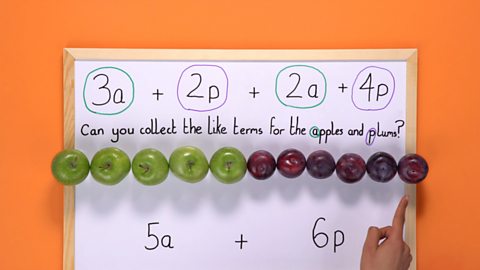
Here is the algebra behind the idea:
Only the coefficients are added; the variable part stays the same.
GCSE Maths - How to Simplify Expressions by Collecting Like Terms (2026/27 exams)
Watch Cognito’s “GCSE Maths - How to Simplify Expressions by Collecting Like Terms.” It gives a concise visual explanation of terms, signs, powers, and several exam-style examples.
Watch terms first to identify what counts as one term. Then watch the main rule, especially the distinction between a and a^2, and the reminder that a minus sign belongs to the term after it. Finish with worked examples; notice that terms can cancel completely and that unmatched terms remain in the answer.
A reliable four-step method
When an expression is short, you may be able to simplify it mentally. In a mock, though, a consistent written method avoids lost signs.
-
Read each term with its sign.
Treat subtraction as adding a negative term. For instance, contains and . -
Group like terms.
Put all terms together, all terms together, all terms together, and all constants together. -
Add or subtract the coefficients in each group.
-
Tidy the answer.
Write terms in a sensible order, usually powers first, then ordinary letter terms, then constants. Do not write a coefficient of .
Consider:
First collect the -terms and the constants:
Now combine each group:
So,
The expression has changed appearance, but not value. It is a simpler version of the same expression.
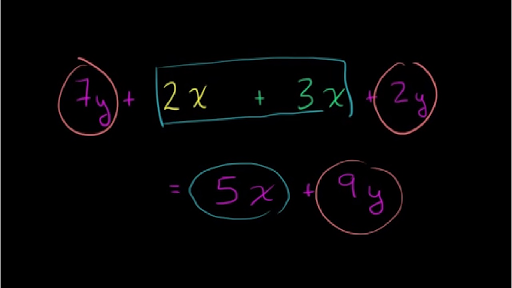
A useful habit is to circle, underline, or colour-code terms on paper before rewriting them. Crucially, move the sign with the term. In
the term after the first minus sign is , not , and the term after the next minus sign is , not .
Collect the groups:
Then simplify:
Notice that and each appeared only once, so they stay exactly as they are.
Collecting like terms - KS3 Maths - BBC Bitesize
Read BBC Bitesize’s “Collecting like terms” for a second, carefully illustrated walkthrough of grouping terms, preserving signs, and simplifying expressions with more than one variable.
In the subsection “Recognising and collecting like terms,” read the identification method, then follow the examples involving x, n^2, and ab. Pay particular attention to the explanation that each sign stays attached to its term when you reorder it. Next, in “Simplifying expressions by collecting like terms,” read the three-step summary and the worked examples immediately below it. Focus on how the source keeps n^2, n, and m^3 as separate groups.
Powers and multiple letters: read the whole variable part
A common trap is thinking that all terms containing can be combined. They cannot.
Take:
There are three different types of term:
- -terms: and
- -terms: and
- an -term: , which has no partner
Group them:
Then combine:
Do not combine and . They represent different quantities, just as and are different.
The same care applies to expressions involving two letters:
Only the -terms match:
The terms , , and do not combine with anything else.
Signs, invisible coefficients, and cancellation
Most collecting-like-terms mistakes come from signs rather than from difficult algebra.
A missing number means
So if you simplify
grouping gives:
Writing as can make the arithmetic clearer.
A zero coefficient removes the term
Therefore,
The -terms cancel, leaving only the constants.
Three errors to avoid
-
Combining unlike terms
This is addition, not multiplication, and -terms and -terms are different groups.
-
Mixing powers
is already simplified. It cannot become .
-
Dropping a minus sign while regrouping
not . Think in coefficients: .
A fast way to check an answer
If you have time in an exam, test your simplification by choosing a simple value for each variable. The original and simplified expressions must give the same result.
For example:
simplifies to:
Choose and .
Original expression:
Simplified expression:
Both give , so the simplification passes this check. This is not a replacement for careful working, but it is very useful when an answer looks suspicious.
Key takeaways
To simplify by collecting like terms:
- A term includes its sign.
- Like terms have the same complete variable part, including powers.
- Constants can be combined with other constants.
- Add or subtract the coefficients, then keep the variable part unchanged.
- means , and means .
- Terms that do not match stay in the final answer.
- A numerical substitution can check that the original and simplified expressions are equivalent.
Next, you will use this skill with single brackets. The important distinction is that today you only rearranged and combined existing terms; in the next lesson, expanding a bracket creates new terms first, and then collecting like terms often finishes the job.
Can't find a good explanation? Sign up and we'll make it for you
Sign up