
Good to see you again. Last lesson was about solving equations with brackets and unknowns on both sides by keeping the equation balanced. That same balance rule is the key today, but there is one important difference: instead of finding a number for , you will rewrite a formula so that a chosen letter is alone.
Allow about 40 minutes. By the end, you should be able to make a new variable the subject of a simple formula, use inverse operations in the correct order, and avoid common fraction and “moving letters” mistakes.
What does “make a letter the subject” mean?
The subject of a formula is the variable that is alone on one side of the equals sign.
For example, in
is currently the subject because it is by itself. If the question says make the subject, the final answer must begin in a form like:
This is called rearranging a formula or changing the subject.
The letters stand for values that could change. A formula such as
can calculate the area of a rectangle from its length and width . But if you know the area and length and need the width, it is more useful to rearrange it into a formula beginning with .
The method is exactly the balance principle:
Whatever operation you perform on one side of the equals sign, perform on the other side too.
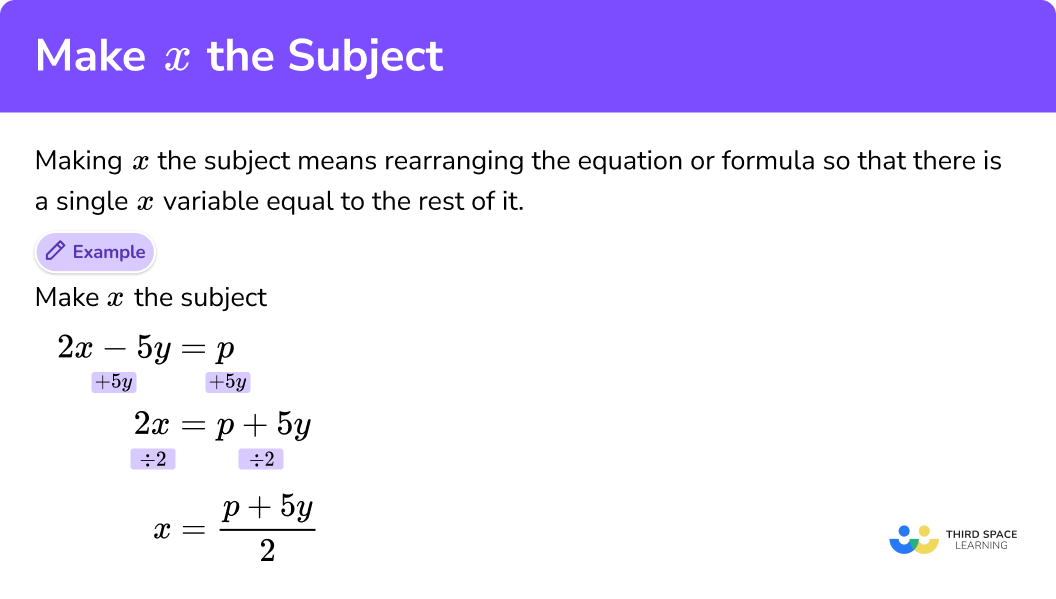
Reverse the operations
Consider again:
We want on its own. Starting with , the formula has done two operations:
- Multiplied by .
- Added .
To undo those operations, do their inverses in reverse order. Since happened last, remove it first.
Subtract from both sides:
Now is multiplied by , so divide both sides by :
Write the subject first:
The brackets in the numerator matter. The whole expression has been divided by , not just the .
Watch this short explanation before continuing. It shows the same “undo in reverse” method and models clear algebraic layout.
Changing the Subject of a Formulae (Higher & Foundation) | GCSE Maths Tutor
Watch Changing the Subject of a Formulae by The GCSE Maths Tutor for a compact introduction to isolating a variable using inverse operations.
Watch the basic example. Follow why the presenter subtracts 4 before dividing by 3, and notice that each operation is applied to both sides.
A useful exam routine is:
- Identify the target letter named in the question.
- Look at what has been done to that letter.
- Use the inverse operation to undo one operation at a time.
- Apply every step to both sides.
- Stop only when the target letter is completely alone.
A product of letters: divide, do not subtract
Suppose a rectangle has area formula
Make the subject.
The is being multiplied by . The inverse of multiplying by is dividing by , so divide both sides:
The cancels on the right:
Therefore,
It is not correct to write . The letter was multiplying , not being added to it.
You can check a rearranged formula with values. If and , the original formula says:
so . The rearranged formula gives:
Both give the same result.
The BBC Bitesize reading below explains the idea of a subject and links rearranging to a reverse “function machine.” Its temperature example is a useful three-step version of the process.
How to use formulae - GCSE Maths Revision - BBC Bitesize
Read BBC Bitesize’s How to use formulae to strengthen the idea that rearranging is a sequence of inverse operations, rather than letters mysteriously changing sides.
In “Changing the subject of a formula,” read the opening explanation and focus on the function machine idea: operations applied to the original subject must be undone in reverse order. Then scroll to the exam-style formula F=\frac{9C}{5}+32 and read the Celsius rearrangement. Track the order: subtract, multiply, then divide.
Formulae with addition and multiplication
A common school and science formula is:
Here, might be a final velocity, an initial velocity, an acceleration, and a time. Make the subject.
The term has added to it, so first subtract from both sides:
Now is multiplied by , so divide both sides by :
Write first:
The order is important. If you divided by at the start, you would have to divide every term on both sides:
That is valid, but it is less tidy. Removing the added first is usually easier.
To check the rearrangement, take , , and . The original formula gives:
Now use the rearranged formula:
It returns the original acceleration, so the formula works.
Brackets and fractions: treat the whole expression properly
Now consider the perimeter of a rectangle:
Make the subject.
Because the entire bracket is multiplied by , undo that multiplication first by dividing both sides by :
Now subtract from both sides:
So:
You could expand first:
and eventually reach an equivalent answer. But dividing by first keeps the working shorter.
A similar grouping issue appears in this formula:
To make the subject, divide both sides by :
You may split the fraction across the subtraction:
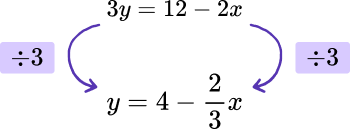
Notice the difference between these two expressions:
and
They are not generally equal. A fraction bar groups everything above it, so use brackets whenever your final answer could be unclear.
Mistakes to catch before they cost marks
“Moving a letter” without an operation
Incorrect:
The has been multiplied, not divided. The correct rearrangement is:
Always name the operation being undone.
Dividing only one part of a side
Incorrect:
If you divide the right side by , then both terms must be divided:
Usually, though, subtracting first is cleaner.
Forgetting that a fraction bar is a bracket
Incorrect:
Correct:
The entire left-hand side was divided by .
Stopping too early
If you are asked to make the subject, this is not finished:
The target letter is still multiplied by . Keep going until the final line has alone.
Key takeaways
- The subject is the variable alone on one side of the equals sign.
- Rearranging a formula uses the same balance rule as solving equations.
- Undo operations using their inverses, in reverse order.
- If a letter is multiplied by another letter, divide to isolate it.
- When dividing an expression with more than one term, use a fraction bar and brackets to show that the whole expression is divided.
- Check a rearranged formula by choosing sensible values and comparing it with the original formula.
You have now completed the core algebra rescue skills: simplifying, expanding and factorising, solving equations, and rearranging formulae. Next, the course moves to a high-yield topic for school assessments: percentage increase and decrease.
Can't find a good explanation? Sign up and we'll make it for you
Sign up