Hello! Welcome to the seventh lesson in our module on Deep Neural Network Fundamentals.
Introduction
In our last lesson, we explored Batch Normalization, a powerful technique for stabilizing and accelerating training by normalizing the inputs to each hidden layer. We noted that Batch Normalization also provides a mild regularizing effect because the normalization statistics are calculated on noisy mini-batches.
Today, we will dive into Dropout, a technique designed specifically and explicitly for regularization. Overfitting is a constant challenge in deep learning, where complex models with millions of parameters can easily memorize the training data, leading to poor performance on unseen data. Dropout is one of the most effective and widely used methods to combat this.
Our learning outcome for this lesson is to apply dropout as a regularization technique to prevent overfitting. We will cover:
- The core concept of Dropout and the intuition behind it.
- The modern implementation standard: Inverted Dropout.
- Why Dropout is so effective at improving generalization.
- How to implement and apply Dropout in practice using PyTorch.
This lesson builds directly on our ongoing theme of improving model training and performance. While techniques like Batch Normalization stabilize the training dynamics, Dropout directly targets the model's capacity to overfit.
1. What is Overfitting and How Does Dropout Help?
Overfitting occurs when a model learns the training data too well, capturing not just the underlying patterns but also the noise and random fluctuations specific to that dataset. This results in high accuracy on the training set but poor performance on the validation or test set.
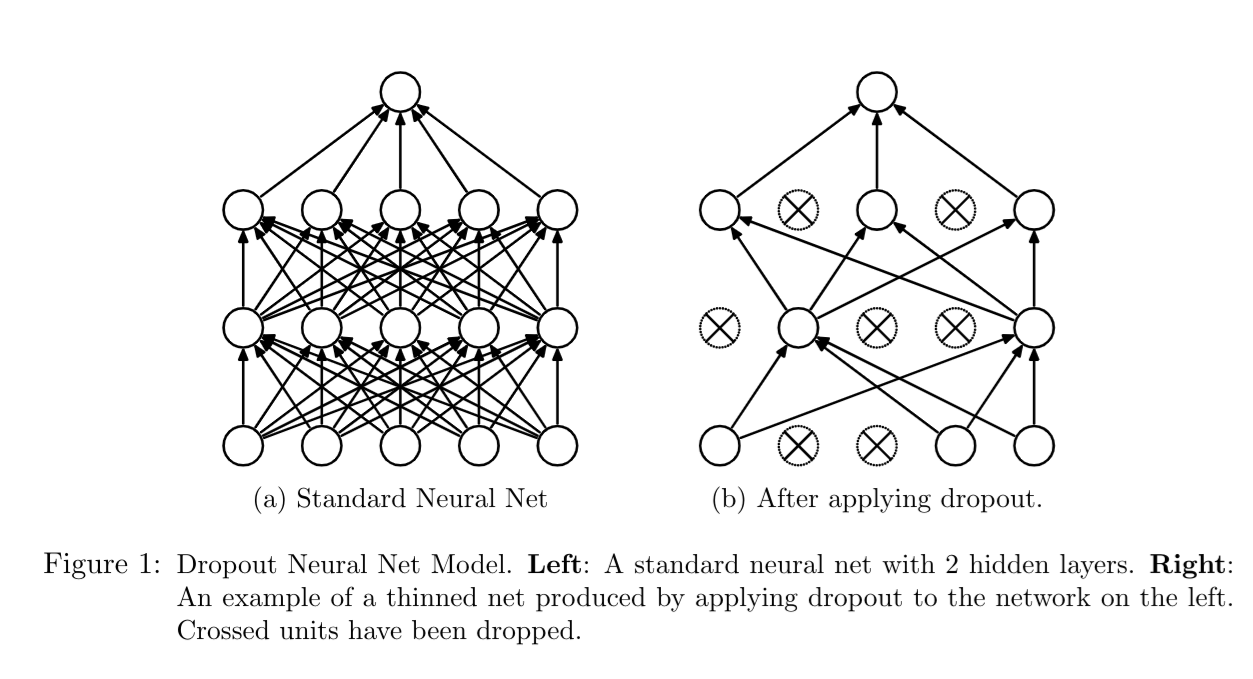
Dropout, introduced by Geoffrey Hinton and his colleagues in 2012, offers a surprisingly simple yet effective solution: during training, randomly "drop" (i.e., temporarily remove) a fraction of the neurons in a layer, along with all their incoming and outgoing connections.
Let's visualize this. On the left is a standard neural network. On the right is the same network after applying dropout. For each training step, a different, "thinned" sub-network is used.
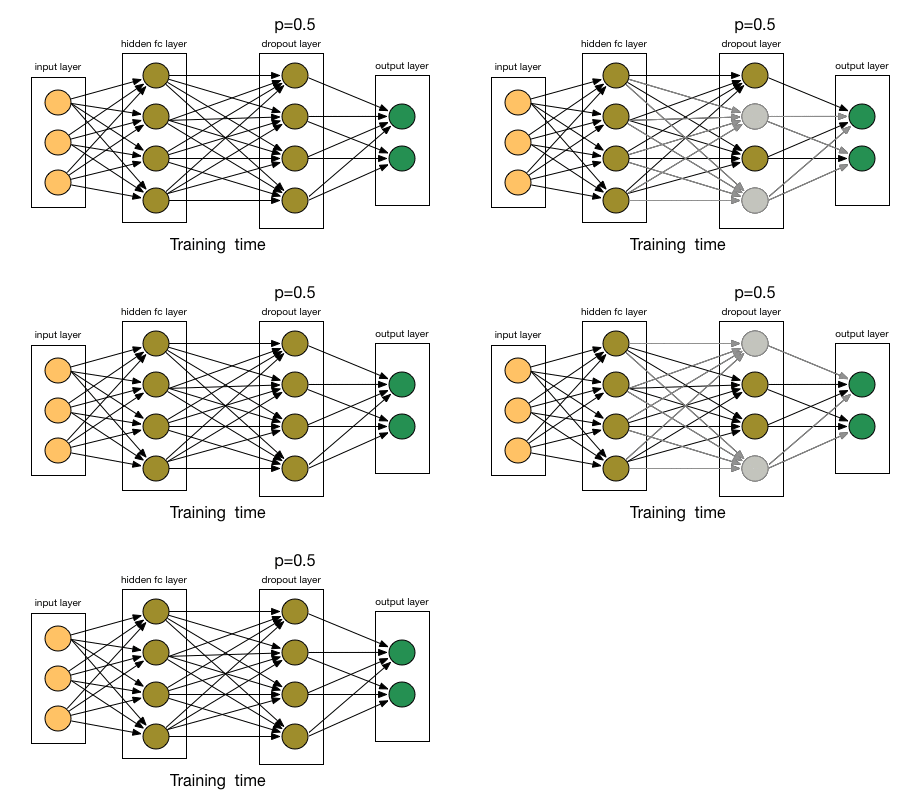
This random deactivation is a dynamic process that changes with every mini-batch, as shown in the animation below.
To get a formal introduction to this idea, let's watch the first part of Andrew Ng's lecture on Dropout.
Dropout Regularization (C2W1L06)
This video, 'Dropout Regularization' from DeepLearningAI, introduces the core idea of randomly deactivating neurons to create a smaller, simpler network for each training example.
Please watch from the beginning to 01:35. Focus on the core concept: by randomly eliminating nodes on each training iteration, we are essentially training on a 'diminished' network, which has a regularizing effect.
This process of training a different sub-network for each mini-batch seems chaotic, but as we'll see, it leads to powerful intuitions about why it's so effective.
2. The Mechanics: Inverted Dropout
While the original dropout paper described a method that required scaling at test time, the modern standard is a slightly modified version called Inverted Dropout. This technique performs the scaling during the training step, which makes the implementation cleaner and leaves the test/inference phase unchanged. Your CS background will appreciate the elegance of moving a computational step to a place where it simplifies the overall algorithm.
Here's how it works during a forward pass in training:
- Generate a Mask: For a given layer, create a random binary mask with the same shape as the layer's activation output. Each element of the mask is set to 1 with probability
p(thekeep_prob) and 0 with probability1-p(thedrop_prob). - Apply the Mask: Perform an element-wise multiplication of the layer's activations with this mask. This effectively zeros out the activations of the "dropped" neurons.
- Scale the Output: Divide the result by the
keep_prob(p). This scaling step is the "inverted" part. It ensures that the expected value of the output from the layer remains the same, whether dropout is active or not. By doing this now, we don't need to make any modifications during inference.
Let's continue with Andrew Ng's video, which provides a crystal-clear explanation of the inverted dropout implementation.
Dropout Regularization (C2W1L06)
This segment of the video details the implementation of inverted dropout, which is the standard method used in all major deep learning frameworks.
Watch from 01:35 to 07:21. Pay close attention to the three steps: creating the dropout vector d, applying it to the activations a, and the crucial final step of scaling a by dividing by keep_prob.
To solidify this, let's look at a practical, from-scratch implementation in PyTorch.
Regularization from Scratch - Dropout
The blog post 'Regularization from Scratch - Dropout' by Nilanjan Chattopadhyay provides a fantastic, code-first explanation. We'll focus on the sections that build up the implementation of inverted dropout.
First, read the section 'Dropout in Practice' to see a basic forward pass and how a binary mask is created and applied. Then, skip to and read 'Inverted Dropout' to see the crucial scaling step H1 = H1/0.6 added to the training logic. This cleanly separates training and inference logic.
3. Dropout at Test Time (Inference)
The beauty of the inverted dropout technique is its simplicity at test time. Because we scaled up the activations during training, we don't need to do anything special during inference. We simply use the full, trained network with all neurons active.
Why not use dropout at test time?
- Determinism: We want our model's predictions to be deterministic and consistent. Introducing randomness at test time would mean getting a different output every time you run the same input through the model.
- Computational Cost: While one could theoretically run an input through the network many times with different dropout masks and average the results (a technique called Monte Carlo Dropout, used for estimating uncertainty), it's computationally expensive for standard prediction tasks.
The final segment of Andrew Ng's video confirms this logic.
Dropout Regularization (C2W1L06)
This last part of the video explains why dropout is turned off during testing and how inverted dropout makes this straightforward.
Watch from 07:21 to the end. The key takeaway is that at test time, you perform a standard forward pass with no dropout and no scaling.
In frameworks like PyTorch and TensorFlow, this is handled automatically. Calling model.eval() switches the dropout layers into "inference mode," where they simply pass the data through without modification. Calling model.train() reactivates them.
4. Why Does Dropout Work?
Now that we understand how dropout is implemented, let's explore the intuitions for why it is such an effective regularizer.
There are two primary ways to think about it:
A. An Ensemble of Thinned Networks
Training a network with dropout is analogous to training a massive ensemble of smaller neural networks. For a layer with neurons, there are possible sub-networks that can be formed by dropping different combinations of neurons. Each mini-batch effectively trains a different one of these sub-networks.
At test time, using the full network with scaled weights is an approximation of averaging the predictions of this huge ensemble of networks. Ensemble methods are a well-known and powerful technique in machine learning for reducing overfitting and improving generalization, and dropout provides a computationally efficient way to approximate this.
B. Preventing Co-adaptation
Because any given neuron can be randomly dropped at any time, other neurons cannot rely on its presence. This forces each neuron to learn features that are independently useful and robust. It prevents "co-adaptation," where a group of neurons might learn to correct each other's mistakes in a way that is brittle and specific to the training data.
Andrew Ng provides an excellent summary of these intuitions.
Understanding Dropout (C2W1L07)
This video, 'Understanding Dropout,' focuses entirely on the intuition behind the technique's effectiveness.
Watch from the beginning to 02:18. He explains the two key intuitions: training smaller networks and forcing weights to be spread out, which acts similarly to L2 regularization by shrinking the squared norm of the weights.
This connection to L2 regularization is powerful. By discouraging large weights on any single input, dropout forces the network to learn a more distributed, and thus more robust, representation.
Test your understanding!
You have a mini-batch activation output from a ReLU layer: a = [0.0, 1.5, 4.0, 0.8]. You apply an inverted dropout layer with keep_prob = 0.8.
Your randomly generated binary mask is mask = [1, 0, 1, 1].
What is the final output of the dropout layer?
Show answer
-
Apply the mask: Multiply the activations
aby themask.a_masked = a * mask = [0.0 * 1, 1.5 * 0, 4.0 * 1, 0.8 * 1] = [0.0, 0.0, 4.0, 0.8] -
Scale the output: Divide the masked activations by
keep_prob.output = a_masked / keep_prob = [0.0 / 0.8, 0.0 / 0.8, 4.0 / 0.8, 0.8 / 0.8] = [0.0, 0.0, 5.0, 1.0]
The final output is [0.0, 0.0, 5.0, 1.0]. Notice how the non-dropped activations were scaled up.
5. Applying Dropout in Practice
Using dropout in a framework like PyTorch is very straightforward.
Dropout Regularization in Deep Learning
Let's see how easy it is to add a dropout layer to a PyTorch model. This article from GeeksForGeeks provides a clear and concise example within a CNN architecture.
Read 'Step 4: Define Model With Dropout' to see how nn.Dropout(p=p) is added to the model definition. Then look at 'Step 5: Training and validation' to see the importance of the model.train() and model.eval() calls, which control whether the dropout layer is active.
As the article shows, you define a nn.Dropout layer and insert it into your nn.Sequential or forward method.
import torch.nn as nn

# Example of a model block with Dropout
p_drop = 0.5 # The probability of dropping a neuron
model_block = nn.Sequential(
    nn.Linear(in_features=128, out_features=128),
    nn.ReLU(),
    nn.Dropout(p=p_drop) #<-- Dropout is often placed after the activation
)
Practical Considerations:
- When to use it: Dropout is a regularizer, so it's primarily useful when your model is overfitting. If your training loss is low but your validation loss is high (or increasing), dropout is a great tool to try.
- Dropout Rate (
p): This is a hyperparameter you need to tune. A common starting point isp=0.5for hidden layers. If you have very large layers, you might use a higher dropout rate (e.g.,p=0.6or0.7). For input layers or smaller hidden layers, a lower rate (e.g.,p=0.1orp=0.2) is more common. - Interaction with Batch Norm: As we saw in the last lesson, Batch Norm has a regularizing effect. Using both strong dropout and Batch Norm together can sometimes lead to suboptimal results. It's common to start with Batch Norm and then add a small amount of dropout if overfitting is still a problem.
- Debugging: A major downside of dropout is that it makes your cost function non-deterministic. If you plot your training loss, it will fluctuate more than usual. A common practice is to first train your model with dropout turned off (
p=0) to ensure the loss is steadily decreasing, then turn dropout on to regularize the model.
Conclusion
You have now learned about Dropout, a fundamental and powerful regularization technique that is essential for training deep neural networks and preventing them from overfitting.
Key Takeaways:
- Core Idea: Dropout combats overfitting by randomly deactivating a fraction of neurons during each training step.
- Implementation: The standard is Inverted Dropout, which scales the remaining active neurons during training. This simplifies inference, as no modifications are needed at test time.
- Mechanism: It works by preventing neuron co-adaptation and by approximating the training of a large ensemble of smaller networks.
- Practical Use: Dropout is implemented as a layer in deep learning frameworks and is primarily used when a model shows signs of overfitting. The dropout rate is a key hyperparameter to tune.
Preview of the next lesson:
Dropout regularizes the model's parameters by forcing them to be more robust. In our next lesson, we will explore methods that regularize the training process itself. We'll learn about early stopping (stopping training when validation performance starts to degrade) and learning rate scheduling (dynamically adjusting the learning rate during training). These techniques, combined with what we've learned about Batch Norm and Dropout, form a powerful toolkit for training stable and high-performing models.