
Hello! Welcome to your next lesson in the "Data Storytelling and Stakeholder Influence" module.
In our last session, we focused on the crucial skill of anticipating stakeholder questions and preparing data-driven responses. You learned how to think like a CFO, preempt concerns about ROI and risk, and steer conversations toward a strategic solution. This put you in a strong position to defend your data-backed proposals.
Today, we shift from defense to offense. A great strategy deserves a great rollout, and that requires more than just good answers—it requires a plan. Your learning outcome is to develop a communication plan for rolling out a significant data-driven change in strategy. This is where your leadership skills truly come to the forefront, as you'll learn to manage change, build consensus, and guide your organization through a transformation, ensuring your brilliant analytical work translates into real business impact.
Why a Communication Plan is Non-Negotiable
When you introduce a significant change based on data—like shifting budgets because an incrementality test revealed low channel performance, or changing campaign targeting based on a new LTV model—you are not just presenting numbers. You are challenging assumptions, altering workflows, and asking people to change their behavior.
Without a deliberate communication plan, you risk:
- Resistance: Teams may feel threatened or confused, leading to pushback.
- Misinterpretation: Stakeholders might not grasp the "why" behind the change, focusing only on the disruption.
- Failed Adoption: The change is announced, but nothing really changes because no one is truly on board.
This is why a structured approach to communication is critical for any data transformation initiative.
Crafting Effective Communication Strategies for Data ...
To understand the central role of communication in these projects, please read this brief section from an article by Cambridge Spark.
Read the section titled 'The Role of Communication in Data Transformation.' It clearly outlines how a good plan fosters collaboration, builds trust, and manages expectations.
The Anatomy of a Communication Plan
A robust communication plan is a strategic document that outlines how you will deliver the right message to the right people at the right time. We are going to build this plan step-by-step. The end goal is to be able to fill out a template like this one for any major initiative you lead.

To build our plan, we'll follow a clear framework. The following video provides an excellent overview of the core components.
How to Create a Strategic Communications Plan
This video, 'How to Create a Strategic Communications Plan,' breaks down the process into logical, manageable steps. We will adopt its core structure for our lesson.
Please watch from 01:32 to 06:52. This section covers the foundational elements: the purpose statement and a deep dive into audience analysis. Pay close attention to the 'who, what, when, where, how, and why' framework.
As the video explains, our plan will be built around these key pillars:
- Purpose & Objectives (The "Why")
- Audience Analysis (The "Who")
- Message & Content (The "What")
- Channels & Cadence (The "How" and "When")
- Feedback & Measurement (Closing the loop)
Let's begin.
Step 1: Define Purpose and Objectives (The "Why")
Every communication plan must start by answering: What are we trying to achieve with this communication? The answer is not simply "to inform people." The goal is to influence attitudes and behaviors.
Your objectives should be SMART (Specific, Measurable, Achievable, Relevant, Time-bound).
| Vague Objective | SMART Objective |
|---|---|
| "Inform the company about the new MMM." | "Secure executive approval for the Q3 budget reallocation proposed by the MMM by June 30th." |
| "Get the team to use the new dashboard." | "Ensure 90% of the marketing team uses the new performance dashboard for their weekly reports within 4 weeks of launch." |
| "Explain the SEO strategy shift." | "Gain alignment from the content and web development teams on the new keyword prioritization framework during the project kickoff meeting." |
Defining these objectives upfront ensures your entire plan is focused on achieving a specific, measurable business outcome.
Step 2: Audience Analysis (The "Who")
You cannot communicate effectively without deeply understanding your audience. In the last lesson, you conducted a stakeholder analysis to anticipate objections. Now, we'll use that same thinking to proactively tailor our communication.
A powerful tool for this is the Stakeholder Communication Map, which segments stakeholders based on their level of influence and interest.
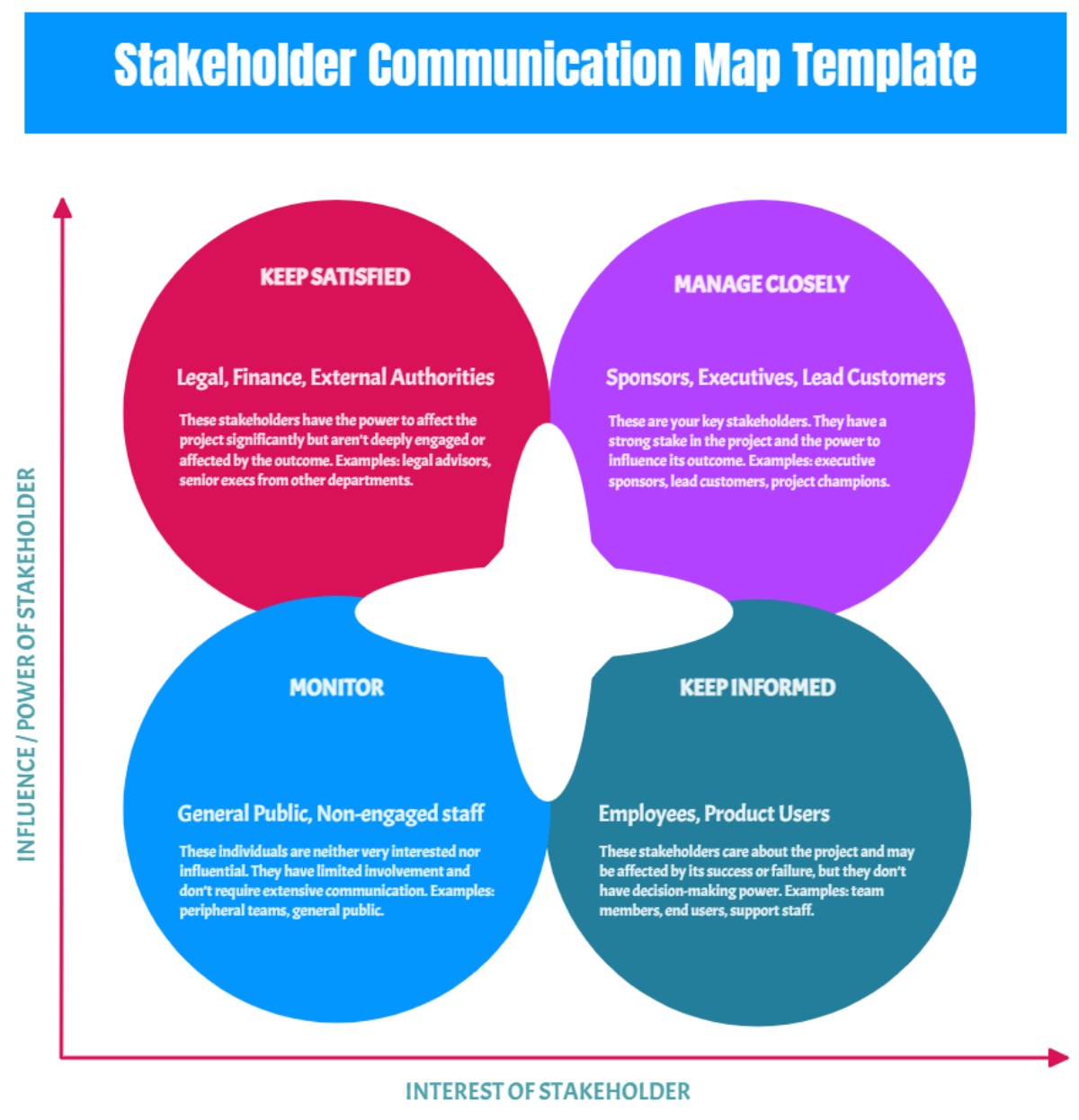
Here’s how you apply it:
- Manage Closely (High Influence / High Interest): This is your C-suite, your direct boss, and key budget holders (like the CFO). They require personalized, frequent communication. Your messaging must focus on business impact, ROI, and strategic alignment (remember "exercising business acumen" from our last lesson).
- Keep Satisfied (High Influence / Low Interest): These might be heads of other departments (e.g., Head of Sales) who can impact your project but aren't involved daily. They need concise, high-level updates that reassure them the change won't negatively affect their world. The goal is to keep them on your side without drowning them in detail.
- Keep Informed (Low Influence / High Interest): This is often your own team and other adjacent teams who are affected by the change. They are highly interested in how it impacts their work. They need clear, practical information, training, and a forum for their questions.
- Monitor (Low Influence / Low Interest): This group is on the periphery. General communications (like an all-hands announcement or a company-wide newsletter) are usually sufficient.
Test your understanding!
You are rolling out a new, data-driven bidding strategy that automates much of what your PPC specialists currently do manually. Where would you place your team of PPC specialists on the Stakeholder Communication Map, and why?
Show answer
They belong in the Keep Informed (Low Influence / High Interest) quadrant.
- High Interest: This change directly impacts their daily jobs, roles, and potentially their career development. They will be extremely interested in the details.
- Low Influence: While their buy-in is crucial for morale and smooth execution, they likely do not have the influence to block the strategic decision itself.
Your communication strategy for them should be focused on transparency, reassurance about their value, and a clear plan for training and upskilling.
Step 3: Crafting the Message (The "What")
Once you know who you're talking to, you can decide what to say. The message must be tailored to each audience segment. A useful framework for this is Know-Feel-Do.
For each audience group, ask yourself:
- What do I need them to KNOW? (The core facts, the data, the plan).
- What do I want them to FEEL? (Confident, reassured, excited, understood).
- What do I need them to DO? (Approve a budget, adopt a new tool, attend training, provide support).
Let's watch a short clip that explains this concept.
How to Create a Strategic Communications Plan
Let's return to the 'How to Create a Strategic Communications Plan' video to see the Know-Feel-Do framework in action.
Watch from 09:29 to 12:16. The speaker provides a clear example of how to structure messaging goals using the Know-Feel-Do model. This will help you move from simply transmitting information to driving action.
Here’s how you might apply this to our scenario of reallocating budget after a revealing incrementality test:
| Audience | Know | Feel | Do |
|---|---|---|---|
| CFO (Manage Closely) | We can achieve the same or better results with 20% less spend by cutting non-incremental channels. | Confident in the data and your strategic command of the budget. | Approve the budget reallocation and champion the data-driven approach. |
| Your Team (Keep Informed) | We are shifting our strategy to focus on channels with higher proven impact. Your roles will evolve to manage these new priorities. | Valued for your ability to adapt and excited about the opportunity to learn new, more impactful skills. | Participate in training for the new channel strategy and help execute the transition. |
Step 4: Channels and Cadence (The "How" and "When")
With your audience and message defined, you can now select the appropriate channels and timeline. A common mistake is relying on a single channel (e.g., one mass email). A multi-channel approach is almost always more effective.
The Cambridge Spark article provides a great, structured list of steps for this.
Crafting Effective Communication Strategies for Data ...
This article provides a fantastic, actionable checklist for developing the tactical side of your communication plan.
Read the section 'Develop a Structured Communication Plan.' Focus on the subsections 'Establish Communication Cadence' and 'Choose Appropriate Channels.' This provides a concrete menu of options for your plan.
Channel selection depends on the message and audience:
- Sensitive/Complex message for High-Influence stakeholders (CFO): Use a rich, synchronous channel like a 1:1 meeting. Follow up with a concise email memo.
- Practical information for your team: A team meeting is great for discussion, supported by a dedicated Slack/Teams channel and documentation on your company intranet (e.g., Confluence).
- High-level awareness for the company: A quarterly all-hands presentation or a post in a company-wide newsletter.
Cadence (Timing) is key:
- Pre-Launch: Announce the "why" and the upcoming change.
- Launch: Official rollout with detailed information and access to resources.
- Post-Launch: Regular check-ins, progress reports, and success stories to maintain momentum.
Step 5: Feedback and Measurement (Closing the Loop)
Finally, a data-driven leader applies data to their own communication efforts. How do you know if your plan is working? You need to build in feedback loops and define success metrics.
Gathering Feedback:
- Surveys: Gauge understanding and sentiment before and after the change.
- Q&A Sessions: Open forums to address concerns directly.
- 1:1 Check-ins: Deeper conversations with key stakeholders.
Measuring Success:
The KPIs for your communication plan should tie back to your SMART objectives.
- If your goal was dashboard adoption, your metric is the adoption rate.
- If your goal was to secure budget approval, your metric is the approval itself.
- Other metrics can include email open/click rates, meeting attendance, and qualitative feedback analysis.
This final step turns your communication plan into a living document that can be optimized over time.
Conclusion
You now have a complete, five-step framework for building a communication plan to roll out any significant data-driven change. This process transforms communication from an afterthought into a strategic tool for driving change and securing buy-in.
Key Takeaways:
- Start with Why: Define clear, SMART objectives for your communication.
- Map Your Audience: Use the Influence/Interest matrix to segment stakeholders and tailor your approach.
- Use Know-Feel-Do: Craft targeted messages that go beyond facts to influence feelings and drive actions.
- Plan Your Channels and Cadence: Select the right mix of communication methods and schedule them thoughtfully across the project lifecycle.
- Measure and Adapt: Close the loop by gathering feedback and tracking metrics to ensure your communication is effective.
Preview of Your Next Lesson:
We've designed the high-level plan. Next, we zoom in on one of the most critical communication events in your plan: the executive presentation. The next lesson, "Present a complex analytical finding (e.g., from an incrementality test) in a simple, persuasive manner," will equip you with the skills to walk into that high-stakes meeting with the CFO and deliver a compelling, data-driven narrative that wins them over.