Hello! Welcome to the final lesson in your "Business Launch and Operations" module.
In our last session, we outlined the unified financial model for your accelerator and fund, establishing the critical "2 and 20" link between your operational company and your investment vehicle. This dual structure, where you act as both an operator (running the accelerator) and a fiduciary (managing the fund), is powerful but also creates natural tensions. Your success depends not just on financial returns, but on the trust you build with founders, investors, and clients.
This lesson directly addresses the learning outcome: Define a strategy to manage potential conflicts ofinterest between consulting clients and portfolio companies.
Our goal is to move from awareness to action. You will learn to identify, categorize, and proactively manage the conflicts of interest inherent in your business model. This isn't just a legal checkbox; it's a core part of your reputation and long-term strategy. For a solo GP running both an accelerator and a consulting practice, having a clear and defensible strategy for this is non-negotiable.
1. Understanding Conflicts of Interest in Your World
A conflict of interest arises when your duties to one party could be compromised by your personal interests or your duties to another party. In your unique position, you will wear multiple hats and owe duties to several stakeholders:
- Your Portfolio Companies: A duty to help them succeed.
- Your Fund's Limited Partners (LPs): A fiduciary duty to maximize their financial return.
- Your Consulting Clients: A contractual duty to provide the agreed-upon services.
- Your Accelerator (Management Company): A duty to ensure its own operational and financial health.
These duties can pull you in different directions. Here are some concrete conflicts you will almost certainly face:
- Competitive Investments: Your fund invests in Startup A. Six months later, a stronger competitor, Startup B, applies to your accelerator. Do you invest in B, potentially harming A? Do you reject B, potentially missing a huge return for your LPs?
- Deal Flow Allocation: You identify a fantastic AI startup through a paid consulting gig. Do you refer them to your fund (where you get carry) or keep them as a lucrative consulting client?
- Information Sharing: You learn confidential strategic information from Portfolio Company A. During a coaching session with Portfolio Company B (a non-competitor, but in an adjacent market), you realize A's information could be immensely valuable to them. Can you share it?
- Resource Allocation: You have limited time. Do you spend Friday helping a portfolio company prepare for a critical investor meeting or on a deliverable for a consulting client paying a high hourly rate?
Ignoring these situations can erode trust and even lead to legal challenges. A proactive approach is essential.
2. A Framework for Assessing Conflicts
Not all conflicts are created equal. Some are minor and easily managed, while others pose a significant threat to your business. A simple way to categorize them is using a risk matrix.
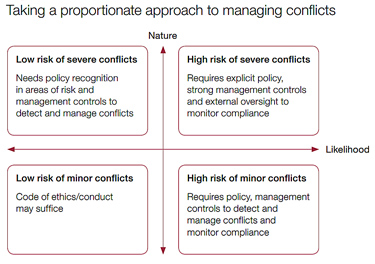
Use this matrix as a mental model. When a potential conflict arises, first ask:
- What is the nature of the conflict? Is the potential harm severe (e.g., direct financial loss for an LP or portfolio company) or minor (e.g., a perceived slight)?
- What is the likelihood of it occurring? Is this a high-risk, frequent scenario or a low-risk, one-off situation?
A conflict between a portfolio company and a major consulting client would clearly fall in the "Severe / High Risk" quadrant, requiring your most robust management strategies.
3. Core Strategies for Managing Conflicts
Your strategy should be built on three pillars: Structure, Policy, and Transparency.
Pillar 1: Structural Safeguards
The cleanest way to manage conflicts is to build safeguards directly into your business structure and decision-making processes. The following playbook, though designed for government-backed incubators, offers a universally applicable and robust framework.
INCUBATION FUND MANAGEMENT Investment Playbook for ...
The 'Investment Playbook for Startup Incubators' provides a best-practice guide for separating incubation activities from investment decisions. This structural separation is your first line of defense against conflicts.
Please read section 14, 'Incubation Fund vs Incubation' (found in PART - D), and section 7, 'Investment Committee' (found in PART - B). Focus on: How the criteria for 'incubation' (program acceptance) can differ from 'investment' (funding decision). The role and composition of the Investment Committee (IC) in ensuring objectivity.
Based on this reading, here are two foundational strategies you should implement:
-
Separate Decision-Making Processes: Even as a solo GP, you can create distinct processes.
- The Accelerator Decision: The decision to accept a startup into your program can be based on broader criteria: strength of the team, alignment with your AI thesis, and your ability to add value. Not all companies you accept need to be "investable" by your fund.
- The Fund Decision: The decision to invest capital must be purely financial, based on rigorous due diligence and return potential for your LPs.
-
Establish an Independent Investment Committee (IC): This is your single most important structural safeguard.
- An IC is a small group (2-4 people) of experienced investors, entrepreneurs, or domain experts who approve all investment decisions.
- This is not just for governance; it's for your protection. By presenting deals to an objective committee and fully disclosing any personal conflicts, you are no longer making the decision in a vacuum. If a conflict is later questioned, you can demonstrate that the decision was made independently and with full knowledge of the situation. This protects you from claims of self-dealing.
Pillar 2: Proactive Policies
Structural safeguards set the stage, but you need clear rules of engagement, especially regarding the most common and thorny conflicts. The VC world's approach to these issues is evolving, and you can adopt modern best practices from the start.
VCs are Changing Their Tune on Conflicts
The article 'VCs are Changing Their Tune on Conflicts' by Chris Neumann offers a pragmatic look at why the old rule of 'never invest in competitors' is breaking down and provides concrete policies for early-stage investors.
Please read the sections 'Why the Change of Heart?' and 'What Can Be Done?'. Pay close attention to the specific, actionable policies suggested for early-stage VCs.
This article highlights that because startups pivot faster (especially with AI) and funds have longer lifespans, a blanket, lifelong ban on investing in competitors is no longer practical. The key is to create fair, transparent policies. Consider adopting the following for your accelerator:
- "Expiration Date" on Conflicts: In your program agreements, state that your obligation to not invest in a direct competitor is not perpetual. It might expire after a certain time (e.g., 36 months) or if the company fails to reach certain milestones (e.g., raising a follow-on round).
- "Pivot" Clause: Make it clear that if a portfolio company pivots into a new market, your obligation not to invest in competitors in that new market may not automatically apply, especially if you don't participate in the pivot round.
- Minimum Ownership Threshold: Clarify that your commitment to avoid conflicts is tied to maintaining a meaningful ownership stake. If your stake is diluted to a negligible level, it's unreasonable to expect your entire fund to be restricted.
Pillar 3: Radical Transparency
Structure and policy are internal. Transparency is how you build external trust.
- Disclose to Founders: The policies above must be clearly written into your program participation agreements. Founders should know the rules of engagement before they join.
- Disclose to LPs: When you raise your fund, you must disclose the nature of your consulting business. Your LPs need to understand this potential for conflict and be comfortable with the management strategies you've put in place. This will be a key part of their due diligence on you.
- Disclose to Clients: Your consulting agreements should also acknowledge that you operate an investment fund. You might even include a "Right of First Look" clause, which transparently states that you may present investment opportunities to clients if it aligns with their strategy.
Test your understanding!
A hot AI startup that competes directly with one of your existing portfolio companies applies to your accelerator. Your portfolio company is 18 months old and has shown slow but steady progress. The new startup seems to have a much stronger team and better technology.
Using the framework from this lesson, what are the key steps you would take?
Show answer
- Categorize the Conflict: Using the 2x2 matrix, this is a Severe / High-Risk conflict. It directly pits the interests of an existing portfolio company against the potential for a massive return for your LPs.
- Consult Your Policies: Review your program agreement with the existing portfolio company. Does your "expiration date" or "milestone" clause apply?
- Disclose and Recuse: This decision cannot be yours alone. Your primary action is to bring the opportunity to your Investment Committee.
- Present Objectively: Prepare a full investment memo on the new startup, but also prepare a status update on the existing portfolio company. You must present both sides dispassionately. Crucially, you must explicitly state your conflict of interest to the committee.
- Abide by the IC's Decision: The IC will make the final call. Their independent judgment is your safeguard. If they decide to invest, you can demonstrate that the decision was made through a fair process. If they decline, you have fulfilled your fiduciary duty to at least consider the opportunity for your LPs.
Conclusion
Managing conflicts of interest is not about avoiding them entirely—in your multifaceted role, that's impossible. It's about managing them with integrity and foresight. By doing so, you build a reputation as a trustworthy partner, which is your most valuable asset.
Key Takeaways:
- Conflicts are inherent in a model that combines consulting, acceleration, and investing. Proactive management is not optional.
- Use a framework like the severity/likelihood matrix to triage conflicts and apply a proportionate response.
- Your primary defense is structural: implement an independent Investment Committee to ensure objective investment decisions.
- Develop clear, modern policies on complex issues like competitive investments and disclose them upfront in your legal agreements.
- Practice radical transparency with all stakeholders—founders, LPs, and clients. Disclose your multiple roles and how you manage potential conflicts.
Preview of the Next Lesson
We have now established your financial architecture and the ethical guardrails to guide your operations. The final step in this module is to bring it all together into an actionable timeline. In our next lesson, we will focus on the learning outcome: "Create a 90-day launch plan with key operational, legal, and marketing milestones." We will translate the strategies from the past few lessons into a concrete, week-by-week plan to get your business off the ground.