Hello! Welcome to your next lesson in the "Business Launch and Operations" module.
In our last session, we crafted your core positioning and marketing message, defining who your accelerator is for and why the best AI-native startups should choose you. Now, we move from the strategic narrative to the numbers that underpin it. A compelling story attracts founders, but a sustainable financial model is what allows you to serve them for the long run.
This lesson directly addresses the learning outcome: Outline a unified financial model for the accelerator and fund, projecting cash flow and sustainability.
We will break down what a "unified model" means for a solo GP like yourself. It's not about becoming an expert financial modeler overnight. Instead, the goal is for you to understand the architecture of this model, its key components, and how it functions as a strategic tool for planning and fundraising. This knowledge will enable you to work effectively with accountants and fund administrators to build your actual model.
1. What is a "Unified" Financial Model?
A common point of confusion for new managers is that you aren't building one model; you are building two interconnected models:
- The Accelerator (Management Company) Model: This is the financial model for your operating business. Think of it like any other startup. It has revenues (e.g., fees, sponsorships) and expenses (e.g., your salary, rent, software). Its primary goal is operational sustainability.
- The Fund Model: This is the model for the investment vehicle, the pool of capital you will invest in startups. Its P&L is driven by investment returns and capital distributions. Its primary goal is to generate a high return for your investors (Limited Partners).
These two entities are legally separate but financially linked. Your accelerator manages the fund, and the fund pays your accelerator for doing so.
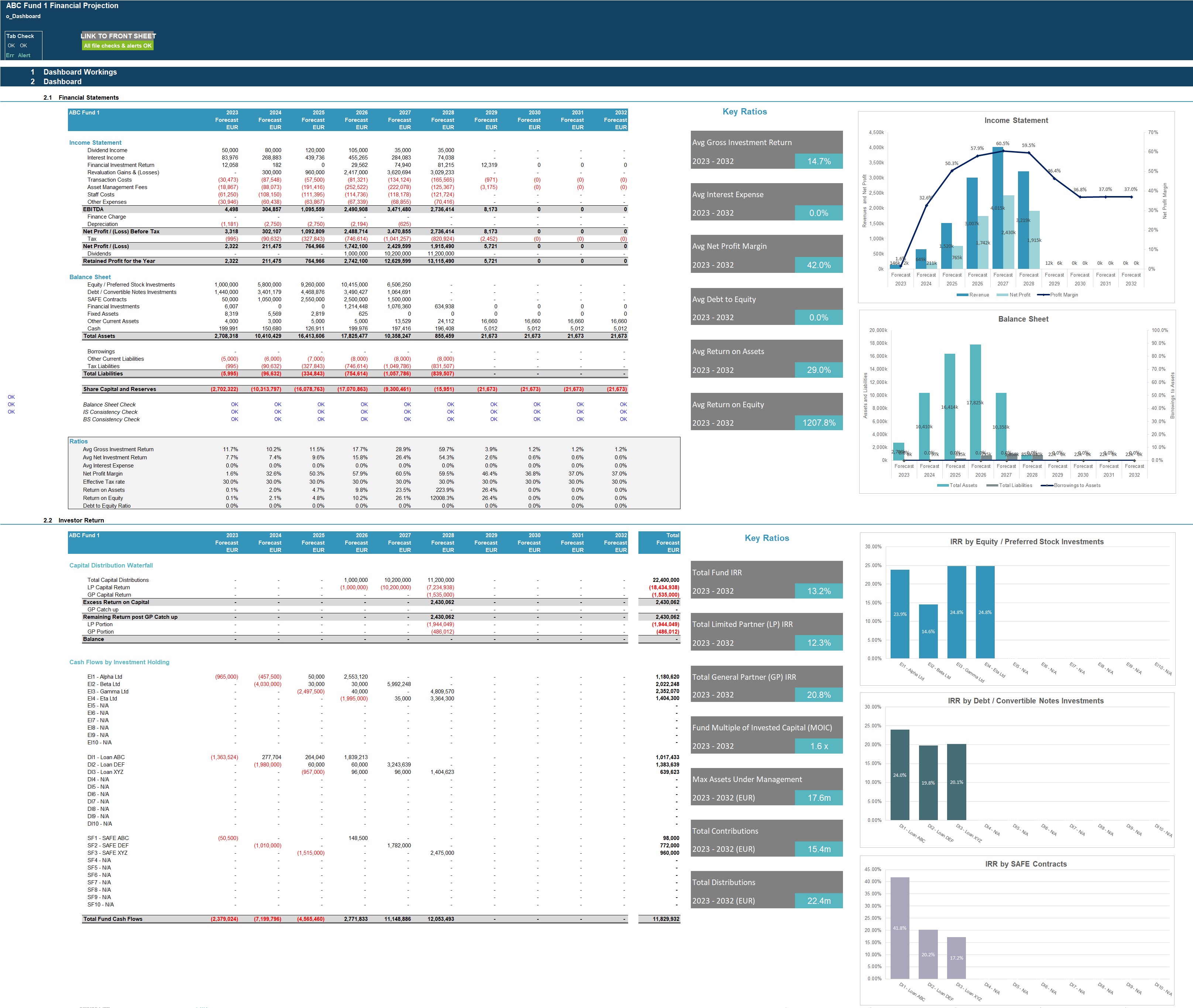
Here is an example of what a professional fund financial projection dashboard looks like. It integrates the income statement, balance sheet, and critically, the investor returns and cash flow waterfall. Our goal today is to understand the pieces that make up a dashboard like this.
2. The Architecture: Connecting the Accelerator and the Fund
The financial relationship between your accelerator and your fund is driven by two main streams of income, famously known as the "2 and 20" model:
- The "2" (Management Fee): The fund pays the management company an annual fee, typically 1-2.5% of the total fund size, to cover operational expenses. This is the primary, predictable revenue source for your accelerator.
- The "20" (Carried Interest or "Carry"): This is the management company's share of the fund's profits, typically 20-25%, after all investor capital has been returned (plus any preferred return). This is the high-upside, long-term incentive.
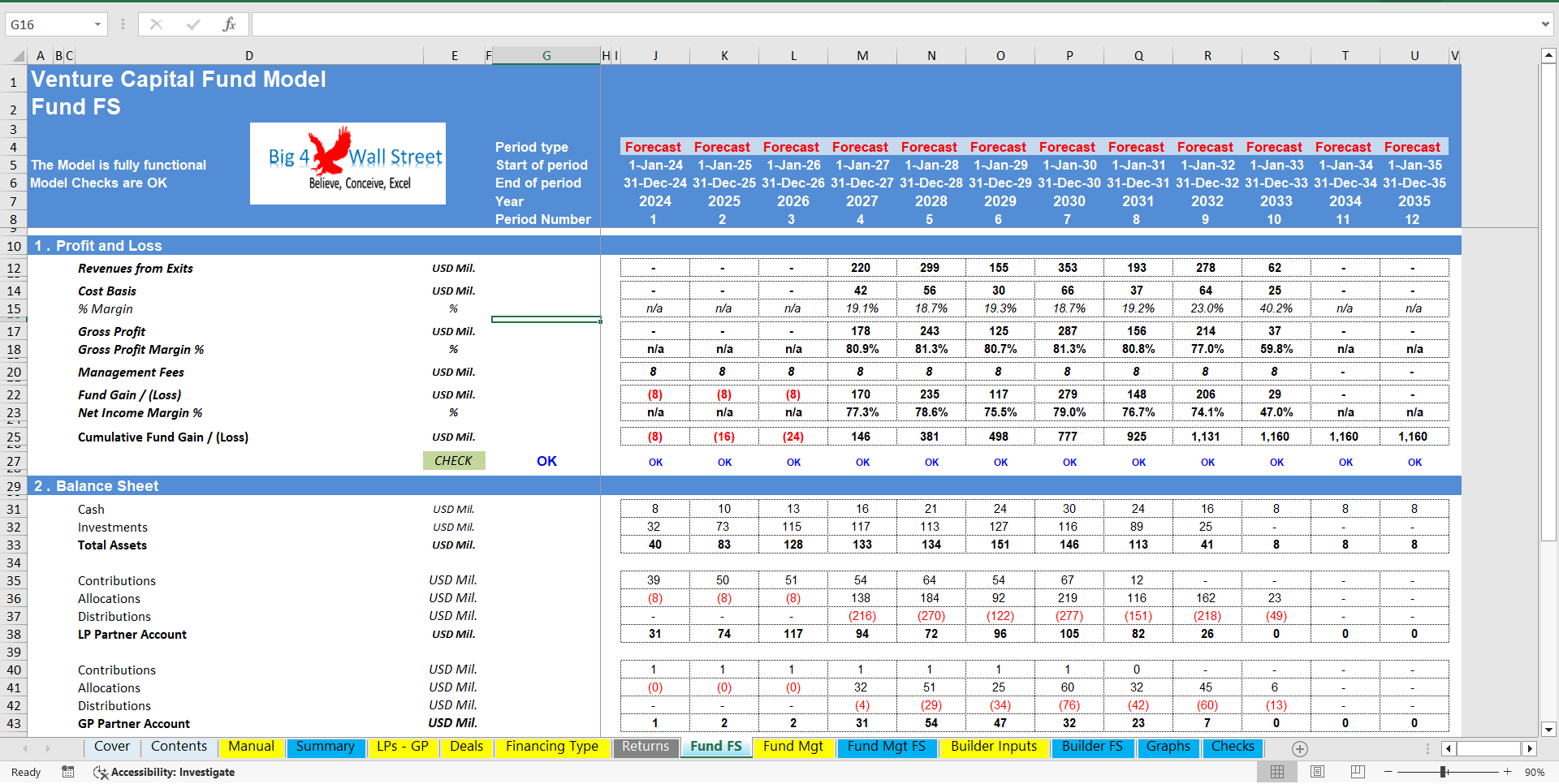
This diagram helps visualize the structure. The "Management LLC" is your accelerator, and the "Venture Fund" is your investment vehicle.
Let's break down how to model each entity.
3. Part 1: Modeling the Accelerator (Management Company)
The goal here is to project your accelerator's cash flow to ensure it can stay in business. You need to answer: "Are my revenues greater than my expenses?"
Accelerator Revenues
Your primary revenue will be the management fee from your fund. For a first-time, solo GP, this fee might be modest. For example, a 2% fee on a $5M fund is $100,000 per year. While a good start, it may not be enough to cover all expenses and provide you with a market-rate salary. This is why diversifying revenue is critical for sustainability.
The following article explores modern, sustainable ways to monetize an accelerator beyond just management fees.
New approaches to funding and monetizing an accelerator
To build a robust financial model for your accelerator, you need to think beyond just management fees. This article, 'New approaches to funding and monetizing an accelerator' by Acterio, provides an excellent overview of diverse revenue streams.
Please read the introduction and the sections titled 'Rethinking how you fund an accelerator' and 'New approaches to funding and monetizing an accelerator'. Pay close attention to: The critique of traditional funding models. The concept of the 'Ecosystem Orchestrator' model. Actionable revenue streams like 'venture clienting,' service revenues, and corporate partnerships.
As you read, consider how you could incorporate these into your model:
- Corporate Sponsorships: Could you charge a corporate partner for access to your AI-focused deal flow?
- Venture Clienting: Can you facilitate paid pilot projects between corporations and your startups, taking a facilitation fee?
- Paid Services: Could you offer paid, deep-dive workshops or consulting services to your alumni companies?
Your accelerator's revenue model might look like this:Total Revenue = Management Fee + Corporate Sponsorships + Service Fees
Accelerator Expenses (OPEX)
These are the costs of running your business. Be realistic and comprehensive.
- Salaries: This includes your own! This is often the largest expense.
- Program Costs: Demo Day expenses, speaker fees, event catering.
- Overhead: Rent (if any), accounting, legal, insurance.
- Tools & Software: CRM, accounting software, marketing automation.
- Marketing & Business Development: Travel, content creation, advertising.
Your accelerator's financial model is essentially a P&L projection that shows Total Revenue - Total Expenses = Net Profit/Loss on a monthly or quarterly basis. The goal is to ensure you don't run out of cash.
4. Part 2: Modeling the Fund
While the accelerator model is about operational sustainability, the fund model is all about investor returns. It's a 10-year projection of cash flows. The best guide for this is the resource below, which provides a comprehensive, step-by-step framework.
How to Model a Venture Capital Fund
The article 'How to Model a Venture Capital Fund' by Taylor Davidson is the definitive guide on this topic. We will use its structure to walk through the essential components. It's detailed, so focus on understanding the concepts, not memorizing the formulas.
This is your core reading for this lesson. Read through the section titled 'The 10 components to building a venture fund model'. We will summarize the key ideas below, but reading the original text will provide crucial depth. Focus on components 1, 2, 3, 4, 5, 6, 8, 9, and 10.
Let's break down the key components from the article:
Component 1: Capital Budgeting (Calculating Investable Capital)
This is the starting point. Not all the money raised is invested in startups.
- Committed Capital: The total amount LPs promise to the fund (e.g., $10M).
- Organizational & Fund Expenses: Costs for setting up the fund, legal, administration, and audit.
- Management Fees: The 2% fee we discussed earlier, paid out over 10 years (so, ~20% of the fund).
- Investable Capital: The money actually left to invest in startups.
Investable Capital = Committed Capital - Lifetime Fees & Expenses
Component 2: Portfolio Construction
This translates your investment strategy from the last lesson into numbers.
- Number of Investments: How many companies in your cohort/portfolio? (e.g., 20)
- Average Initial Check Size: How much do you invest upfront? (e.g., $100k)
- Follow-on Reserve: How much capital do you set aside to re-invest in your best-performing companies in their later funding rounds? (Crucial! Often 50% or more of investable capital).
Component 4 & 5: Capital Deployment & Realized Cash Flows (Timing)
This turns the static model into a cash flow projection.
- Investment Period: Over what period will you make your initial investments? (e.g., Years 1-3)
- Hold Period: How long, on average, until a startup exits? (e.g., 7-10 years)
- Exit Projections: When do you project cash to come back to the fund from acquisitions or IPOs? (e.g., starting in Year 6)
Component 6 & 9: The Waterfall and GP/LP Economics
This is where you model the distribution of profits.
For a clear, verbal walkthrough of the "2 and 20" waterfall, watch this short segment.
Venture Capital For Beginners (Complete Tutorial) Startup & VC Investing Explained 2023
This clip from the video 'Venture Capital For Beginners' provides a very clear explanation of management fees and carried interest, which are the core of the fund's fee structure and the waterfall.
Watch the segment from 23:26 to 26:35. The speaker breaks down the 2% management fee and the 20% carried interest with a simple $10M fund example, which makes the concept easy to grasp.
The simplified waterfall logic is:
- Return of Capital: All proceeds from exits first go to LPs until they have received back 100% of the capital they invested.
- Splitting Profits: After LPs are paid back, remaining profits are split, typically 80% to the LPs and 20% to the GP (you). This 20% is your carried interest.
Component 8: Performance Metrics
This is the fund's scorecard. Your model must project these key metrics, as this is how LPs will evaluate you.
- TVPI (Total Value to Paid-In Capital): The total value (realized + unrealized) of the fund divided by the capital invested by LPs. A key goal is to achieve a TVPI of 3x or higher.
- DPI (Distributed to Paid-In Capital): The cash actually returned to LPs.
- IRR (Internal Rate of Return): The time-weighted rate of return. This is the most important metric, as it accounts for how long it took to generate the return. A top-tier VC fund aims for an IRR of 25%+.
Test your understanding!
Let's do a simplified calculation based on your potential fund.
Assume you raise a $10M fund.
- You allocate 20% for lifetime fees and expenses.
- You decide to reserve 50% of your investable capital for follow-on investments.
- What is your total Investable Capital?
- How much capital is available for initial investments?
- If your average initial check size is $125,000, how many initial investments can you make?
Show answer
- Investable Capital: $10M (Committed) - $2M (20% fees/expenses) = $8M.
- Capital for Initial Investments: 50% of $8M = $4M. (The other $4M is reserved for follow-ons).
- Number of Initial Investments: $4M / $125,000 per investment = 32 investments.
This simple exercise shows how your strategic decisions (fund size, fees, follow-on strategy) directly determine the shape of your portfolio.
Conclusion: Your Model as a Strategic Blueprint
Outlining a unified financial model is a critical step in turning your vision for an accelerator into a viable, fundable business. It forces you to make concrete decisions about your strategy and exposes the financial implications of those choices.
Key Takeaways:
- A unified model consists of two connected parts: the Accelerator (Management Co.) model focused on operational sustainability, and the Fund model focused on LP returns.
- The "2 and 20" structure (management fee and carried interest) is the primary link between the two entities.
- For your accelerator, sustainability depends on diversifying revenue beyond just the management fee. Think like an "ecosystem orchestrator."
- For your fund, the model is built on key assumptions about portfolio construction, deployment speed, and exit timing, all aimed at projecting the key metrics LPs care about: TVPI and IRR.
- This model is not just a financial exercise; it is the quantitative expression of your entire business strategy.
Preview of the Next Lesson
Your financial model quantifies the incentives and economic structure of your business. With this in place, it's crucial to consider the ethical and operational guardrails. Our next lesson will address: "Define a strategy to manage potential conflicts of interest between consulting clients and portfolio companies." We will explore how to maintain trust and transparency as you navigate the dual roles of consultant, operator, and investor.