
Hello. In the previous lesson, you worked backward from a technically valid stop to a position size: define invalidation first, calculate the dollar risk per NQ or MNQ contract, then round contract quantity down to remain under the risk cap.
That calculation assumes you can enter and exit at the prices in the plan. In practice, order type determines how much control you have over execution certainty versus price certainty. This lesson builds the operating vocabulary needed for NQ/MNQ trading: market, limit, stop-market, and stop-limit orders. The goal is not to memorize buttons on a platform, but to choose an order that matches what must happen in a specific execution situation.
Every order answers two questions
Before choosing an order, separate these questions:
- Must I get filled if the market reaches this condition?
- What is the worst price I am willing to accept?
You generally cannot maximize both. An order that prioritizes getting filled gives up certainty about the precise fill price. An order that restricts price gives up certainty of being filled.
This is the core trade-off:
| Order type | What it does | Main priority | Main risk |
|---|---|---|---|
| Market | Executes immediately at the best available price | Speed / immediate execution | Fill price can differ from the displayed price |
| Limit | Executes only at the limit price or better | Price control | May not fill |
| Stop-market | Waits for a trigger, then sends a market order | Conditional execution | Fill can be worse than the stop trigger |
| Stop-limit | Waits for a trigger, then becomes a limit order | Conditional price control | May trigger but never fill |
“Better” depends on whether you are buying or selling:
- A buy limit means “buy at this price or lower.”
- A sell limit means “sell at this price or higher.”
- A buy stop is normally placed above current price.
- A sell stop is normally placed below current price.
For NQ and MNQ, all order prices must be valid -point increments.
Watch the order mechanics once, then use the framework
The following short explanation uses generic futures examples rather than NQ specifically, but the execution logic is the same.
FRM: Order Types (market, limit, stop, stop-limit)
Watch “FRM: Order Types” by Bionic Turtle. It gives a compact visual explanation of the distinction between an order being triggered, being filled, and being filled at an acceptable price.
Watch market and limit to establish the execution-versus-price trade-off. Then watch buy stop orders for the distinction between a stop-market and stop-limit buy. Finish with sell-side logic, paying particular attention to why “or better” means a higher price when selling.
A useful way to think about all four orders is to distinguish three stages:
- Submission: you send the instruction to the exchange or broker.
- Triggering: relevant for stops; the specified price condition occurs.
- Filling: an actual trade completes your order, perhaps at a price different from the trigger.
A market order has no waiting stage: it seeks an immediate fill. A limit order is already eligible to fill but only at its limit price or better. A stop order waits until triggered; what happens after triggering depends on whether it is stop-market or stop-limit.
The four order types in NQ terms
1. Market order: “I need an immediate position or exit”
A buy market order takes the best available ask. A sell market order takes the best available bid. The order normally fills quickly in a liquid contract such as the active NQ or MNQ contract, but there is no promise that the fill will equal the last price displayed on a chart.
Suppose NQ is quoted:
| Best bid | Best ask |
|---|---|
| 21,000.00 | 21,000.25 |
- A buy market order is expected to execute at the ask, , assuming enough quantity is available there.
- A sell market order is expected to execute at the bid, , under the same assumption.
If available quantity is thin or price moves rapidly, the order may consume multiple price levels. This is slippage: receiving a worse execution price than expected.
Use a market order when getting filled now matters more than controlling the exact price. Typical early-course examples include:
- You have made a discretionary decision to enter immediately after your conditions are met.
- You are already in a position and decide the premise has failed before your resting stop has triggered.
- You need to flatten an unintended position.
A market order is not “bad”; it is the direct expression of an execution priority. The mistake is using one while pretending its fill price is known in advance.
2. Limit order: “Fill me only at this price or better”
A limit order sets a price boundary:
- A buy limit at can fill at or lower.
- A sell limit at can fill at or higher.
A resting limit order is commonly used when price must come to a chosen location. For example, imagine you have identified a level where you would be willing to attempt a long, but you do not want to chase price higher. You could place a buy limit at that level.
The cost of that price control is non-execution risk. NQ may turn one tick above your buy limit and rally without you. That is not necessarily a failed trade; it means your entry condition was not filled.
Limit orders are also the natural basic tool for a predefined profit-taking exit:
- Long from , target : use a sell limit at .
- Short from , target : use a buy limit at .
A limit order controls price, but not queue position. If many orders are already waiting at your price, traded volume may be insufficient to reach your order before price reverses.
3. Stop-market order: “If this level trades, act immediately”
A standard stop order on retail futures platforms is often called a stop-market order. It is conditional: it waits until its stop price is triggered, then it becomes a market order.
For a protective stop:
- If you are long, your protective order is a sell stop-market below current price.
- If you are short, your protective order is a buy stop-market above current price.
Example: you buy 3 MNQ at , and the long thesis is invalid below . A sell stop-market at waits. If triggered, it seeks to sell at the best available prices at that time.
The critical distinction is:
A stop-market order uses the stop price as a trigger, not as a guaranteed fill price.
If the stop is , you might fill there, one tick lower, or materially lower in a fast market. Thus, the loss calculated in the preceding lesson is planned price risk, not a guarantee of maximum realized loss.
Stop-market orders also serve as breakout-entry orders:
- A buy stop-market above current price can enter only if price pushes upward through a defined breakout level.
- A sell stop-market below current price can enter only if price pushes downward through a defined breakdown level.
For a breakout entry, you are accepting the possibility of a worse fill because participating after the trigger matters more than holding a precise entry price.
4. Stop-limit order: “Trigger here, but do not fill beyond this boundary”
A stop-limit order has two prices:
- The stop price, which activates the order.
- The limit price, which controls the worst acceptable fill after activation.
For a buy stop-limit, the limit price is normally set at the stop price or above it. For a sell stop-limit, the limit price is normally set at the stop price or below it.
Suppose MNQ is trading near . You want to participate only if it breaks above , but you refuse to pay more than .
You might enter:
- Buy-stop trigger:
- Buy-limit price:
If price trades , the order activates as a buy limit. It can fill from through , but it cannot fill at or higher.
This controls the maximum chase. But it creates a new risk: NQ may jump from to , leaving the order activated but unfilled. Price control survives; participation does not.
That trade-off makes a stop-limit potentially reasonable for a planned entry when you explicitly prefer missing the trade to entering too far from your intended level.
It is usually a poor default for a protective stop-loss. If your long is invalid below , a sell stop-limit might trigger at but refuse to sell if price falls through your limit. You would remain long while the original invalidation condition has already occurred. A stop-limit is therefore not a safer version of a stop-loss; it is a price-control tool that can leave you exposed.
CME terminology and platform terminology
CME Group explains the exchange-level distinction between market, limit, stop-limit, and protected market-style orders. The precise labels and protections shown in a retail platform can differ by broker, routing configuration, and product. Before using any order live, confirm what your platform means by “stop,” what triggers it, and whether it uses an exchange-native or broker-managed order.
Read “Futures Order Types” from CME Group for the exchange-oriented definitions. Its discussion of protected orders is particularly useful because it prevents the simplistic assumption that every order labelled “market” behaves identically in every market condition.
In the “Market Order” section, read the market-order discussion. Then, in “Limit Order,” read the limit-order explanation, including its fast-market warning. Finally, in the “Stop Order” section, read the stop-order section. Focus on the fact that a stop-limit becomes a limit order after activation, whereas a protected stop uses market-style execution within its permitted protection range.
A practical selection framework
Choose the order by answering these questions in sequence:
- Am I entering or exiting?
- Do I need action now, action at a future level, or a fill only at a specific price?
- If the level is reached, is non-fill more harmful than a less favorable fill?
- Is this an entry idea, a profit target, or an invalidation exit?
The following scenarios translate those questions into a choice.
| Execution scenario | Appropriate default | Why |
|---|---|---|
| You have decided to exit an existing position immediately | Market | The priority is becoming flat now |
| You want to buy only on a pullback to or lower | Buy limit | You require price control and accept that you may not enter |
| You are long and your thesis is invalid below | Sell stop-market | You need an exit after invalidation; exact fill cannot be guaranteed |
| You are short and your thesis is invalid above | Buy stop-market | Same protective logic, using the opposite side |
| You want long exposure only if price breaks above | Buy stop-market | Breakout is the condition; participation after the trigger is the priority |
| You want the same breakout, but will not pay above | Buy stop-limit | You cap the entry price and explicitly accept possible non-fill |
| You are long and plan to take profit at | Sell limit | A target is normally an acceptable-or-better price objective |
| You are short and plan to take profit at | Buy limit | Same target logic on the buy side |
The language matters. A protective stop says: “My idea is wrong beyond this level; I need out.” That usually favors stop-market logic. A limit entry says: “This is the most I will pay, or the least I will accept.” That favors a limit. A breakout entry says: “Do not enter unless the market proves something first.” That favors a stop. A stop-limit adds: “And do not chase beyond this extra boundary.”
A visual comparison of the stop variants
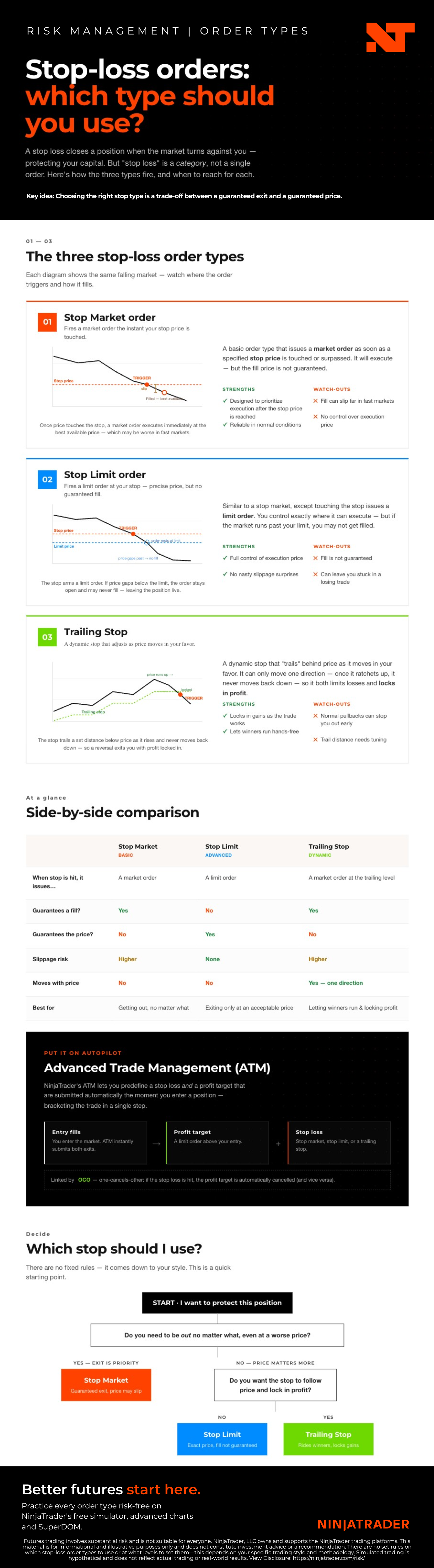
The graphic also includes a trailing stop. A trailing stop automates movement of the stop trigger as price moves favorably; it does not change the underlying execution trade-off. A trailing stop that becomes a market order still has price uncertainty after activation, while a trailing stop-limit can still fail to execute. For now, use fixed technical invalidation levels rather than adding automatic trailing logic.
Build the order around the trade plan
A properly structured trade plan contains separate instructions for entry, invalidation, and target. For example:
| Plan component | Example for a long MNQ trade | Order logic |
|---|---|---|
| Entry | Buy only if price retraces to | Buy limit |
| Invalidation | Exit if price trades below | Sell stop-market |
| Target | Take profit at | Sell limit |
Many platforms can submit these as a bracket or link the target and stop as an OCO group: if one exit fills, the other is canceled. That is operationally useful, but never assume the linkage is configured correctly. In simulation, verify all of the following before relying on a bracket:
- The entry quantity matches the stop and target quantities.
- The protective stop is on the correct side of the market.
- The target is a limit order and the invalidation exit is the intended stop type.
- The orders are attached to the correct NQ or MNQ contract.
- You understand whether the orders reside at the broker, the platform, or the exchange.
A simple directional check catches many order-entry errors:
| If you are… | Protective stop should be… | Profit target should be… |
|---|---|---|
| Long | Sell stop below entry/current price | Sell limit above entry/current price |
| Short | Buy stop above entry/current price | Buy limit below entry/current price |
Do not place a protective stop simply because a fixed dollar amount feels tolerable. First identify the technical invalidation, as in the previous lesson. Then determine the stop order type that best serves its purpose: usually an order designed to exit after invalidation rather than one designed to negotiate for a favorable price.
Key takeaways
Market, limit, stop-market, and stop-limit orders are tools for making a deliberate choice between execution and price control:
- Market: immediate execution is the priority; the fill price is uncertain.
- Limit: the price boundary is the priority; the fill is uncertain.
- Stop-market: a future price event triggers market-style execution; useful for protective exits and participation-based breakout entries.
- Stop-limit: a future price event activates a limit order; useful only when you accept the possibility of no fill after the trigger.
For an NQ/MNQ protective exit, a stop price is a technical invalidation trigger, not a promise of execution at that exact price. This is why the dollar risk calculation from the prior lesson is planned gross risk rather than a guaranteed maximum loss.
Next, you will quantify the gap between gross price movement and the real result by incorporating commissions, exchange fees, and slippage into a sample NQ or MNQ trade.
Can't find a good explanation? Sign up and we'll make it for you
Sign up