
Hello. Last lesson established the arithmetic of NQ and MNQ: NQ moves at USD 20 per index point (USD 5 per tick), while MNQ moves at USD 2 per point (USD 0.50 per tick). You also calculated gross profit or loss from actual entry and exit fills.
Now we use that arithmetic before the trade. A technically valid stop defines how much one contract can lose; your predefined dollar-risk limit then determines how many contracts, if any, are appropriate. The central discipline is simple: the stop comes from the trade idea; size adapts to the stop.
Start with the stop, not the contract count
A position-size calculation needs three inputs:
- A maximum planned dollar risk for one trade, .
- A planned entry price.
- A technical invalidation level, expressed as a stop price.
A technical stop is not “the number of points I can afford.” It is the price at which the reason for taking the trade is no longer valid. At this early stage, that may be a clear intraday swing:
- For a long, a stop can sit below the swing low whose hold is necessary for the long idea.
- For a short, a stop can sit above the swing high whose hold is necessary for the short idea.
Later modules will make this more specific using auction references, value boundaries, liquidity behavior, and order flow. The principle will not change: first identify the price that invalidates the setup, then measure the distance from intended entry to that price.
A small buffer beyond the reference can be part of the technical plan, provided it is chosen before sizing. For example, if a short thesis fails above a swing high at 21,007.25, placing the stop at 21,007.50 creates a 0.25-point buffer. The stop must still be at a valid 0.25-point futures increment.
The contract facts behind the calculation are fixed by the exchange.
E-mini Nasdaq-100 Futures Contract Specs - CME Group
Read the CME Group contract page to verify the official NQ multiplier and minimum price movement rather than relying on platform defaults or memory.
In the “About E-mini Nasdaq-100” section, read the contract description. Focus on the USD 20 multiplier and the 0.25-index-point minimum tick; together they imply a USD 5 value per NQ tick.
The Micro E-mini futures specifications table below gives the corresponding MNQ figures. MNQ has the same 0.25-point minimum tick, but its multiplier and tick value are one-tenth of NQ’s.
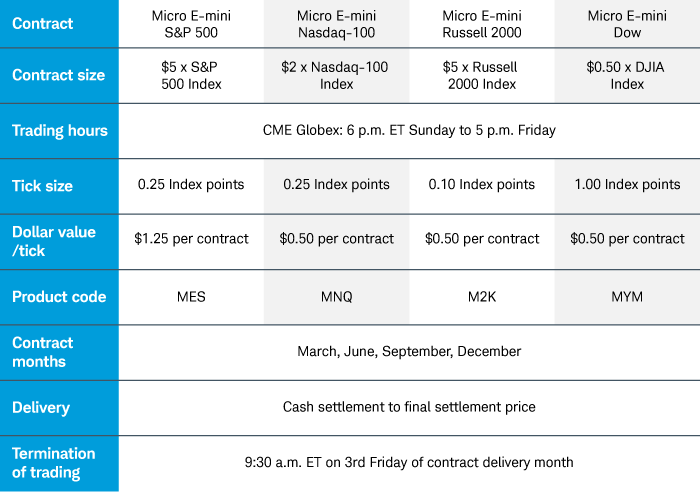
| Contract | Point value | Tick size | Tick value |
|---|---|---|---|
| NQ | USD 20 per point | 0.25 point | USD 5.00 |
| MNQ | USD 2 per point | 0.25 point | USD 0.50 |
Do not use margin as a substitute for trade risk. Margin is the broker-required deposit to hold a position; it does not tell you what a particular stop-out will cost. A one-contract NQ position might be permitted by margin, yet still risk far more than your trading plan allows.
The position-sizing formula
First calculate the stop distance. For a long or short, use the positive distance between planned entry and stop:
Because NQ and MNQ move in 0.25-point ticks:
Then calculate the dollar risk of one contract.
Using points:
where for NQ and for MNQ.
Or, using ticks:
where for NQ and for MNQ.
Finally, divide your maximum permitted risk by the risk of one contract:
Contracts must be whole numbers, so the permitted size is always rounded down:
This rounding rule is non-negotiable. Rounding to the nearest whole number can make a trade exceed the risk limit.
How Futures Position Sizing Works: A Practical Guide
Read MetroTrade’s practical overview for a compact explanation of why stop distance, tick value, and a preset risk ceiling determine futures size.
Begin with the “Notional Value vs. Margin” discussion, then read “Step 2: Set Your Dollar Risk Per Trade” and “Step 3: Measure Your Stop Distance.” In the fixed-dollar-risk discussion, read the implementation issue: a risk limit is a ceiling, not an amount that must be used in full. Then continue through “Applying the Position Sizing Formula,” paying particular attention to risk per contract and the NQ example.
A useful shortcut is to recognize the ten-to-one relationship:
in point-value exposure. At the same stop distance, one NQ risks exactly ten times as many dollars as one MNQ. MNQ therefore lets you make smaller sizing adjustments without altering the technical stop.
Worked example: one technical stop, two valid sizes
Assume you plan a short at 21,000.00. The short thesis is invalid above a defined swing high, so your stop is set at 21,007.50.
The stop distance is:
In ticks:
Suppose your maximum planned price risk is USD 200.
NQ calculation
One NQ contract risks:
Equivalently:
The raw position size is:
Round down:
So the permissible NQ position is 1 NQ contract, with planned gross price risk of:
There is USD 50 of unused risk capacity. That is acceptable. The risk limit is a maximum, not a target to be filled.
MNQ calculation
One MNQ contract risks:
The raw position size is:
Round down:
So the permissible MNQ position is 13 MNQ contracts, with planned gross price risk of:
Both positions respect the same technical stop and the same USD 200 cap. MNQ simply gets closer to the cap because it offers smaller units of exposure.
When NQ does not fit the risk limit
Suppose a planned long entry is 21,000.00 and the technically necessary stop is 20,986.75.
The stop distance is:
That equals:
With a USD 100 risk limit, one NQ contract risks:
Since USD 265 exceeds the USD 100 limit:
The correct conclusion is not “trade one NQ because the setup looks strong.” It is: this NQ trade does not fit the predefined risk rule.
Now check MNQ:
Three MNQ contracts carry planned price risk of:
Four MNQ contracts would risk USD 106, which exceeds the limit. Therefore the permissible position is 3 MNQ, not 4.
If even one MNQ exceeds the limit, the setup cannot be traded at that risk level. The choices are to pass on the trade, wait for a different entry that genuinely changes the technical structure, or reassess the trading plan outside the pressure of the moment. Do not pull a stop closer merely to force a trade into the budget.
A pre-trade sizing routine
Before every simulated or live order, write the calculation in this order:
| Field | Example |
|---|---|
| Risk limit | USD 200 |
| Contract considered | MNQ |
| Planned entry | 21,000.00 |
| Technical stop | 21,007.50 |
| Stop distance | 7.50 points, or 30 ticks |
| Risk per contract | USD 15 |
| Raw size | 13.33 MNQ |
| Permitted size | 13 MNQ |
| Planned gross price risk | USD 195 |
Use these operating rules:
- Measure from the planned entry to the actual protective stop, not from entry to a hoped-for target.
- Calculate risk per contract first. This exposes immediately whether NQ is too large for the setup.
- Round down every time. A position smaller than the cap complies; a position above it does not.
- Keep the stop and size linked. If you move a stop before entry, recalculate size. If the entry changes materially, recalculate size.
- Do not increase size because of conviction. A stronger opinion does not reduce the dollar loss if the stop is hit.
- Treat this as planned gross price risk. It assumes execution at the stop price and excludes commissions, fees, and adverse slippage. The next lesson will quantify how those execution costs affect the final net result.
For now, use a calculator rather than trying to do every division mentally. Fast arithmetic is helpful, but a consistent written process is more important than speed.
Key takeaways
Position sizing is the reverse of the profit-and-loss calculation from the previous lesson. First, use the chart to place a technically justified stop. Next, convert that stop distance into dollar risk per contract. Then divide the predefined dollar-risk cap by that per-contract risk and always round down.
The core formulas are:
Use for NQ and for MNQ. If one NQ is too large, MNQ may allow a valid smaller position; if one MNQ is too large, the trade does not fit the risk plan.
Next, you will choose among market, limit, stop, and stop-limit orders for particular execution situations—an important distinction because a well-sized trade can still be poorly executed.
Can't find a good explanation? Sign up and we'll make it for you
Sign up