
Hello again. In the previous lesson, you turned a location or subject into a working artistic intention: a statement about the visual event the eventual painting should pursue. Now comes the first reality check. Before investing time in studies and references, you need to ask whether the actual motif can supply a durable design for a larger canvas.
A promising motif is not necessarily dramatic, picturesque, or packed with detail. It is one whose large shapes, value organization, and light effect remain clear when the small incidents of nature are ignored. This lesson gives you a practical way to make that judgment in the field.
The enlargement question: what survives when detail disappears?
A small plein-air study can succeed through freshness, a few lively marks, or the pleasure of directly observed color. A larger studio painting needs more structural endurance. The viewer will stand farther away at times, and the larger surface gives every weak interval, confused edge, or accidental patch of contrast more authority.
So evaluate the motif at two scales at once:
- From a distance: Does it read as a coherent arrangement of light, dark, and middle-value masses?
- Up close: Is there enough observed variation in the subject to develop selected areas without disrupting that large arrangement?
The first question matters more at this stage. If the motif does not work as a reduced pattern, extra foliage, stones, reflections, or texture will not rescue it at a larger scale.
The forest-and-water block-in below is useful precisely because it strips away local color and detailed description. The pale sky opening, dark vertical tree grouping, middle-value bank, and darker water are already doing the essential work. The individual trunks and reflected marks can be developed later only because these broad relationships are established first.
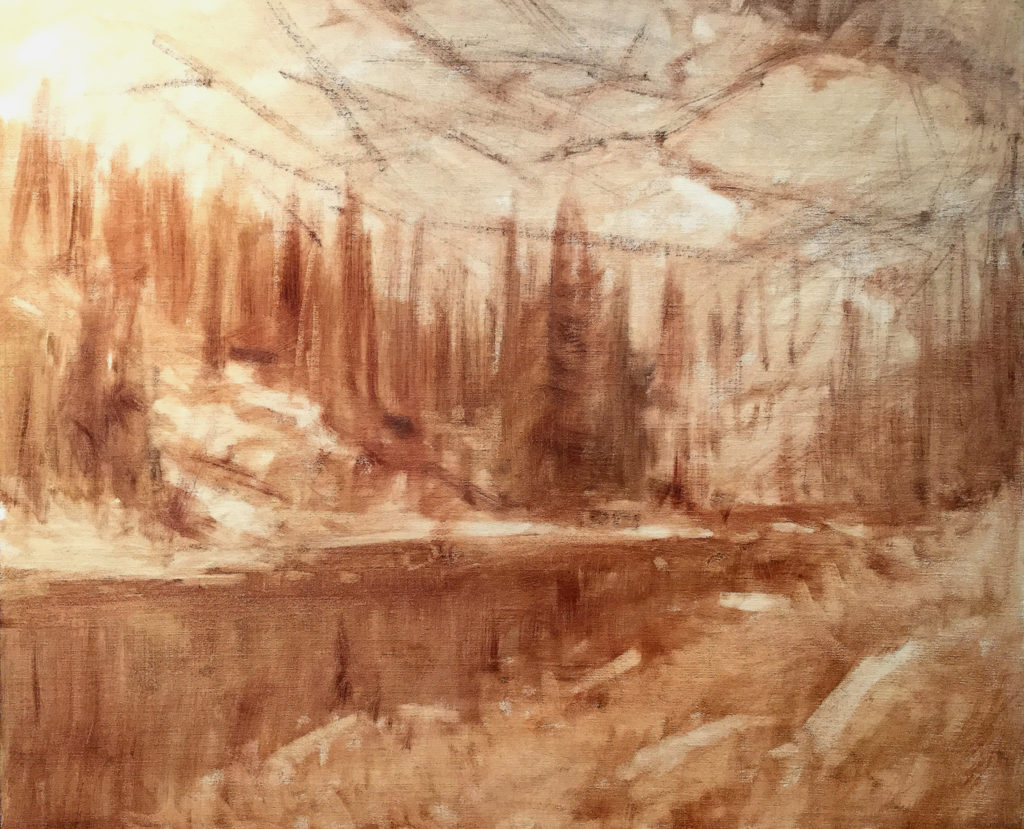
When judging a motif, try to name its components by their pictorial role, not merely by their objects:
- not “some trees, a lake, and a hill,”
- but “a dark vertical enclosure against a pale opening, supported by a horizontal reflecting plane.”
That second description reveals whether there is a design premise worth enlarging.
First screen: can the scene become a few decisive shapes?
A landscape is full of boundaries, but not every boundary deserves to become a painted shape. The decisive test is whether you can reduce the view to a small number of major masses while retaining its particular energy.
A notan uses only two values, usually white paper and a dark mark. It does not record all the information you see. It asks a more severe question: if every subtle transition vanished, would the remaining light-dark pattern still be worth looking at?
Composition Before Color — Considerations in the First Phases of Plein Air Painting
Read Mitchell Albala’s discussion of notan, limited-value studies, and major shape design. It gives a disciplined way to judge whether a motif has an abstract structure strong enough to support a painting.
Begin with the subsection “The 2-value study (notan),” reading the explanation of notan. Then continue through “The 3-value study” and “Designing with Shapes.” In the first bullet list under “Designing with Shapes,” read the criteria for major shapes, especially the guideline of three to seven dominant masses, variation in their sizes, and unequal proportions of light and dark. Finish with “In praise of the humble thumbnail”; read the thumbnail guidance and note why a bold, small study exposes shape structure more honestly than a detailed drawing.
The guideline of three to seven major shapes is not a law. A quiet horizon may be built from only three large zones; a complex harbor may need more. The point is that the painting should have a limited number of masses that dominate all its lesser events.
What to look for in the shape pattern
A motif has promising shape structure when:
-
The major masses have distinct silhouettes.
You can indicate where a hill meets sky, where dark trees interrupt a field, or where water cuts beneath a bank without tracing hundreds of little contours. -
The shapes differ in size and role.
A large quiet area, a medium supporting mass, and a small interruption usually create more life than several similarly sized patches distributed evenly across the view. -
The spaces between objects are active.
The opening of sky around a tree group, the gap between two hills, or a wedge of light entering a dark wood can be as important as the objects themselves. If these negative shapes are vague or repetitive, enlargement often makes the painting static. -
The pattern has an identifiable emphasis.
One shape or one relationship should feel like the reason to look: a bright inlet held by dark land, a diagonal shadow crossing a field, a tall dark tree against a luminous sky. -
Details sit inside larger containers.
A busy foreground may contain grasses, rocks, and small shadows, but it should first read as one foreground mass. If every small event demands equal attention, the motif is likely to fragment on a larger canvas.
Phil Starke’s thumbnail demonstration shows why reduction is an evaluation tool rather than merely a preparation step.
The Importance of Thumbnails for Landscape Painting Tutorial
Watch “The Importance of Thumbnails for Landscape Painting Tutorial” by Phil Starke. He demonstrates how thumbnails sort a complex scene into large placements, light-dark groups, and shadow patterns before color or detail takes over.
Watch the purpose for the basic role of thumbnails in arranging major value masses. Then watch the examples, where Starke reduces photographs into simple dark and light groupings, changes elements, and tests whether the subject has a stronger large-scale arrangement than the unedited reference provides.
A useful field habit is to make a tiny two-value thumbnail with a broad pencil, marker, or brush. Keep it quick enough that you cannot render foliage or texture. If the image reads immediately at arm’s length, the motif has passed a meaningful first test. If it becomes an indecisive gray puzzle, you have identified a problem early.
That does not always mean reject the location. A different crop, a shift in viewpoint, or a different time of day may reveal the structure that is currently hidden.
Second screen: does the value structure separate the shapes?
Clear shapes need clear value differentiation. In painting, two objects can be different colors yet merge visually if they are too close in value. A viewer may recognize them in life because the eye moves, focuses, and uses binocular depth perception. On a flat canvas, their separation has to be deliberately organized.
A practical value study generally uses three or four groups:
| Value group | Typical role in a landscape |
|---|---|
| Light | Sky, direct sunlit planes, high-key water reflections, snow |
| Light middle | Open ground, hazy distance, muted sunlit surfaces |
| Dark middle | Hillsides, distant vegetation, shadowed ground |
| Dark | Tree masses, cast shadows, deep recesses, strong silhouettes |
These are functional groups, not fixed formulas. A storm sky can be darker than a sunlit field, and water may be dark rather than reflective. The essential question is whether the values make the important forms separate, readable, and hierarchically ordered.
The Landscape Painter's Guide to Selecting Reference Photos
Read Mitchell Albala’s guide as a field-selection tool, not only as advice about photography. Its central distinction—clear versus poor differentiation—applies directly to judging a view in person.
In “Shape and Value Differentiation,” read the diagnosis of close values, then examine the examples under “Photos with Poor Differentiation.” Continue to “Photos with Good Differentiation” and read the contrast with stronger motifs. Next, in “How the Direction of the Light Affects Differentiation,” read the discussion of crosslight. Finally, in “Setting Up the Spatial Stage,” read from “In terms of visual perception” through the explanation of overlap and scale.
The squint test
To assess values on location, soften your focus until small details disappear. Squinting is not magic, but it compresses the scene into broader zones. Ask:
- Does the sky separate from the land?
- Do the major landforms separate from each other?
- Does the foreground establish itself without becoming a dead, undifferentiated dark band?
- Is the focal event supported by a useful contrast of value?
- Are there enough middle values to connect lights and darks, rather than only isolated black-and-white spots?
A common weak motif is visually attractive yet built almost entirely from middle values: green grass against green trees, gray rocks against gray earth, or a cloudy sky over a similarly valued hill. Such a scene can feel rich in person, but a large painting may become muddy unless there is a strong shape relationship or color contrast that can be responsibly developed.
Another danger is the detail trap. A sunlit shrub may contain hundreds of distinct leaves, but if the shrub’s overall light value is nearly identical to the wall, hill, or field behind it, its intricate detail does not create a usable large shape. At studio scale, rendering all those leaves would increase labor without increasing clarity.
The four-value approach helps prevent this. Instead of asking, “What exact value is this small patch?” ask, “Which major value family must this patch belong to for the painting to read?” Minor variations can be added later, contained within the larger mass.
Third screen: is the light effect clear, coherent, and worth preserving?
Light is not merely an attractive surface effect. It is often the condition that organizes the entire motif. It tells you why one plane is light, another dark, and why forms turn or separate in space.
The most direct situation for evaluating form is crosslight: light arriving from the side at an angle. This gives a subject a light side and a shadow side. On a building, it may distinguish the front plane from the side plane; on trees, it can separate sunlit foliage from interior shadow; on terrain, it reveals the tilt of hills and the direction of ground planes.
For a landscape intended to feel dimensional, ask whether the light is doing at least one of these jobs:
- revealing the orientation of large planes;
- casting shadows that connect or lead through the composition;
- separating a foreground mass from its background;
- creating an atmospheric event such as a bright opening, a rim-lit silhouette, or a reflection;
- establishing a believable time, direction, and temperature of light.
Backlighting and overcast conditions are not automatically weak. Backlight can create powerful silhouettes, especially when a dark tree line cuts clearly against a bright sky or water. Overcast conditions can produce quiet, unified color and subtle atmosphere. The standard is not “must be sunny.” It is whether the selected condition gives you a clear visual effect and enough separation to sustain the intended painting.
What weakens a motif is light that seems accidental: scattered, unrelated bright spots; large shadow regions with no readable structural role; or a scene in which the light source is impossible to infer. A large painting magnifies these ambiguities.
Because sunlight changes rapidly, evaluation sometimes requires returning to the motif rather than deciding from a single encounter. Ian Roberts’s approach to scouting makes this practical: observe the site before the desired light occurs, identify the moment when shadows create the needed arrangement, and be ready to work as that moment arrives.
How to Catch the Light en Plein Air
Watch “How to Catch the Light en Plein Air” by Ian Roberts for a concise demonstration of scouting a subject according to the development of its light and shadow pattern.
Watch the scouting method to see why Roberts identifies the best time for a view before beginning to paint. Continue with the shadow comparison, where he compares the scene before the target moment with the later pattern of shadows he actually wants to capture. Focus on the idea that a paintable light effect is specific in time, not a generic feature of the place.
When you find a potentially strong light effect, record more than “late afternoon” or “nice shadows.” Note:
- the direction from which the sun enters the scene;
- which major planes are lit and which are in shadow;
- the cast-shadow shapes that matter to the composition;
- whether the light is becoming stronger, weaker, warmer, or cooler;
- the approximate time when the pattern is most convincing.
Those observations will become important evidence for later plein-air studies, but right now they help you decide whether the motif has a repeatable or at least clearly understood visual condition.
Make an enlargement judgment, not a beauty judgment
Use the following screen to distinguish a location that is pleasant from one that has a viable foundation for a large painting. Rate each category mentally as strong, uncertain, or weak while standing before the motif or looking at a preliminary sketch.
| Screen | Strong indication | Warning sign |
|---|---|---|
| Major shapes | A few distinct masses create a memorable pattern when reduced. | The view depends on innumerable small objects or repeated, similar shapes. |
| Value structure | Light, middle, and dark families separate major forms. | Most important forms merge into one value range. |
| Light effect | Light has a clear direction or a deliberate silhouette effect. | Highlights and shadows are scattered or do not clarify the scene. |
| Spatial stage | Overlap, scale changes, diagonals, or plane changes establish depth. | Foreground, middle ground, and distance collapse into a flat band. |
| Focal potential | One contrast, opening, turn, or form can receive emphasis. | Every area competes with equal contrast and detail. |
| Enlargement potential | The pattern remains interesting as a small value sketch, while selected areas offer room for development. | The design dies when reduced, or it requires copying detail to retain interest. |
A motif need not receive “strong” in every category. A simple backlit scene may have flat forms but exceptionally clear silhouettes; a misty landscape may use subtle values but possess a powerful depth sequence. The crucial issue is whether one strength is genuine enough to organize the painting and whether the weaknesses can be addressed through a modest crop, viewpoint adjustment, or return at a better light condition.
Three decisions are especially useful:
-
Proceed: The motif has a compelling reduced pattern, clear value grouping, and a light condition you can observe or document consistently.
-
Return and scout: The underlying location is promising, but the present light is not revealing its best structure. Identify the likely time, weather, or viewpoint to test next.
-
Harvest, but do not commit: The scene contains useful color, texture, a tree shape, or a local detail, but it lacks a durable overall arrangement. Keep it as supplemental material rather than making it the basis of a large project.
This protects you from an expensive mistake: committing to a large canvas because a place feels emotionally attractive while its pictorial structure remains unresolved. Emotional attachment can absolutely motivate a painting, but the structure must carry that attachment to the viewer.
Key takeaways
A landscape motif is suitable for enlargement when its essential design survives simplification.
- Reduce the view to a two-value notan and then a three- or four-value study to discover whether its major masses are clear.
- Seek a limited number of dominant shapes with varied size, role, and spacing.
- Judge differentiation by value, not by the amount of visible detail or the number of colors present.
- Look for light that clarifies planes, creates a purposeful shadow pattern, or produces strong, distinct silhouettes.
- Check that overlap, scale, and directional cues provide a spatial stage.
- If the motif fails as a small abstract pattern, reconsider the crop, viewpoint, or time of day before committing to it.
Next, you will choose a target format and canvas size that suits the motif’s visual structure, the intended viewing distance, and any competition constraints.
Can't find a good explanation? Sign up and we'll make it for you
Sign up