
Hello, and welcome to the first stage of your field-to-studio landscape project. This module is about designing a project before you begin collecting plein-air studies, photographs, and notes. The aim is not to predetermine every brushstroke. It is to give your observations a purpose.
For a large studio landscape, a location is only raw material. “A marsh at sunset,” “mountains after snow,” or “the harbor near my house” names a subject, but it does not yet say what the painting is about visually. In this lesson, you will formulate a concise artistic intention: a working statement that identifies the visual event you want to pursue, the experience or movement you want to create for the viewer, and the design priorities that fieldwork must investigate.
By the end, you should have a practical one- or two-sentence intention that can guide your choices in the field without imprisoning you in a rigid plan.
From subject matter to a visual intention
A landscape contains far more information than a painting can use: changing weather, innumerable details, multiple possible crops, competing light effects, and the simple fact that your attention shifts as you look. Without an intention, it is easy to collect attractive but disconnected reference: a good cloud photograph, a nice tree study, a road that interests you, a sunset that may not match the rest.
An artistic intention is a selective premise. It says:
- what visual relationship initially matters;
- what the painting will emphasize;
- what will be subordinated or left out;
- why this particular landscape warrants a large studio treatment.
It is not a claim about accurately documenting a place. It is an internal design brief for a painting.
For example, compare these statements:
| Kind of statement | Example | What it does |
|---|---|---|
| Subject label | “A painting of a snowy mountain valley.” | Names what is depicted. |
| Technical plan | “I will make a large oil painting from sketches and photos.” | Names a method. |
| Artistic intention | “I will use the interlocking dark rock masses and broad snowfields to lead the eye through a stark, descending mountain space, preserving the quiet dominance of winter light.” | Names the visual event, design means, and intended effect. |
The final version is still concise, but it can direct real decisions. It implies that dark-light pattern and the rhythm of snow shapes matter more than cataloguing every rock. It also implies that any field study should investigate the mountain’s large value structure, not merely its surface detail.
Mitchell Albala calls such a starting point an “aesthetic event”: the compelling relationship that makes the subject more than its literal inventory. In his rooftop example, the key event is not simply buildings under clouds; it is the opposition of orderly constructed lines and chaotic weather.
Evaluating Photo Reference for a Series of Landscape Paintings
Read Mitchell Albala’s critique example to see how a broad subject becomes a visual mission. His term “aesthetic event” is especially useful when you are tempted to begin with only a place name or an attractive view.
In the opening response, read from “These photos are a fine starting point. Unlike many photos we have reviewed” through the question about improving on the source. Then continue through the paragraph beginning “It sounds like you have already discovered” and ending “much more than that!” Notice the shift from literal motif—rooftops and sunset—to the tension of order against weather.
The phrase “improve on the source” does not mean nature or a photograph is inadequate. It means a painting should make a deliberate selection and organization. Your work may intensify a relationship already present, simplify it so it reads clearly at a larger scale, or develop an atmosphere that a camera could not organize for you.
Think in relationships, not objects
A useful intention is usually built around a relationship rather than a list of things. Landscapes become paintable when you notice interactions such as:
- a low band of intense evening light compressed beneath a heavy sky;
- dark evergreens cutting across a pale, open lake;
- the ordered perspective of buildings interrupted by irregular vegetation;
- a winding illuminated road disappearing into subdued, cool distance;
- a vertical stand of trees resisting the broad horizontal sweep of water and shore;
- a quiet expanse interrupted by one concentrated, high-contrast event.
These are not recipes. They are examples of visual propositions: statements about how shapes, values, colors, edges, and directional forces work together.
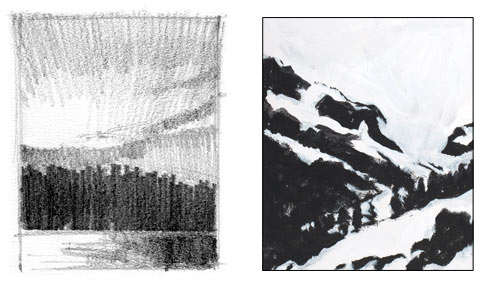
Look at the mountain study in the image. Its identity does not depend on carefully rendering each ridge. Large white snowfields and dark rock shapes create the sense of descent, scale, and terrain. If the artistic intention concerned the forceful pattern of snow and rock, then fieldwork would prioritize:
- several quick value studies to test the placement and proportion of light and dark;
- notes on the temperature of snow in light versus shadow;
- close studies of rock edges and snow transitions only where they support the major pattern;
- observations of atmospheric distance, so the darks do not flatten into a single black silhouette.
That is the practical power of intention: it tells you what evidence to gather.
Richard Robinson describes this as beginning with a “big idea.” In his example, the central idea is a contrast arrangement: dark distance set against light foreground. He then protects that idea, even when changing light offers attractive but distracting possibilities.
Painting - what's the big idea!?
Watch Richard Robinson Studio’s “Painting - what’s the big idea!?” for a compact demonstration of how one visual concept governs later decisions.
Watch the big idea to hear the distinction between subject and visual concept. Then watch protecting contrast. Focus on the moment when Robinson declines to add distant highlights: the observed scene changed, but those highlights would have weakened his stated contrast design.
A clear intention therefore has a productive negative side: it grants permission to omit, quieten, alter, or postpone material that does not serve the painting. This is particularly important for a large canvas, where every additional element has more visual weight and more time spent on it can make it harder to remove.
The intention must anticipate composition
“Atmosphere,” “beauty,” “nature,” and “light” can be meaningful personal motivations, but alone they are too broad to guide fieldwork. To become useful, an intention must connect the desired feeling to visible means.
For instance:
- Too broad: “I want to capture the peacefulness of the coast.”
- More actionable: “I will create stillness through a low horizon, a broad quiet middle-value sea, and one small, crisp boat silhouette held against a band of cooler distant light.”
The second statement can be tested. Does the horizon need to be low? Is the sea actually a broad middle-value mass under the intended light? Does a boat create a focal interruption, or does it become too illustrative? What must be observed before the light changes?
Ian Roberts makes the same point from the standpoint of composition: the painter structures a route for attention, rather than accepting every feature at equal strength. A focal area needs support from the rest of the painting, not competition from equally emphatic contrasts elsewhere.
Landscape Painting Techniques - Design - DVD with Ian Roberts
Watch selected passages from Jackson’s Art’s “Landscape Painting Techniques - Design - DVD with Ian Roberts.” Roberts connects painterly depth and emotional force to the arrangement of color shapes, then shows how a stated intention becomes a compositional roadmap.
Begin with design first for the premise that landscape depth and feeling are made through organized color shapes rather than finish alone. Then watch the roadmap, where Roberts identifies a chosen destination for the eye and explains why competing high-contrast elements must be reduced. Relate this to your own intention: where should the viewer arrive, and what areas must release attention rather than hold it?
At this stage, you do not need to settle every compositional issue. The next lessons will assess motifs, formats, and planned studies more systematically. But your intention should already suggest a provisional answer to three questions:
-
What is the dominant visual relationship?
Usually a relationship among large value masses, color temperatures, directional movement, or contrasting forms. -
What is the viewer’s journey or focal destination?
This can be a quiet resting point, an area of visual tension, a distant opening, or an emphatic foreground event. It does not have to be a literal object. -
What must remain subordinate?
Naming likely distractions early is useful. Examples include an overly busy foreground, dramatic but unrelated clouds, equal detail across the canvas, or photographic color that disrupts the chosen harmony.
A concise structure that remains flexible
Use this template as a drafting tool:
I will use [dominant observed relationship] to create or reveal [intended visual experience], organizing attention around [focal destination or movement] while subordinating [likely competing material].
Not every intention needs all four clauses in its final form. The point is to make the necessary decisions visible.
Here are several landscape-specific examples.
Example 1: storm and architecture
I will contrast the measured horizontal and vertical rhythm of waterfront buildings with a looming, irregular storm sky, allowing a narrow band of reflected light to carry the eye toward the distant harbor.
This implies fieldwork on perspective, cloud mass, the value of the reflected strip, and the effect of the harbor at different stages of weather. It does not require painting every building or every cloud.
Example 2: late-afternoon woodland
I will build a sense of passage into the woods through a warm, broken path entering a cool, enclosed mass of trees, with the brightest and sharpest contrasts reserved for the path’s turn into shadow.
This tells you to record the warm-cool relationship, path geometry, tree spacing, and the exact value hierarchy at the turn. It also warns against scattering bright highlights across the entire forest.
Example 3: expansive winter scene
I will use broad pale snow shapes against a small number of dark, angular landforms to make a quiet but forceful descent through an open winter valley.
This is close in spirit to the value study shown above. The landscape’s “story” is not merely snow; it is the spatial rhythm and pressure of the large abstract shapes.
Example 4: an ordinary nearby subject
I will transform a familiar road-edge view into a study of changing scale: a large, textured foreground verge will give way to simplified fields and a thin, cool horizon, making distance feel unexpectedly vast.
A compelling intention does not require a spectacular site. Albala’s rooftop work began with a repeatedly accessible subject and developed through changing interpretations of composition, color, and light. Revisiting a place can be an advantage because it gives you time to distinguish a passing attraction from a motif with deeper potential.
Landscape Painting: Working in Series with “Rooftops”
Read Mitchell Albala’s account of his rooftop series to see how a modest, accessible motif can support sustained investigation. The useful lesson here is not to copy a series format, but to identify a visual question that gives repeated observation direction.
Read the section “Requirements for Painting in Series,” from “Before beginning a series, ask yourself if the subject has enough visual potential” through the discussion of revisiting a subject. Then read “Benefits of Working in Series,” especially the paragraph beginning “A series is also a great way to explore color.” Finally, in “Process and Inspiration,” read from “I first find the composition by applying a limited focus” through the composition and color adjustment example. Notice that observation supplies material, while limited focus and deliberate color choices create the interpretation.
Drafting your own field-to-studio intention
Set aside a brief planning page before your first field session. Keep the writing private and direct; it is not an artist statement for an audience.
Write four short fragments:
- Motif or place: What location, view, or recurring subject are you drawn to?
- Aesthetic event: What contrast, rhythm, light effect, spatial condition, or tension makes it compelling?
- Focal priority: Where should attention gather, pause, or move?
- Non-negotiable evidence: What must you study from life before you can responsibly make the larger painting?
Then compress the fragments into one or two sentences. Aim for roughly 25 to 50 words. If the statement becomes long, it may be trying to preserve too many ideas at once.
A practical intention should pass these checks:
| Check | A strong answer sounds like |
|---|---|
| Specific enough to guide observation? | “Record the warm road against the cool tree shadow” rather than “study color.” |
| Visual rather than merely narrative? | “A bright opening held inside dark woods” rather than “a memory of a hike.” |
| Selective? | It gives you a reason to simplify or omit some material. |
| Open to discovery? | It identifies a pursuit, not a promise to reproduce one fleeting scene exactly. |
| Appropriate to scale? | It depends on relationships that can remain legible and compelling on a large canvas. |
Do not mistake flexibility for vagueness. Weather may change, access may be limited, and a stronger composition may emerge in the field. Your intention can be revised after seeing the place. But revisions should become clearer, not merely accumulate new attractions. If your original idea is “the narrow gold light beneath the storm,” and you discover that the real power lies instead in the dark shoreline’s zigzag against that light, revise the intention to name that newly understood relationship.
Before leaving for fieldwork, make a final working version in this form:
Working intention: [one or two sentences]
I need to observe: [three or four kinds of visual evidence]
I will resist: [one or two distractions likely to weaken the idea]
This small document will become the basis for the next lesson, where you will judge whether a particular landscape motif actually has shapes, value structure, and light effects strong enough to sustain enlargement.
Key takeaways
A large studio landscape begins with more than a location or a pleasing photograph. Its starting point is a concise artistic intention: a statement of the visual event you want to investigate and the design priorities that will organize your fieldwork.
Remember:
- A subject names what is there; an intention identifies what matters in it.
- Strong intentions focus on relationships among value, color, shape, depth, edges, and directional movement.
- An intention establishes a focal priority and also identifies what should remain subordinate.
- It should be concrete enough to direct your studies, yet open enough to accommodate genuine discovery outdoors.
- Treat it as a working compass, not a public statement or an inflexible contract.
Next, you will evaluate a landscape motif for its enlargement potential: whether its large shapes, value pattern, and light effect can remain compelling when translated from field observation to a larger studio canvas.
Can't find a good explanation? Sign up and we'll make it for you
Sign up