
Introduction
Hello! In our last lesson, we delved into the Wayuu creation myth, meeting the creator deity Maleiwa and witnessing how the dramatic interactions of other divine beings gave birth to the world and the Wayuu people. We were briefly introduced to two of those key figures: Juya, the rain, and Pulowi, a complex being of the underworld, whose conflict sparked the origin of humanity.
Today, we will focus entirely on this divine pair to address our learning outcome: to explain the roles of Juya (rain) and Pulowi (drought/underworld) in the Wayuu worldview. Think of them not just as gods of weather, but as the two poles of a battery that powers the Wayuu cosmos. Their constant push and pull—a dynamic of opposition, union, conflict, and dependence—provides a powerful narrative framework for understanding life, death, and the challenging environment of La Guajira. For someone with your background in systems thinking and storytelling, this duality is a fascinating example of how a culture builds a coherent model to explain its reality.
1. The Divine Couple: A Story of Love and Conflict
The relationship between Juya and Pulowi isn't one of simple good versus evil. They are intrinsically linked as husband and wife, and their stories are foundational. To understand their dynamic, let's start with a version of the myth that highlights their relationship and its consequences.
Forgotten Guerillas of La Guajira, Colombia
This reading, from the blog 'Notes from the Road', recounts a version of the Wayuu origin story that specifically focuses on the relationship between Juya and Pulowi. It establishes them as a divine couple whose actions have direct consequences for the world.
Read the section beginning with the line 'In the fifth generation, Juuya, the god of rain fell in love with another Wayuu goddess, who we call pulowi.' Continue reading to the end of the myth, where it concludes with '...women’s vaginas are thankfully toothless. With this story I wanted to share with you how important our older brothers are to us and the respect we have for them.' This is the same myth from our last lesson, but I'd like you to reread this specific part with a new focus: the nature of the relationship between Juya and Pulowi.
This story frames their relationship through romance, infidelity (Juya's affair), and jealousy (Pulowi's reaction). This is not just a meteorological explanation; it's a family drama on a cosmic scale. This narrative directly connects their relationship to the creation of the first Wayuu man and woman, reinforcing that their dynamic is not just about the weather, but about the very existence of people.
2. Juya and Pulowi: The Poles of Existence
Now, let's break down their individual roles and how they function as a system. They represent a fundamental duality that defines the world.
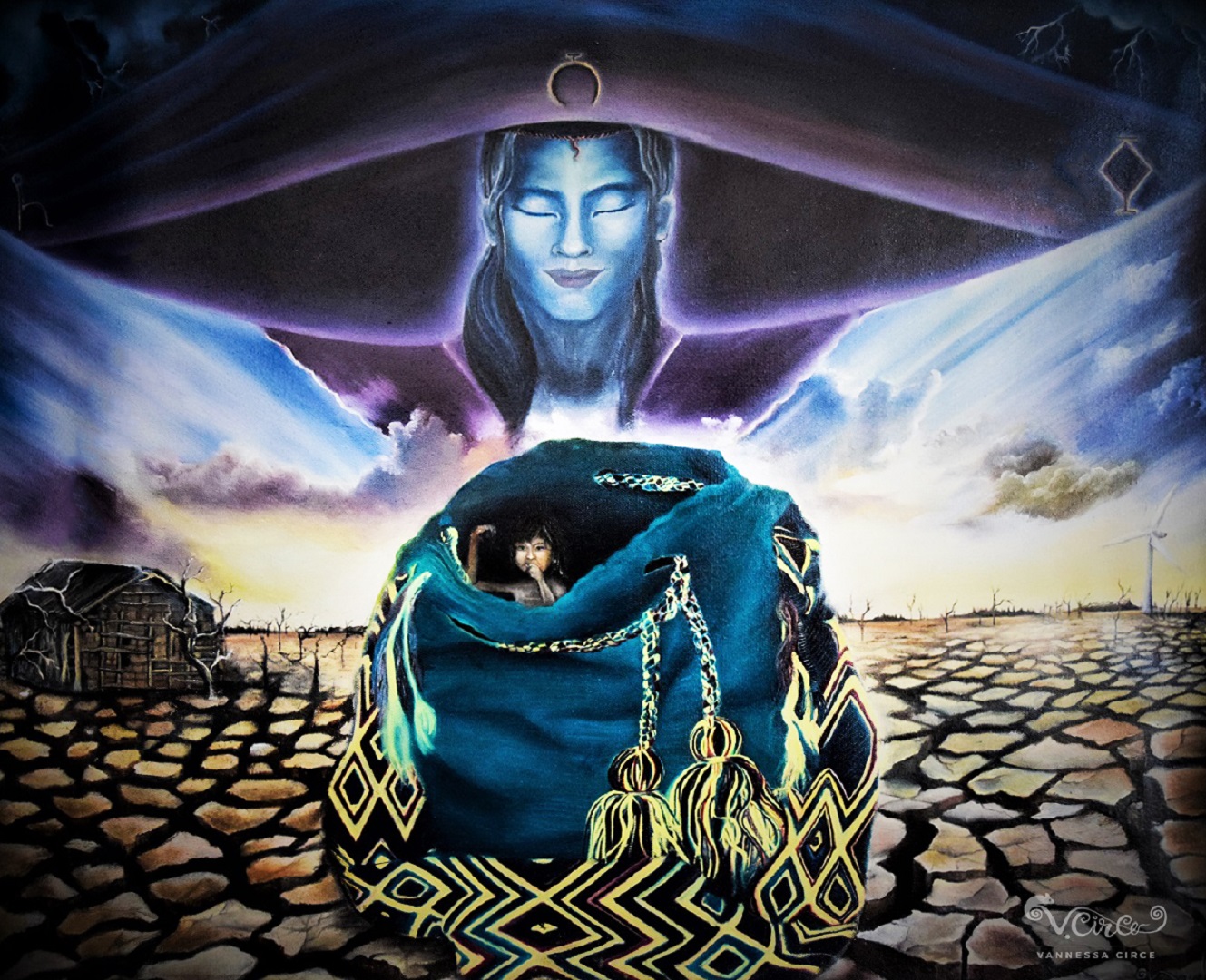
Juya: The Wandering Bringer of Life
As you've learned, Juya is the personification of rain. In the arid landscape of La Guajira, rain is life.
- Role: He is the life-giving, fertilizing force. He brings the water that allows plants to grow, animals to drink, and people to survive.
- Attributes: Juya is associated with the masculine, the sky, and mobility. As we saw in the previous lesson, Wayuu men are symbolically linked to him, embodying this "wandering" nature as they move with herds or travel for trade.
- Authority: Juya is not just a passive phenomenon. He is a powerful being with agency. The story of the winds Jepirachi and Aruleeshi, which you can explore in the resource "Stories with GPS," shows Juya acting as a grandfatherly authority figure, sending messengers and receiving tribute from the winds who are his "fisher grandsons." His influence extends beyond just making it rain.
Pulowi: The Sovereign of Place
Pulowi is a far more complex figure than simply "drought." She is a sovereign entity, tied to specific, dangerous, and powerful places on both land and sea.
To understand her multifaceted nature, let's turn to a resource that breaks down her different aspects.
Stories with GPS. A mythic and historical geography of La ...
The resource 'Stories with GPS' provides a clear and concise explanation of Pulowi's role. It moves beyond a simple definition of 'drought' and reveals her as a powerful owner of specific domains.
Read the section that begins with 'Pulowi is a feminine mythical being...'. It's a short but dense paragraph. Focus on the distinction between the 'Pulowi from the deep sea' and the 'Pulowi of the land'.
From this, we can see Pulowi is not just absence (of rain) but a powerful presence:
- Role: She is the sovereign of the underworld, the sea, and wild, untamed places. She is the owner of the animals that live there. She is associated with disease and death, and places named after her are considered dangerous.
- Attributes: Pulowi is associated with the feminine, the earth/underworld, and permanence. She is rooted in place, contrasting with Juya's mobility. As the reading notes, "All Pulowi are wives of Juya."
- A Dual Domain: The distinction you just read about is key.
- Pulowi of the sea is considered wealthy, owning turtles, fish, and jewels. She represents the vast resources of the ocean.
- Pulowi of the land is poor, her herds consisting of wild animals like deer and foxes. This reflects the harsh, resource-scarce reality of the desert.
This duality within Pulowi herself shows a sophisticated understanding of the environment. The sea, while dangerous, is a source of great wealth (fishing), while the arid land offers a more precarious existence.
3. The System in Action: Balance, Cycles, and Explanation
The interaction between Juya and Pulowi creates a dynamic system that explains the world.
- The Cycle of Seasons: When Juya travels, he brings the rainy season (Juyapu). When he is absent, the long dry season (Jemial) dominates, which is the time of Pulowi's influence. Their cyclical "relationship" is the engine of the seasons.
- Explaining Fortune and Misfortune: This duality provides a framework for explaining events. A successful hunt for turtles could be seen as a gift from the wealthy Pulowi of the sea. A snakebite or disease could be attributed to transgressing into a land-based Pulowi's territory. A good rainy season is a sign of Juya's presence and favor.
- A Necessary Tension: Life is not possible without both. Juya's life-giving rain needs Pulowi's earth to fall upon. The wealth of Pulowi's sea provides sustenance when the land is dry. Their opposition is not a flaw in the system; it is the system. It creates the world and the conditions for life within it.
Test your understanding!
Imagine you are a Wayuu elder explaining two recent events to a child:
- The community's fishing boats returned with an unusually large catch of fish and lobster.
- A herder, searching for a lost goat near a strange-looking cave, became mysteriously ill.
How would you explain these events using the concepts of Juya and Pulowi?
Show answer
You might explain it like this:
- For the large catch: "The sea was generous to us. The great Pulowi of the deep sea, who is wealthy and owns all the creatures in the water, shared her riches with our fishermen. We must be thankful for her gift." This acknowledges Pulowi's role as the sovereign of marine wealth.
- For the ill herder: "The herder wandered too close to a place that belongs to Pulowi of the land. That cave is one of her homes. She is the owner of wild places and does not like to be disturbed. His illness is a warning to respect her territory." This explains the negative event as a transgression against Pulowi's sovereignty over a specific, dangerous place.
Notice that neither event is directly attributed to Juya, as they relate to the domains of wealth and sickness that are specifically under Pulowi's control.
Conclusion
In this lesson, we have moved beyond a simple introduction to Juya and Pulowi to understand their profound and complex roles in the Wayuu worldview.
Key Takeaways:
- Juya is the masculine, mobile deity of rain, associated with the sky, travel, and the life-giving wet season.
- Pulowi is the feminine, stationary deity of the underworld and wild places. She is a complex sovereign who is both "wealthy" (in the sea) and "poor" (on land) and is associated with danger, disease, and death.
- Their relationship as husband and wife is the central dynamic of the Wayuu cosmos. It is a system of opposition and union that drives the cycle of seasons and provides a narrative framework for explaining fortune, misfortune, and the very structure of their world.
Preview of the Next Lesson:
We have now explored two key aspects of the Wayuu of the Guajira desert. Next, we will journey south to a completely different environment: the floodplains of the Sinú river valley, home to the Zenú culture. We will explore their key features and location, setting the stage to understand a people whose relationship with water was not one of scarcity, but of masterful abundance and control. This will provide a fascinating point of comparison for how different environments shape culture and mythology.
Can't find a good explanation? Sign up and we'll make it for you
Sign up