
Introduction
Hello! In our last few lessons, we explored the Wayuu culture, shaped by the arid, unforgiving landscape of the La Guajira peninsula. We saw how their relationship with the natural world, particularly the duality of Juya (rain) and Pulowi (drought), formed the core of their worldview.
Today, we leave the desert and travel south to a completely different environment: the lush, flood-prone river valleys of Colombia's Caribbean lowlands. This is the ancestral home of the Zenú people. Our goal for this lesson is to describe the key features of the Zenú culture and their location in the Sinú river valley.
You'll discover a society whose relationship with water was not one of scarcity, but of mastery and abundance. They were sophisticated engineers, organized administrators, and brilliant artisans. For someone with your background in systems thinking and design, the Zenú offer a fascinating case study in how a culture can design and build a large-scale system to reshape its environment and create a thriving civilization. This lesson will build the foundational context we need before we can explore their specific myths and cosmology.
1. The World of the Zenú: A Land of Water
First, let's establish where the Zenú lived. Unlike the desert environment of the Wayuu, the Zenú inhabited a fertile but challenging landscape defined by the great rivers of the Caribbean plains.

To get a more precise understanding of their territory and timeline, let's consult a couple of key resources.
First, the Wikipedia article on the Zenú provides a concise definition of their territory and historical timeline.
Please read the introductory section of the article, which appears before the 'Pre-Columbian period' heading. Focus on the geographical names (rivers and modern departments) and the long period their civilization flourished.
gold museum cartagena colombia: Unearthing Ancient ...
Next, this article about the Gold Museum in Cartagena reinforces the Zenú's regional dominance. The museum's specific focus on this culture speaks to their importance in this part of Colombia.
Read the section titled 'Who Were the Zenú People, Anyway?' for another description of their domain. Then, read the first FAQ question, 'Why is the Gold Museum in Cartagena specifically focused on the Zenú culture...?'. This will help contextualize their regional significance.
From these readings, we can establish a clear picture:
- Location: The Zenú civilization was centered in the valleys of the Sinú and San Jorge rivers, in the modern-day Colombian departments of Córdoba and Sucre.
- Timeline: They were a long-enduring culture, flourishing from approximately 200 BCE to 1600 CE.
- Environment: Their world was a network of rivers, floodplains, and swamps. This geography presented their biggest challenge: massive seasonal flooding.
2. A Designed Environment: The Great Hydraulic System
The Zenú's most remarkable achievement was their solution to the problem of seasonal flooding. They didn't just adapt to their environment; they engineered it on a massive scale. This is where your appreciation for systems thinking will be particularly useful. They created one of the largest and most sophisticated water management systems in the ancient Americas.
Let's dive into how this system worked.
The Wikipedia article provides an excellent, detailed explanation of the mechanics of this incredible engineering feat.
Please read the section titled 'Waterworks'. Pay close attention to how the channels and terraces worked together to control floods, create habitable land, and fertilize crops.
As the reading describes, the Zenú created a system that was both simple in its components and complex in its scale:
- The Network: They dug a vast web of canals, some stretching for kilometers, to divert floodwaters.
- The Raised Fields: The soil excavated from the canals was used to build up artificial platforms or terraces (
camellones) where they built their homes and planted crops, keeping them safe from the water. - The Benefit: This system had a dual purpose. It prevented destructive flooding and, as the waters receded, they left behind a layer of nutrient-rich sediment in the canals, which the Zenú used as a natural fertilizer.
This was a brilliant act of sustainable design that supported a large, dense population for over a thousand years. It demonstrates a profound understanding of their ecosystem and an ability to organize labor on a massive scale.
3. Key Features of Zenú Society
Beyond their engineering prowess, the Zenú developed a rich and complex society. Let's look at three key features: their social organization, the prominent role of women, and their intricate art.
Social and Political Structure
The Zenú were not a single, monolithic group but a federation of communities with a shared culture. Evidence suggests a well-organized and hierarchical society.
- Chiefdoms: They were likely governed by caciques (chiefs) who held political and spiritual authority.
- Specialized Provinces: At the time of Spanish contact, their territory, known as the Great Zenú, was organized into three distinct provinces with complementary functions:
- Finzenú: Located on the Sinú river, this was the religious and ceremonial center, famous for its vast burial mounds.
- Panzenú: Situated in the San Jorge river basin, this was the region for food production, leveraging the hydraulic system.
- Zenúfana: Between the Cauca and Nechí rivers, this was the center for gold production and metalwork.
This territorial specialization shows a high degree of social and economic organization, much like a well-designed system where different components serve specific, interconnected roles.
The Role of Women: Fertility and Authority
One of the most distinctive aspects of Zenú culture was the significant social and political power held by women.
Let's return to the Wikipedia article to explore this fascinating aspect of Zenú society.
Read the section titled 'Symbol of fertility'. Note how female figures were used in their art and rituals, and the direct mention of a powerful female chief.
As you just read, women were central to the Zenú worldview. They were symbols of fertility, wisdom, and respect. This was not just an abstract concept; it was reflected in their social structure. The Spanish themselves recorded that Finzenú, the religious heartland of the territory, was governed by a female chief named Toto. This prominent role for women is a key feature that distinguishes them from many other pre-Columbian cultures.
Art that Reflects the World
The Zenú were master artisans, particularly renowned for their goldwork, pottery, and textiles. For a designer like yourself, the most fascinating aspect is how their artistic language directly reflected their physical world.
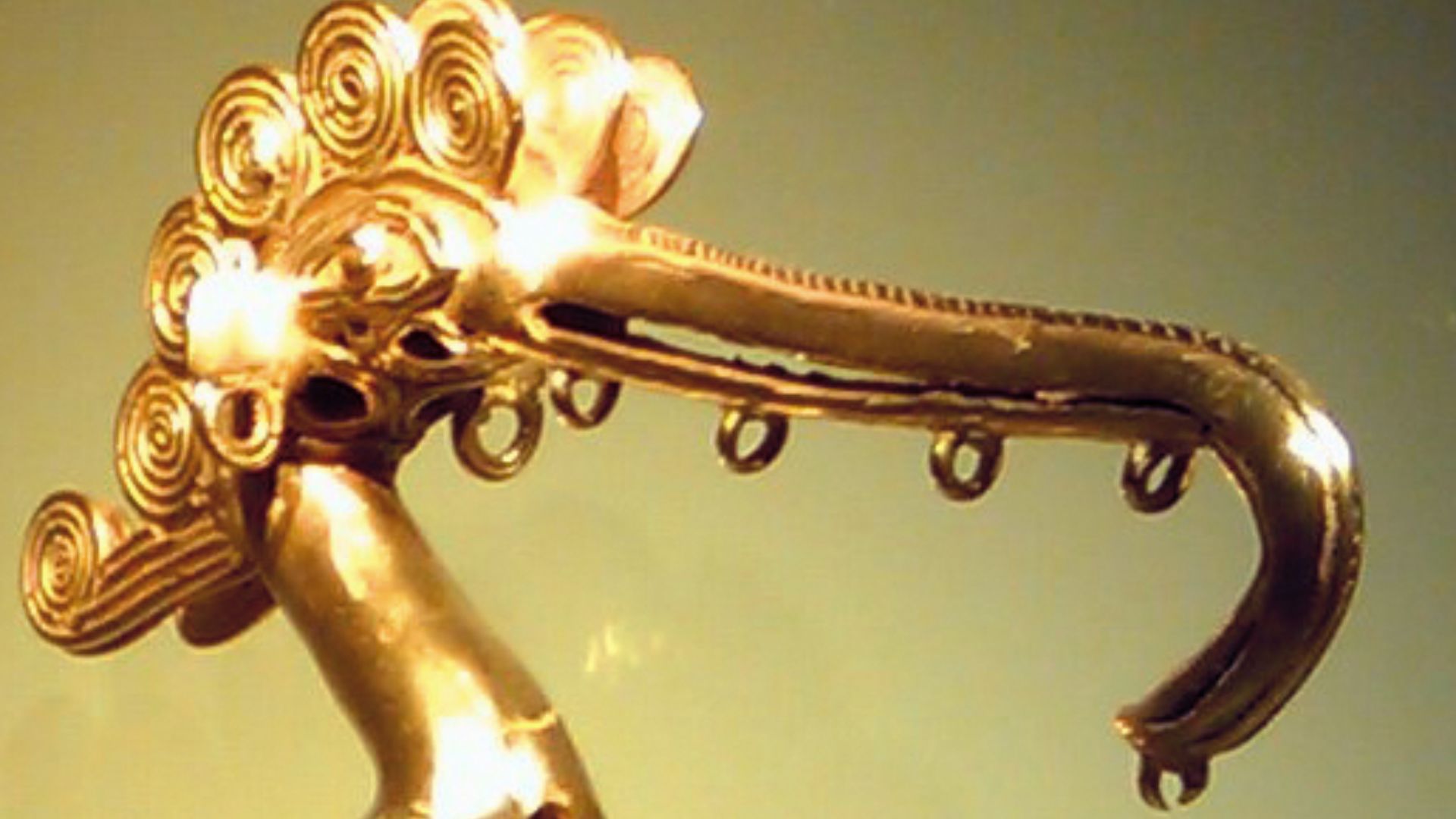
The intricate web of canals they built was not just a functional piece of infrastructure; it became a core motif in their symbolic thinking and art.
This final reading from Wikipedia makes a direct and powerful connection between the Zenú's engineering, worldview, and artistic patterns.
Read the sections 'Gold ornaments,' 'Textiles and wickerwork,' and 'Zenú identity.' Focus on the recurring idea that the world was seen as a 'large wicker-work' and how this pattern is visible in their famous semi-filigree goldwork and other crafts.
This connection is a brilliant insight into the mind of the Zenú. The patterns of their daily life—the intersecting lines of canals and fields—were elevated into a cosmic symbol, representing the fabric of the world itself. This pattern is beautifully rendered in their semi-filigree goldwork, a technique where complex, woven-like designs were cast, not woven, from gold. Their art is a direct visual expression of their engineered environment.
Test your understanding!
A UX designer's mantra is "form follows function." How could you apply this concept to the Zenú hydraulic system and their art?
Show answer
You could apply it in two ways:
- Hydraulic System: The form of the system (a network of canals and raised fields) directly followed its function (to control floods, provide habitable land, and fertilize crops). It was a perfectly designed solution for the specific environmental problem they faced.
- Art: In a more symbolic sense, the form of their artistic patterns (the woven, web-like designs in gold and pottery) followed the function of representing their worldview. Since their world was physically and metaphorically a network of canals, their art adopted this pattern to communicate their identity and relationship with their environment.
Conclusion
In this lesson, we have mapped out the world of the Zenú and identified the core features that made their culture unique.
Key Takeaways:
- Location: The Zenú thrived for nearly 2,000 years in the fertile but flood-prone river valleys of the Sinú and San Jorge in modern-day Córdoba and Sucre.
- Hydraulic Engineering: Their defining feature was a massive, sophisticated system of canals and raised fields that allowed them to control flooding and sustain a large population. This is a premier example of ancient environmental design.
- Social Structure: They had a complex society with specialized provinces for religion, food, and gold, and afforded significant authority and symbolic importance to women.
- Integrated Art: As master artisans, their work in gold, pottery, and textiles visually mirrored their worldview, with web-like patterns reflecting the canal system that formed the basis of their existence.
Preview of the Next Lesson:
Now that we have established the physical and cultural landscape of the Zenú, we are ready to explore their spiritual one. In the next lesson, we will delve into Zenú cosmology and the spiritual significance of their complex hydraulic systems. We'll see how their incredible engineering was not just a practical solution, but also a deeply sacred act that connected them to their gods and their vision of the cosmos.
Can't find a good explanation? Sign up and we'll make it for you
Sign up