
Welcome back. In the previous lesson, you turned order economics into usable limits: break-even CPA, break-even ROAS, and a more conservative operating target. Those numbers now become part of a campaign brief—the document that makes a paid campaign specific enough to launch, measure, and improve.
In this lesson, you will create a concise campaign brief for a fictional ecommerce business. By the end, you should be able to state exactly who a campaign is for, what it offers, what business result it aims to produce, how success is measured, how much can be spent, and which limits cannot be ignored.
A campaign brief is a decision document
A campaign brief is not a decorative summary or a collection of vague ambitions. It is an agreement between the people responsible for the business, creative, media buying, website, and reporting.
A useful brief answers six questions:
- Audience: Who should this campaign influence?
- Offer: Why should that audience act now?
- Objective: What business outcome should the campaign achieve?
- KPI: Which measure determines whether it is working?
- Budget: What financial resources are available, and what outcome is plausible?
- Constraints: What conditions, limits, or risks shape the plan?
Smart Insights frames campaign planning similarly: goals and tracking, targeting, messages and offers, media and budget, assets, and execution. The important point for performance marketing is that each part must be connected. A budget, CPA target, offer, and conversion-rate assumption cannot be chosen independently.
How to structure an effective campaign plan to win more customers
Read this short overview to see how a campaign brief fits into the wider campaign-planning process. Focus on the questions each section forces a marketer to answer, rather than treating the stages as a checklist to complete mechanically.
In the section “How should a campaign plan be structured?”, read the six planning stages. Then read the “Campaign plan example” section, from the template components. Notice that a campaign plan includes both commercial choices, such as the offer, and operational choices, such as landing pages, timing, and reporting.
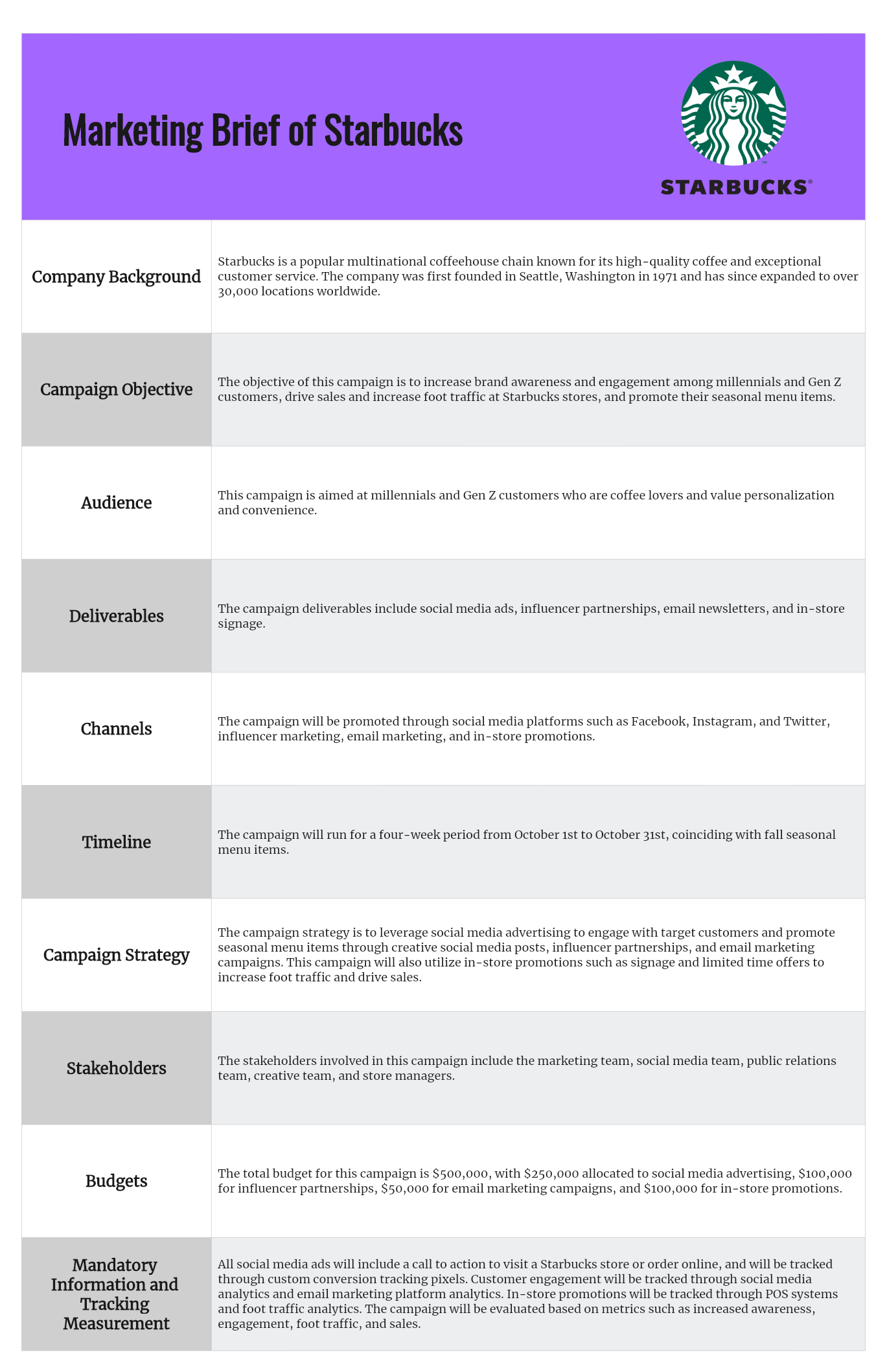
The Starbucks example below shows the form a brief can take. It includes more than this lesson’s core fields—such as stakeholders, channels, deliverables, and timeline—but its main strength is that the campaign choices are visible in one place. Treat it as a layout example, not as research into a current Starbucks campaign.
Keep the core elements distinct
Early-career marketers often use objective, KPI, audience, and offer almost interchangeably. They are related, but they answer different questions.
| Brief element | What it answers | Weak version | Stronger version |
|---|---|---|---|
| Audience | Who is most likely to respond? | “Adults interested in fitness” | “UK adults aged 25–45 who are shopping for a reusable bottle for commuting, gym use, or short trips” |
| Offer | What value or incentive encourages action? | “Buy our bottle” | “£10 off a first order of £90 or more; new customers only” |
| Objective | What business result should occur by a date? | “Increase sales” | “Acquire 100 first-time purchasers in 14 days” |
| Primary KPI | What measure governs the central decision? | “Engagement” | “Cost per first-time purchase at or below £27” |
| Budget | What can be invested? | “Around £3,000” | “Maximum media spend of £2,700, excluding creative production” |
| Constraints | What must remain true? | “Keep it on-brand” | “UK delivery only; offer cannot stack; do not scale until purchase tracking is verified” |
A brief becomes credible when these fields reinforce each other. For example, “increase sales” is not enough. It omits the kind of customer, the time period, the expected cost, and the definition of a sale. It also gives a media buyer no basis for choosing what to optimize.
Audience is not merely demographics
A usable audience definition has enough detail to inform targeting, creative, offer design, and exclusions. Depending on the business, include:
- Customer status: prospect, existing customer, lapsed customer, or high-value repeat buyer.
- Need or use case: the job the person wants the product to do.
- Relevant behaviour or intent: researching, comparing, actively shopping, or returning to a site.
- Location and practical eligibility: delivery area, language, legal restrictions, or store radius.
- Exclusions: people who should not receive the message, such as recent purchasers.
Do not confuse the audience with the eventual platform setup. “New UK customers with a commuter or gym use case” is an audience decision. The detailed Google keyword list or Meta interest targeting that may implement it comes later.
An offer is more than a call to action
A call to action tells someone what to do: “Shop now,” “Book a demo,” or “Get a quote.” An offer gives them a reason to do it. It may be:
- A price incentive, such as a first-order discount
- A bundle or added item
- A limited-time benefit
- A free consultation, audit, or trial
- A non-price proposition, such as faster delivery or a warranty
Every offer has an economic cost. A £10 discount can increase conversion rate, but it also reduces realised revenue per order. That means it may lower the CPA the business can afford. The brief should state offer terms plainly so the profitability calculation uses the correct revenue figure.
Write one outcome and one primary KPI
For a direct-response ecommerce campaign, a business outcome might be a first purchase. For lead generation, it might be a qualified lead or an opportunity accepted by sales. Choose the outcome that has meaningful value to the business—not simply the easiest platform event to count.
A strong objective is SMART:
- Specific: what result is sought?
- Measurable: can it be counted consistently?
- Achievable: does the forecast support it?
- Relevant: does it support the business need?
- Time-bound: by when?
For example:
Acquire 100 first-time purchases from UK customers during a 14-day paid-acquisition campaign, while maintaining profitable first-order economics.
The primary KPI then translates the objective into a performance decision:
Maintain cost per first-time purchase at or below £27.
The distinction matters:
- The objective is the desired business result: 100 first-time purchases.
- The KPI is the measure used to manage delivery: CPA at or below £27.
- The target is the acceptable threshold: £27.
- The supporting metrics help diagnose why the KPI changes: CPC, conversion rate, CTR, purchase volume, and ROAS.
For a purchase campaign, CPA is often a practical primary KPI because it accounts for spending. Revenue alone rises when budget rises, even if each additional purchase becomes inefficient. ROAS remains valuable as a profitability guardrail, particularly when order values vary.
How To Create a Marketing Campaign (FREE Template)
HubSpot Marketing’s “How To Create a Marketing Campaign” provides a compact overview of the planning choices behind a campaign. Watch it to reinforce the relationship among outcome, audience, value proposition, budget, and measurement.
Watch the core elements for the campaign-planning overview. Then watch audience definition and value proposition; focus on needs and motivations rather than broad demographic labels. Finish with budget and promotion and relevant metrics, noting why metrics should follow the campaign goal.
Reconcile the budget with the target
A campaign brief needs a budget cap and a forecast. The budget is what the business is willing or able to invest; the forecast states what that amount may produce under explicit assumptions.
Suppose a retailer’s previous profitability work produced these figures:
| Item | Amount |
|---|---|
| Realised revenue per order after discount | £80 |
| Variable fulfilment and product costs per order | £43 |
| Contribution before advertising | £37 |
| Break-even CPA | £37 |
| Operating target CPA | £27 |
| Operating target ROAS |
The business chooses a maximum media budget of £2,700. At the £27 target CPA, the planned purchase volume is:
Now make the assumptions visible. If the expected conversion rate is , the campaign needs approximately:
The implied maximum CPC is:
If 100 orders generate £80 each in realised revenue, expected revenue is £8,000 and forecast ROAS is:
This is internally consistent. It does not guarantee that the campaign will obtain 100 purchases. It says: if CPC remains near £0.81 and conversion rate remains near , the £2,700 budget can plausibly produce 100 purchases at the profitability target.
This is why you should not accept both a fixed budget and an arbitrary volume target without checking the arithmetic. If the same campaign’s actual CPC becomes £1.20 and conversion rate remains , its estimated CPA would be:
A £40 CPA exceeds both the £27 operating target and the £37 break-even CPA. The appropriate response is not to keep the original target because it appeared in a slide. The team must change at least one variable: improve conversion rate, reduce CPC, revise the offer, increase the acceptable acquisition cost based on better customer value evidence, or lower the purchase-volume expectation.
Define effective digital marketing objectivs and KPIs to ...
Read this material for a useful reality check: KPIs need to contribute to a business goal, but budget and forecast assumptions determine whether a stated target is feasible.
In “Setting digital marketing KPIs,” read from choosing meaningful measures. Then move to “Tying budgets to digital marketing KPIs” and read the budget-versus-conversion example. Focus on the calculation logic: spend, CPC, conversion rate, and conversion volume must agree.
Constraints protect the campaign from false success
Constraints are boundaries, not optional preferences. They prevent a campaign from appearing successful in a dashboard while failing commercially, operationally, or legally.
For a performance campaign, common constraints fall into several categories:
| Constraint type | Examples | Why it belongs in the brief |
|---|---|---|
| Economic | CPA must remain at or below £27; discount cannot exceed £10 | Protects contribution margin |
| Budgetary | £2,700 maximum media spend; creative costs excluded | Prevents unapproved overspend |
| Time | 14-day flight; results reviewed after enough conversion data accumulates | Defines the decision window |
| Audience and geography | UK mainland only; exclude existing customers | Keeps the campaign aligned with the objective |
| Product and operations | At least 120 units available; delivery promise must be supportable | Avoids advertising unavailable products |
| Brand and legal | Approved claims only; discount terms visible on landing page | Reduces compliance and trust risks |
| Measurement | Purchase event, revenue value, and new-customer status must be verified before launch | Prevents optimization on broken data |
It helps to separate a constraint from an assumption:
- “Media spend cannot exceed £2,700” is a constraint.
- “The campaign will achieve a conversion rate” is an assumption.
- “Only new customers are eligible for the discount” is a constraint.
- “Average order value after discount will be £80” is an assumption, though it should be based on pricing and historical data.
Assumptions should be documented because they can be tested and updated. Constraints should be documented because everyone needs to respect them.
Build a complete sample brief
Here is a one-page brief for the fictional retailer used throughout this lesson.
Campaign brief: PeakSip first-purchase acquisition
| Field | Campaign decision |
|---|---|
| Business context | PeakSip sells premium insulated bottles online. The standard bottle price is £90. |
| Campaign purpose | Acquire profitable first-time customers, rather than maximise traffic or social engagement. |
| Funnel stage | Conversion: drive an online first purchase. |
| Audience | UK mainland adults aged 25–45 who are likely to need a reusable bottle for commuting, gym use, or day trips. Prioritise prospective customers with relevant shopping intent. Exclude existing purchasers and employees. |
| Offer | £10 off a first order of £90 or more using code FIRST10. The offer is available for 14 days, cannot be combined with other discounts, and applies only to eligible UK deliveries. |
| Objective | Acquire 100 first-time purchases during the 14-day campaign while maintaining profitable first-order economics. |
| Primary KPI | Cost per first-time purchase of £27 or less. |
| Supporting measures | Purchases, spend, revenue, ROAS, CPC, click-to-purchase conversion rate, and use of the FIRST10 code. |
| Profitability guardrail | Target ROAS of at least . Break-even CPA is £37; campaigns should not be scaled simply because they remain above break-even. |
| Budget | Maximum media spend of £2,700. Creative production, website development, and internal labour are outside this media budget. |
| Forecast assumptions | £80 realised revenue per purchase after discount; click-to-purchase conversion rate; approximately £0.81 maximum CPC; approximately 100 purchases if assumptions hold. |
| Schedule | Launch after tracking and landing-page checks are complete. Run for 14 days; review delivery and measurement early, then evaluate performance against the full campaign period. |
| Measurement constraint | The purchase event must pass the actual discounted revenue value. Reporting must identify first-time purchasers, and campaign URLs must use the agreed tracking convention. |
| Operational constraints | Inventory must support at least 120 orders to allow for forecast variation. The discount code must work on mobile and desktop checkout. |
| Decision owner | Marketing lead approves budget and commercial targets; ecommerce lead confirms stock, offer eligibility, and checkout functionality. |
Notice what this brief does not claim:
- It does not promise that 100 purchases will occur.
- It does not call CTR the campaign’s success metric.
- It does not treat a £37 break-even CPA as an attractive target.
- It does not assume that all purchases are new customers without a way to identify them.
- It does not hide the impact of the £10 discount on revenue and margin.
The brief is ready to guide later work: channel selection, ad concepts, landing-page messaging, tracking URLs, platform setup, and reporting. It does not need to contain every execution detail yet.
A reusable brief structure
For future portfolio work or interview cases, use this compact structure. Fill in each field with a decision and, where possible, a number.
| Brief field | Prompt |
|---|---|
| Business problem | What commercial problem or opportunity is this campaign addressing? |
| Funnel stage | Is the campaign primarily for awareness, consideration, lead generation, purchase, or retention? |
| Audience | Who is included, why are they relevant, where are they located, and who is excluded? |
| Offer | What does the customer receive, what are the eligibility rules, and what urgency exists? |
| Objective | What measurable business outcome should occur by a stated date? |
| Primary KPI | What single measure will govern the main performance decision? Include its target and unit. |
| Supporting metrics | Which diagnostic measures explain the primary KPI? |
| Budget and forecast | What is the spend cap, which costs are included, and what volume is forecast from stated assumptions? |
| Constraints | Which commercial, operational, legal, brand, and measurement boundaries apply? |
| Owners and approvals | Who can approve spend, offers, creative claims, and changes to scope? |
Before a brief is approved, run four checks:
- Commercial check: Does the CPA or ROAS target reflect actual contribution economics?
- Arithmetic check: Does the forecasted volume reconcile with budget, CPC, and conversion-rate assumptions?
- Measurement check: Can the conversion and its value be captured consistently?
- Clarity check: Could a colleague who did not attend the planning meeting explain what success means?
Key takeaways
A performance campaign brief turns a broad business request into an accountable plan.
- Define an audience by customer status, need, behaviour, eligibility, and exclusions—not only age or interests.
- State an offer with its exact value and terms, then account for its impact on revenue and margin.
- Write a time-bound objective based on a meaningful business outcome.
- Choose one primary KPI that drives the principal decision; use other metrics to diagnose performance.
- Reconcile budget, CPA, CPC, conversion rate, purchase volume, revenue, and ROAS before launch.
- Document constraints explicitly, especially economic limits, inventory, offer rules, geography, and measurement requirements.
Next, you will turn the campaign’s tracking requirement into consistent UTM-tagged URLs, so traffic from paid activity can be identified reliably in analytics and reporting.
Can't find a good explanation? Sign up and we'll make it for you
Sign up