
Welcome back. In the previous lesson, you calculated CPA and ROAS from campaign results. Those metrics describe what happened; they do not yet tell you whether the result was financially sustainable.
This lesson turns campaign reporting into a profitability decision. You will calculate the maximum amount a business can spend to acquire a purchase without losing money (break-even CPA) and the minimum revenue return it needs from each unit of ad spend (break-even ROAS). You will also use conversion-rate assumptions to translate a purchase-level target into practical click and lead-cost limits.
Break-even means “no profit, no loss”
For an ecommerce order, revenue does not all belong to the business. Before considering advertising, the business must pay costs that occur when it sells and fulfils that order.
Typical variable costs include:
- Cost of goods sold (COGS)
- Packaging and shipping paid by the business
- Payment-processing fees
- Pick-and-pack or fulfilment fees
- Per-order marketplace or transaction fees
At the break-even point, the money left after those costs is exactly equal to advertising spend. There is no remaining profit, but no loss on the order either.
That makes break-even a minimum threshold, not an ambition. A campaign that merely meets break-even may contribute nothing toward salaries, rent, software, agency fees, returns, or profit.
How To Quickly Calculate Your Break-Even ROAS | Facebook Ads & Ecommerce
Watch "How To Quickly Calculate Your Break-Even ROAS" by Nick Theriot for a quick visual walk-through of moving from selling price and product cost to a margin-based ROAS threshold.
Watch the worked math. Follow the sequence: selling price, cost per order, profit per order, margin, then break-even ROAS. Pay particular attention to the contrast between a high-margin and a low-margin product.
One precision point from that example: if the margin is , the exact calculation is . Report this as 1.67x break-even ROAS, not 1.6x. Rounding down a break-even threshold can make a loss-making campaign look acceptable.
The two calculations you need
Use these terms for a typical purchase campaign:
| Symbol | Meaning |
|---|---|
| Revenue per order, usually the average order value or net selling price | |
| Total non-ad variable cost per order | |
| Contribution available to pay for advertising | |
| Pre-ad profit margin as a decimal |
First calculate the contribution available before ad spend:
Then calculate the margin:
The business can spend at most that contribution amount to acquire one purchase. Therefore:
Break-even ROAS is the revenue required for each unit of ad spend:
Because , this can be written more compactly as:
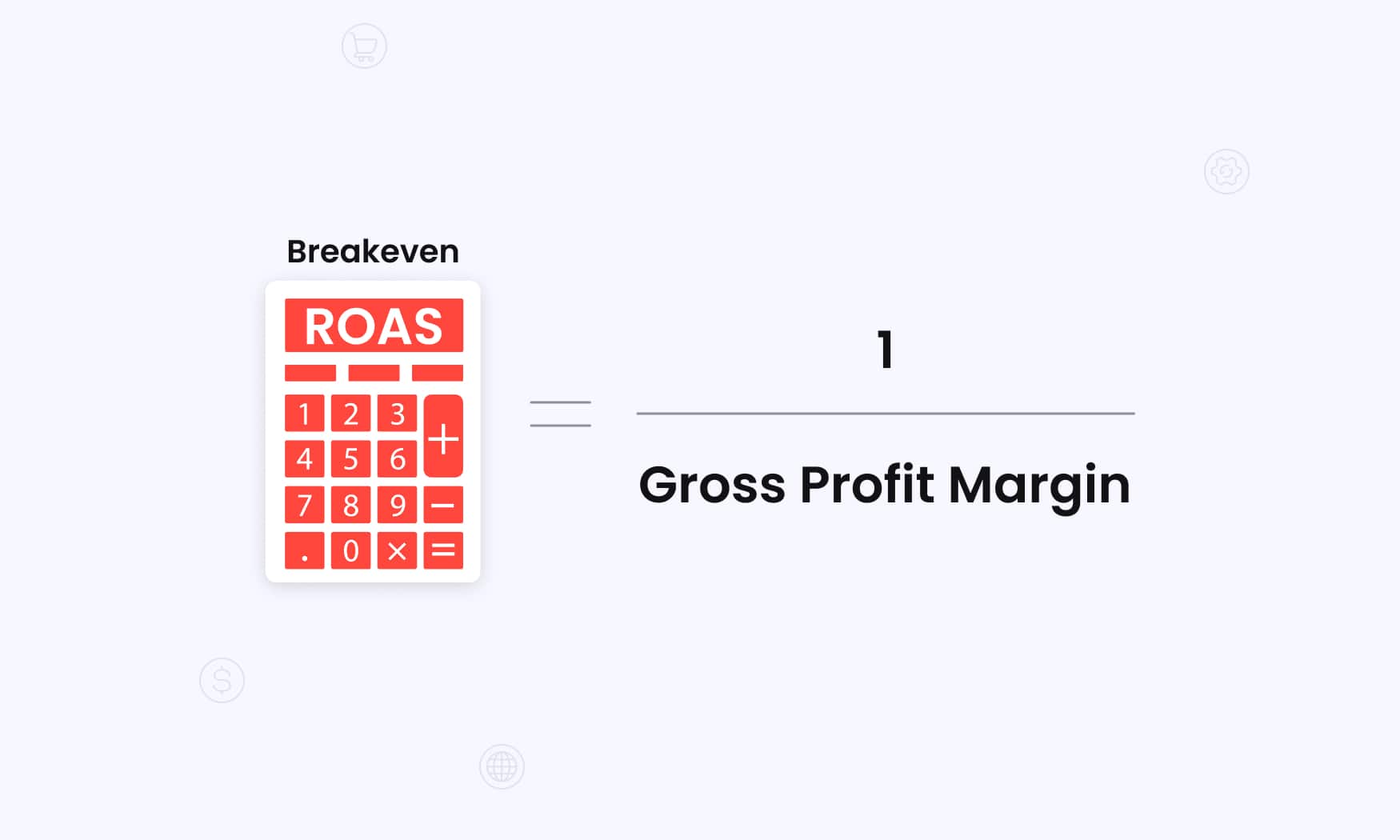
The two thresholds are simply different views of the same economics:
- Break-even CPA asks: What is the most I can pay for one order?
- Break-even ROAS asks: How much revenue must each £1 of ad spend generate?
Build the target from real order economics
Shopify’s guide uses the same logic: identify the proportion of each sale left after variable costs, then invert that margin to find the required ROAS.
Break-Even ROAS Calculator: How To Measure Break-Even ROAS (2026) - Shopify
Read Shopify’s explanation to see the core calculation applied to a product with a stated sale price and fulfilment costs. It is especially useful for seeing why product cost alone is not enough.
In the section “How to calculate break-even ROAS,” first read the worked calculation. Then continue to the discussion beginning the cost checklist. Focus on which per-order costs belong in the calculation and why omitting them produces an unrealistically low ROAS target.
Worked example: an £80 order
Suppose an online retailer has the following economics per order:
| Item | Amount |
|---|---|
| Customer revenue per order | £80 |
| Cost of goods sold | £30 |
| Shipping and packaging | £6 |
| Payment fee | £2 |
| Pick and pack | £5 |
| Total variable cost | £43 |
The contribution available for advertising is:
So the break-even CPA is:
The pre-ad margin is:
The break-even ROAS is:
The retailer therefore needs at least 2.16x ROAS. Put plainly, every £1 in ad spend must generate at least £2.16 in tracked revenue just to cover the product and fulfilment costs.
You can check the result from the alternative formula:
And you can test the break-even point for one order:
Revenue covers the variable order costs and the ad cost exactly. No money remains.
Start with margin when it is already known
Sometimes an interviewer, manager, or campaign brief gives you a margin directly rather than itemised costs. In that case, use the margin shortcut.
Suppose a product has:
- Selling price: £120
- Pre-ad margin:
First find the break-even CPA:
Then find break-even ROAS:
This business can spend up to £54 to acquire an order, and it needs at least 2.22x ROAS.
Be careful with the phrase gross margin. Businesses do not always include exactly the same costs in it. One company’s reported gross margin may exclude shipping, transaction fees, or fulfilment labour. Before setting a media target, ask what costs were included. For campaign decision-making, the useful number is the pre-ad contribution per order after all material costs that increase when an extra order is sold.
Why margin changes the required ROAS so sharply
A common beginner mistake is to assume that 2x, 3x, or 4x ROAS is universally “good.” It is not. The required ROAS depends on the business’s margin.
| Pre-ad margin | Break-even ROAS | Meaning |
|---|---|---|
| £1 of ads needs £1.25 in revenue | ||
| £1 of ads needs £1.67 in revenue | ||
| £1 of ads needs £2.00 in revenue | ||
| £1 of ads needs £2.50 in revenue | ||
| £1 of ads needs £5.00 in revenue |
Low-margin businesses have very little room for inefficient advertising. A campaign delivering 3x ROAS might be strong for a business with a margin, yet unprofitable for one with a margin.
This is why a performance marketer asks for unit economics before recommending a bid target, scaling budget, or declaring that a campaign performs well.
Check an actual campaign against break-even
Continue the £80-order example. The retailer ran a campaign that produced:
| Campaign result | Amount |
|---|---|
| Ad spend | £1,800 |
| Purchases | 96 |
| Revenue | £7,680 |
From the previous lesson:
Now compare actual performance with the thresholds:
| Metric | Actual result | Break-even threshold | Assessment |
|---|---|---|---|
| CPA | £18.75 | £37.00 maximum | Below break-even CPA |
| ROAS | minimum | Above break-even ROAS |
The campaign is profitable on a contribution basis. We can verify this directly:
That £1,752 is available to cover fixed operating costs and profit. It is not necessarily final net profit, but it is a much more commercially meaningful result than ROAS alone.
Use conversion assumptions to set click and lead-cost limits
A break-even CPA is a per-purchase threshold. Conversion assumptions do not change that underlying order economics.
However, conversion assumptions let you translate the purchase-level CPA target into earlier-funnel targets.
From break-even CPA to maximum CPC
Suppose the retailer’s break-even CPA is £37 and its expected click-to-purchase conversion rate is .
At a conversion rate, the campaign can afford about £1.11 per click.
The logic becomes clearer over 100 clicks:
| Assumption | Result |
|---|---|
| Clicks purchased | 100 |
| Expected conversion rate | |
| Expected purchases | 3 |
| Contribution before ads per purchase | £37 |
| Total contribution available for ads | £111 |
| Break-even CPC | £1.11 |
If the actual CPC is £1.20 while conversion rate stays at , the estimated CPA becomes:
That exceeds the £37 break-even CPA, so the campaign would lose money on first-order economics.
If conversion rate improves to , the same £1.20 CPC becomes:
The click cost has not changed, but the campaign becomes viable because more clicks become purchases.
From new-customer value to maximum cost per lead
The same unit logic matters in lead generation. A form completion is not necessarily a customer acquisition.
Suppose a B2B business earns £300 in pre-ad contribution from a newly acquired customer. Historically, of qualified leads become customers.
The business can pay at most £60 per qualified lead at break-even.
Why? Five leads cost:
At a close rate, those five leads are expected to generate one customer, whose contribution is £300.
The key is to match the target to the tracked action:
- If the platform counts purchases, use break-even CPA per purchase.
- If it counts qualified leads, use an allowable cost per qualified lead based on lead-to-customer rate.
- If it counts only raw leads, account for the lower raw-lead-to-customer rate or improve the conversion definition.
For lead campaigns, ROAS is useful only when revenue or a defensible conversion value is reliably connected to the lead. Otherwise, cost per qualified lead and cost per acquired customer are usually safer decision metrics.
Break-even is not your operating target
A business normally wants profit after advertising, not merely survival. If the retailer needs £10 contribution after ads from every £80 order, reduce the allowable CPA accordingly:
The corresponding target ROAS is:
Here, 2.16x is the financial floor and 2.96x is the more useful operating target. Keeping these separate prevents two opposite errors:
- Scaling a campaign that only looks good because it barely clears an incomplete break-even threshold.
- Pausing a campaign that is genuinely profitable because it does not meet an arbitrary industry ROAS benchmark.
Practical checks before using the numbers
Before putting a break-even target into Google Ads, Meta Ads, or a report, verify these points:
- Use realised revenue. Account for discounts, bundles, refunds, and shipping revenue consistently where they materially affect the order value.
- Include relevant per-order costs. Excluding payment fees or fulfilment can make a target look safer than it is.
- Keep units aligned. A purchase-level CPA cannot be compared directly with a lead-level CPA.
- Use the same attribution scope. If reported ROAS uses a seven-day click attribution window, compare it with a target built for that same reporting approach.
- Treat estimates as estimates. Conversion rate and lead-close-rate assumptions should be updated as real campaign and CRM data accumulate.
- State what is excluded. Fixed costs may be excluded from a contribution break-even calculation, but they still matter to the company’s overall profitability.
Key takeaways
Break-even thresholds connect paid-media metrics to the economics of a sale:
For the £80 order with £43 in variable costs, the break-even CPA is £37 and the break-even ROAS is 2.16x. A conversion-rate assumption does not change the value of a customer, but it translates that value into a maximum CPC or cost per lead.
In the next lesson, you will use these commercial targets inside a campaign brief, alongside the audience, offer, budget, objective, and measurement constraints that define a credible paid-campaign plan.
Can't find a good explanation? Sign up and we'll make it for you
Sign up