In our previous lesson, you successfully configured Google Analytics 4, moving beyond its default settings to capture business-specific data with custom dimensions. You now have a robust analytics foundation ready to receive detailed information. This lesson focuses on standardizing the most critical piece of that information: where your users are coming from.
Today, we will address how to design and enforce a systematic UTM parameter schema. UTM parameters are the universal language for tracking the effectiveness of your marketing campaigns. Without a disciplined approach, your traffic source data will become a chaotic mix of inconsistent labels, making it impossible to attribute conversions or calculate the return on your marketing efforts. Your background in information systems will be particularly useful here, as we'll be designing a data-entry standard—a schema—to ensure data integrity from the very first click.
Our goal is to create a clear, scalable, and enforceable system that allows you to know, with precision, which campaign, channel, and creative element brought a user to your site.
1. The Anatomy of a Tracked URL
Before designing a schema, it's essential to understand how UTM parameters work at a technical level. They are not magic; they are simply a standardized set of URL query parameters. A URL isn't a single block of text but is composed of distinct parts that a browser and server interpret differently.
The following video from MeasureSchool provides an excellent breakdown of a URL's structure and the role of the query string. This is the "first principles" foundation for our work today.
Query Strings and Parameters explained - Marketers Tech Knowledge
This video explains the components of a URL and dissects the structure of a query string, which is the mechanism that carries UTM parameters.
First, watch the introduction to understand the different components of a URL: protocol, hostname, path, and the query string. The key insight is that the query string can pass information without changing the content of the page itself. Next, focus on the breakdown of the query string structure. Pay close attention to the concepts of the identifier (?), connectors (&), and the key=value pairs that carry the actual data.
As the video demonstrates, a query string is a series of key=value pairs appended to a URL after a ?. UTM (Urchin Tracking Module) parameters are simply a conventional set of keys that analytics platforms like Google Analytics are pre-programmed to recognize and use for traffic attribution.
The five standard UTM parameter keys are:
utm_sourceutm_mediumutm_campaignutm_contentutm_term
When a user clicks a link containing these parameters, your GA4 tag reads them from the URL and sends them along with the page_view event. GA4 then uses these values to populate its default traffic source dimensions, such as "Session source," "Session medium," and "Session campaign."
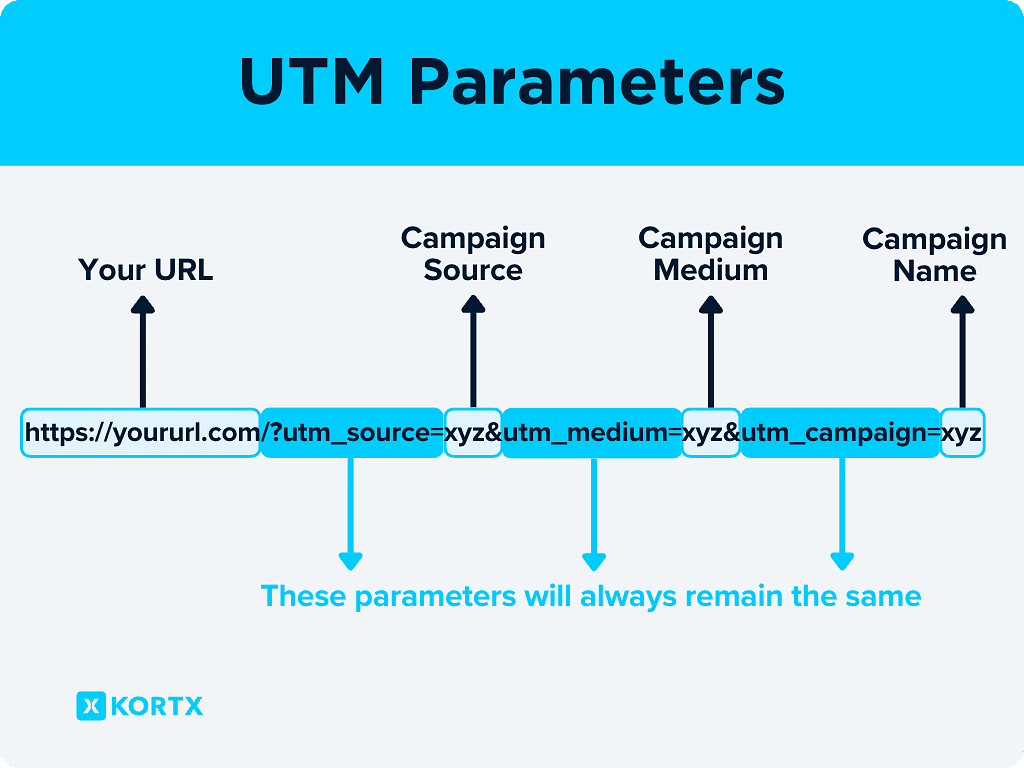
From a data perspective, the parameters are simply part of the page location (dl) field in the raw data payload sent to Google Analytics. Your technical background will help you appreciate what this looks like under the hood.

2. Designing Your UTM Schema
A schema is just a set of rules. For UTMs, this means defining exactly what each parameter represents and what values are acceptable. Without these rules, one person might use facebook as a source, another Facebook, and a third fb, splitting your data across three different rows and making analysis impossible.
The following video and reading provide a solid framework for defining each parameter.
UTM Parameter Tracking Fundamentals and Best Practices
This video from Paid Media Pros clearly explains the purpose of each of the five core UTM parameters with practical examples for paid advertising.
Watch the section that breaks down each parameter type. The presenter gives their personal preferences, which is a great starting point for developing your own consistent rules.
Now, let's formalize these definitions. We'll use the "UTMs: Master UTM Strategy & Standard Parameters" article as our guide to build a robust schema.
UTMs: Master UTM Strategy & Standard Parameters
This article from Improvado provides a crisp, clear table defining the five core UTM parameters.
Read the section titled The 5 Core UTM Parameters Explained. Use the table in this section as the foundation for your schema.
Synthesizing these resources, here is a recommended schema to start with. The key is not to adopt this verbatim, but to understand the logic and adapt it for your own needs, then enforce it with absolute consistency.
| Parameter | Purpose: Answers the question... | Example Values | Rules & Notes |
|---|---|---|---|
utm_source |
Where did the traffic come from? (The platform or brand) | google, facebook, linkedin, newsletter, partner-name |
Always lowercase. Identifies the specific referrer. |
utm_medium |
How did the traffic get here? (The marketing channel) | cpc, organic, social, email, affiliate, referral |
Always lowercase. A broad category. cpc (cost-per-click) is a common standard for all paid ads. |
utm_campaign |
Why are we sending the traffic? (The specific promotion) | q1-promo-2024, summer-sale, new-product-launch |
Always lowercase. Use hyphens for spaces. Specific and descriptive. Consider adding date markers for easier analysis. |
utm_content |
What specific creative was clicked? (For A/B testing) | blue-banner-ad, header-link, video-testimonial-1 |
Optional but highly recommended. Differentiates ads or links within the same campaign. |
utm_term |
Which paid keyword was used? | running+shoes, crm+software |
Optional. Primarily for paid search to track specific keywords. Can be adapted for other uses, like targeting criteria in social ads. |
3. Governance: Enforcing Your Schema
A schema is useless if it isn't enforced. Inconsistent data is dirty data. This is where most organizations fail. Your goal is to build a system that makes it easy to do the right thing and hard to do the wrong thing.
The following article from Cometly provides a great step-by-step process for establishing this system.
Utm Parameter Tracking Best Practices Guide 2026 Tips
This guide walks through the practical steps of building a robust UTM system, from defining rules to creating tools for enforcement.
First, read Step 2. This reinforces the importance of a "single source of truth" document for your team. Next, read the beginning of Step 3, which proposes a brilliant and practical solution: a centralized spreadsheet with dropdown menus to enforce your schema.
Let's turn these concepts into a concrete governance framework.
Best Practices for Clean Data
These are the non-negotiable rules for maintaining data integrity.
- Be Consistent & Document Everything: Create a "UTM Taxonomy" document (a simple Google Sheet or Notion page) that lists the approved values for
utm_sourceandutm_medium. This is your single source of truth. - Lowercase Everything: Google Analytics is case-sensitive.
Facebookandfacebookare treated as two different sources. Enforce a lowercase-only rule for all parameters. - Use Consistent Separators: Choose a separator for spaces (hyphens
-are a common standard) and stick to it.summer-saleis good;summer saleorsummer_saleintroduces inconsistency. - NEVER Use UTMs on Internal Links: Tagging a link from one page of your website to another (e.g., from your homepage to your pricing page) with UTMs will overwrite the original traffic source. This is a critical mistake that destroys attribution. It starts a new session, attributing the user to your "internal campaign" instead of the ad or search that brought them there initially.
Systematizing URL Generation
Manual UTM creation is a recipe for typos and errors.
- URL Builders: For one-off links, use Google's Campaign URL Builder. It provides a simple form to fill out and generates the final URL, reducing syntax errors.
- Centralized Spreadsheet: For team-wide enforcement, create a shared spreadsheet.
- Columns for each UTM parameter (
source,medium,campaign, etc.). - Use data validation to create dropdown menus for
utm_sourceandutm_medium, populated from your taxonomy document. - Use a formula to concatenate the values into a final, ready-to-use URL. This prevents errors and ensures compliance.
- Columns for each UTM parameter (
- Dynamic Parameters: For high-volume paid advertising, explore your ad platform's dynamic URL parameters. For example, in Meta Ads, you can use
utm_campaign={{campaign.name}}. The platform automatically inserts the campaign name, eliminating manual entry and typos.
The article "UTMs: Master UTM Strategy" contains an excellent summary of best practices and common mistakes. It's a great reference to keep handy.
UTMs: Master UTM Strategy & Standard Parameters
This resource provides a checklist-style approach to best practices, common mistakes, and governance.
Scan through the sections on Best Practices, Common Mistakes, and the Governance Checklist. These sections consolidate everything we've discussed into actionable rules and a pre-launch quality gate.
Conclusion
In this lesson, you've moved from simply collecting data to actively shaping its quality and structure at the point of entry. By designing and implementing a systematic UTM schema, you ensure that your analytics platform receives clean, consistent, and meaningful data about your marketing efforts. This is the foundation of reliable attribution and intelligent budget allocation.
Key Takeaways:
- UTMs are Standardized Query Parameters: They are a technical mechanism for passing campaign information to analytics tools via the URL.
- A Schema is a Set of Rules: Your UTM schema must define the purpose and acceptable values for each of the five core parameters (
source,medium,campaign,content,term). - Consistency Overrides Everything: The most important rule is consistency. Enforce lowercase, use standard separators, and document everything in a central taxonomy.
- Never Use UTMs for Internal Links: Doing so breaks session attribution and corrupts your traffic source data.
- Systematize for Success: Use URL builders and centralized spreadsheets with validation to minimize human error and ensure compliance with your schema.
In our next lesson, we will delve into the architecture of server-side tracking. While UTMs tell us where users came from, server-side tracking provides a more reliable way to capture what they do on your site, especially for critical conversions. This technique is becoming essential for maintaining data accuracy in an era of increasing browser privacy restrictions and ad blockers.