Hello! Welcome to our next lesson.
In our previous session, we established a systematic approach to UTM parameters, ensuring you can precisely track where your users are coming from. This was our first step in enforcing data quality at the point of collection. However, clean source attribution is only half the battle. The very act of collecting user behavior—what they do on your site—is facing significant challenges.
Today, we will explore the architecture of server-side tracking, using Meta's Conversions API (CAPI) as our primary example. We'll examine why traditional browser-based tracking is becoming less reliable and how a server-side approach provides a more robust and accurate solution. Given your background in software development and information systems, you'll find our focus on data flows, API calls, and architectural trade-offs particularly relevant. We're moving beyond the "what" of tracking to the fundamental "how."
1. The Frailty of the Browser: Why Client-Side Tracking is Faltering
For years, the standard method for tracking user actions has been client-side. This involves placing a snippet of JavaScript, like the Meta Pixel or a Google Analytics tag, on your website. When a user performs an action (like a page view or clicking "Buy Now"), this script runs in their browser and sends a request directly to the vendor's servers.
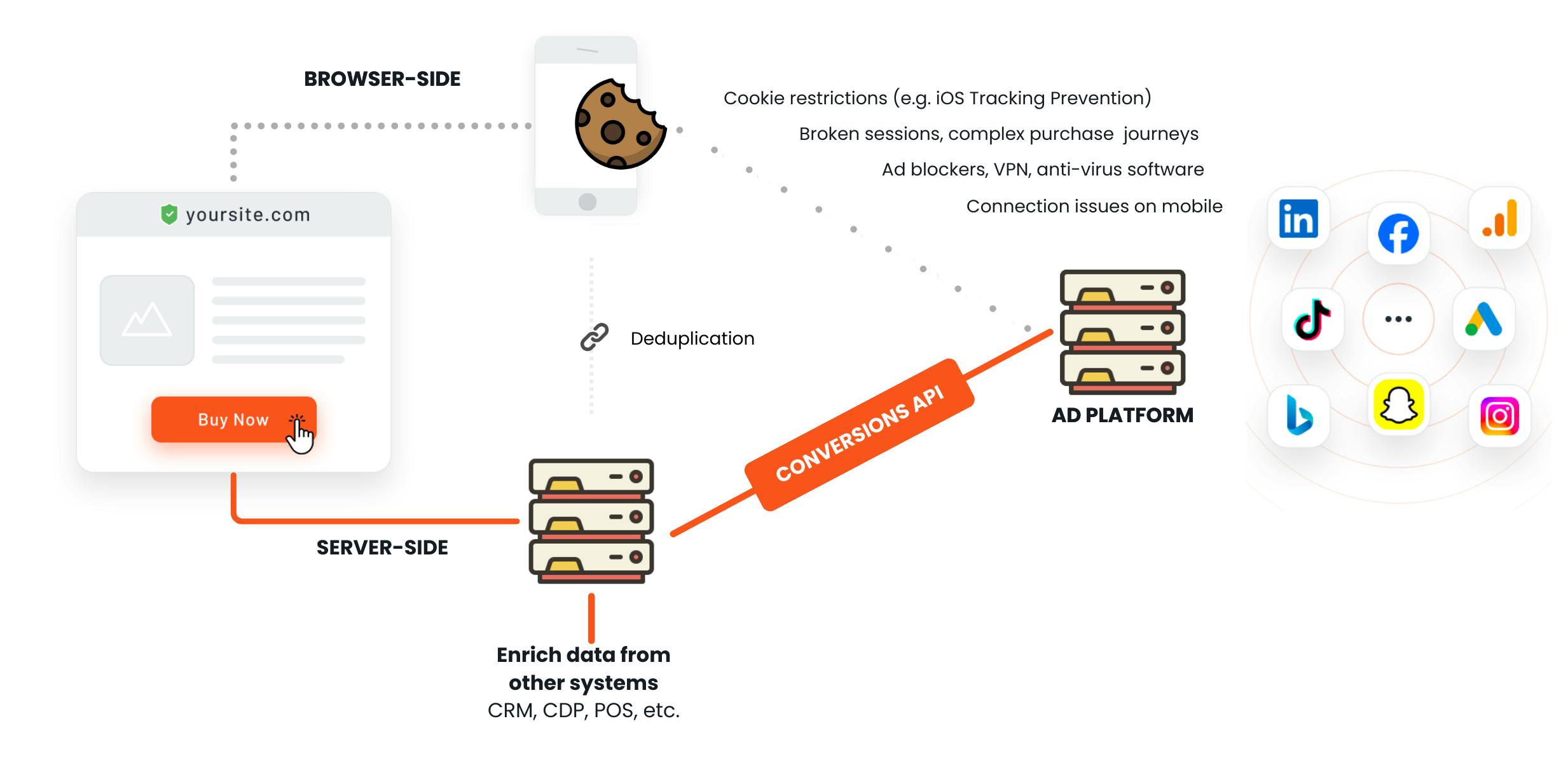
This direct browser-to-vendor communication, however, has become increasingly unreliable. Simo Ahava, a leading expert in the field, provides a brilliant "first principles" breakdown of the problems with traditional client-side tagging.
"Server-Side Tagging: Data Quality or Data Quantity?" - Simo Ahava (Simmer - Helsinki, Finland)
This segment from Simo Ahava's talk at the Superweek Analytics Summit explains the fundamental issues inherent in client-side tracking, setting the stage for why a server-side architecture is necessary.
Watch the section where Simo explains client-side tagging and its associated problems. As you watch, focus on how each issue he mentions—from giving third-party scripts full privileges, to browser privacy measures like ITP, to PII leaks—represents a point of failure or a vulnerability in the data collection pipeline.
As Simo explains, the client-side model is vulnerable to a growing number of threats to data integrity:
- Ad Blockers: These tools explicitly block requests to known tracking domains like
facebook.com. - Browser Privacy Features: Technologies like Apple's Intelligent Tracking Prevention (ITP) in Safari and similar features in Firefox limit cookie lifetimes and block cross-site tracking.
- User Consent and Opt-Outs: Privacy regulations (like GDPR) and platform changes (like Apple's App Tracking Transparency) mean users can simply opt out, preventing the tracking script from ever running.
- Network Errors & Page Performance: A slow connection, a JavaScript error, or a user closing the "thank you" page too quickly can all prevent the tracking pixel from successfully firing.
The result is signal loss. A significant percentage of your actual conversions may go unrecorded, leading to inaccurate reporting, poor ad optimization, and a skewed understanding of your marketing performance.
2. The Server-Side Architecture: A More Reliable Data Pipeline
Server-side tracking introduces a crucial intermediary into the data flow: your own server. Instead of the user's browser sending data directly to vendors, it first sends a single, consolidated data stream to a server that you control. This server then processes the data and forwards it to the various marketing and analytics platforms.
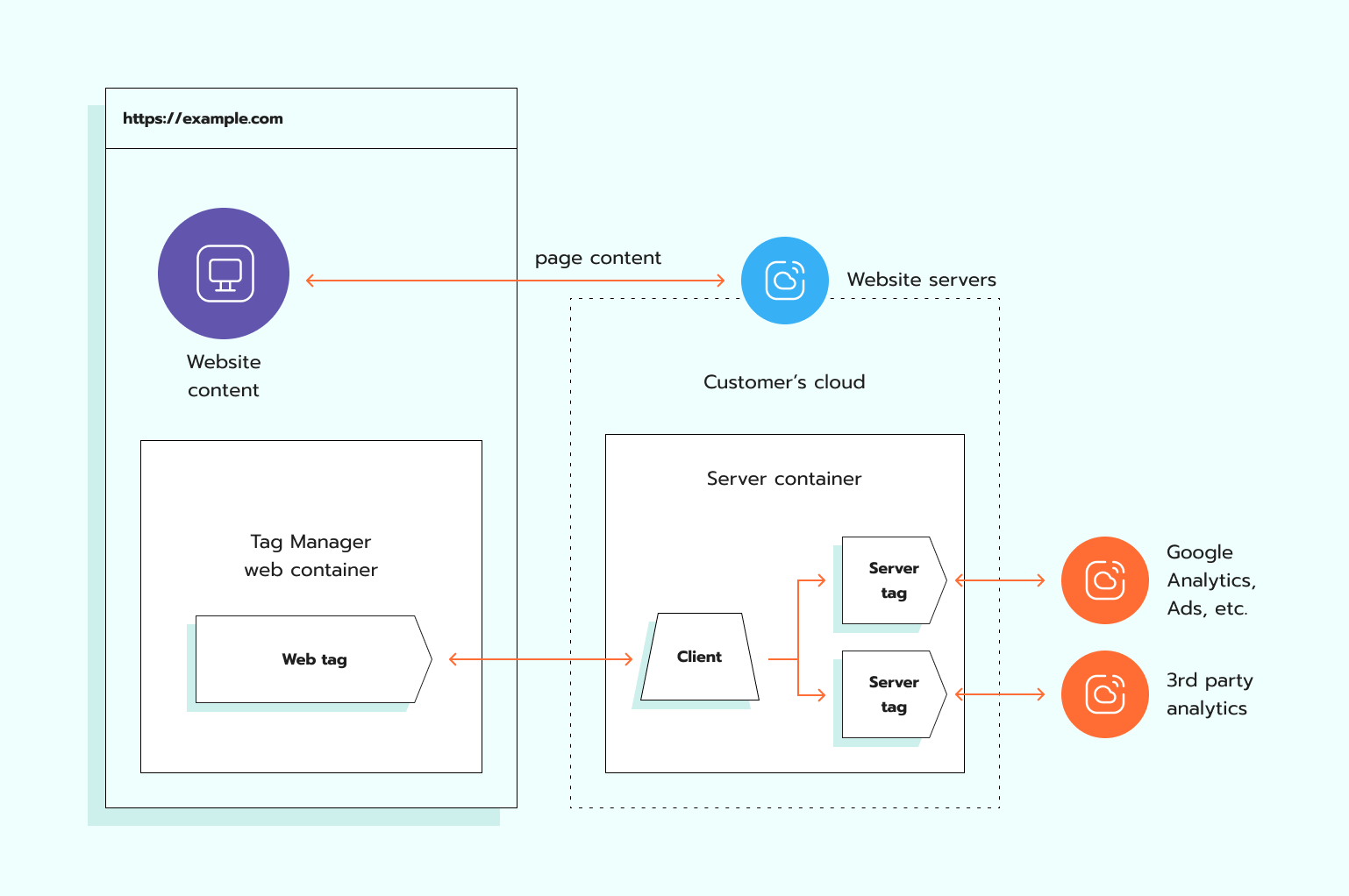
This architectural shift from a client-to-vendor model to a client-to-server-to-vendor model has profound benefits.
Google Tag Manager Server-side Tagging Tutorial 2026 || Server-side tracking with GTM
In this video, Julius from Analytics Mania provides a concise overview of the benefits of server-side tagging.
Watch the first part of the video outlining the benefits. Pay attention to how each benefit directly counteracts a weakness of the client-side model we just discussed.
To summarize the key architectural advantages:
- Data Control: You decide what data is collected, what is scrubbed (e.g., removing accidental PII), and what is forwarded to each vendor. The server becomes a powerful gatekeeper.
- Increased Resilience: Because the request from the browser goes to your own domain (e.g.,
data.yourwebsite.com), it is less likely to be blocked by ad blockers, which primarily target third-party domains. - Data Enrichment: Your server can enrich the incoming data with information from other systems, like your CRM or product database, before sending it to the vendor.
- Improved Performance: You can reduce the number of heavy JavaScript libraries loaded in the user's browser, improving page load times.
This intermediary server acts as a trusted, stable environment for data collection, in stark contrast to the volatile and untrusted environment of a user's browser.
3. Deep Dive: Meta's Conversions API (CAPI)
Meta's Conversions API is their implementation of this server-side architecture. It's designed to work in tandem with the traditional Meta Pixel, not replace it. This creates a redundant, hybrid system that maximizes data capture.
Meta Conversions API: Complete Setup & Optimization Guide ...
This guide from Ads Uploader provides clear definitions and diagrams explaining what CAPI is and how it relates to the Pixel.
Please read the first three short sections: What is Meta Conversions API?, Server-Side Tracking Explained, and How It Relates to Facebook Pixel. This will solidify your understanding of the core concepts.
The hybrid model works like this:
- A user makes a purchase.
- The Meta Pixel fires in the browser (if not blocked) and sends a "Purchase" event.
- Simultaneously, your website's backend processes the order, and your server sends a "Purchase" event directly to Meta's API.
This raises an obvious question: won't this double-count every conversion? The answer is no, thanks to a key architectural component: deduplication.
Key Mechanism 1: Event Deduplication
To prevent double-counting, you generate a unique event_id for each conversion. This ID is passed to both the Pixel event and the CAPI event. When Meta receives two events with the same event_id within a 48-hour window, it understands they are the same conversion and "deduplicates" them, counting it only once.
Meta Conversions API Explained: What It Is, Why It Matters, and How ...
This article from ISE Media Agency gives a great, non-technical explanation of the key mechanisms behind CAPI.
Read the subsection titled Pixel + CAPI together (deduplication). This explains the crucial role of the event_id.
Key Mechanism 2: Event Match Quality (EMQ)
Recovering "lost" events is only part of CAPI's role. Its other critical function is to improve the quality and attributability of the data. This is measured by the Event Match Quality (EMQ) score.
When your server sends an event, you can include additional customer information (securely hashed, of course) that helps Meta match the conversion to a specific user profile and the ad they interacted with. This is data the browser-side Pixel often can't access or is blocked from sending.
Meta Conversions API: Complete Setup & Optimization Guide ...
The Ads Uploader guide has an excellent, detailed breakdown of Event Match Quality.
Focus on the section Event Match Quality (EMQ). Note which parameters have the biggest impact on the score.
By including parameters like a hashed email (em), phone number (ph), and the Facebook click ID (fbc), you dramatically increase the chances that Meta can attribute the conversion correctly. This leads to better audience building, more effective optimization, and more accurate reporting on your ad spend.
This is the dual role of CAPI in improving data accuracy:
- Quantity: It captures events that the Pixel misses.
- Quality: It provides richer data that allows for more accurate attribution of the events it captures.
4. Under the Hood: A CAPI Payload
Given your technical background, let's look at what this looks like in practice. A CAPI event is simply an HTTP POST request to Meta's Graph API containing a JSON payload.
Meta Conversions API Explained: What It Is, Why It Matters, and How ...
The developer section of this article provides a clear walkthrough of a manual implementation, including a sample JSON payload.
Read through the section For developers. You don't need to memorize the code, but pay close attention to the structure of the JSON payload. Notice the event_name, event_id (for deduplication), and the user_data object (for EMQ).
Notice how the user_data object contains the fields for hashed PII, IP address, and user agent, while custom_data holds the transaction details. This structure gives you granular control over the data packet being sent from your server to Meta's.
5. The Architectural Trade-Off: The "Vegas Rule"
While server-side tracking offers tremendous benefits in terms of data quality and control for the advertiser, it introduces a new architectural trade-off: opacity. Simo Ahava calls this the "Vegas Rule": what happens in the server, stays in the server.
"Server-Side Tagging: Data Quality or Data Quantity?" - Simo Ahava (Simmer - Helsinki, Finland)
In this final clip, Simo Ahava discusses the most significant challenge and philosophical trade-off of server-side tagging.
Watch his explanation of the Vegas Rule. This is a critical concept for understanding the full implications of this architectural shift.
The data flow from the browser to your server can be audited by the user. The subsequent flow from your server to vendor servers cannot. This increases the burden of trust on you, the website owner. It's a powerful tool, and with that power comes the responsibility to use it ethically and in compliance with your privacy policy and user consent.
Conclusion
In this lesson, we've explored the fundamental shift from client-side to server-side tracking architecture. You've seen how this change addresses the growing reliability issues of browser-based methods and offers a path toward more accurate, resilient, and controllable data collection.
Key Takeaways:
- Client-side tracking is fragile: It's vulnerable to ad blockers, browser privacy settings, and network issues, leading to significant "signal loss."
- Server-side tracking is a robust alternative: By sending data from your own server, you create a more reliable and controllable data pipeline.
- Meta CAPI uses a hybrid model: It works alongside the Pixel, not as a replacement, using a dual-channel approach to maximize data capture.
- Deduplication is essential: The
event_idparameter is the key architectural component that prevents double-counting in a hybrid setup. - Event Match Quality (EMQ) drives accuracy: CAPI improves accuracy not just by capturing more events, but by enriching them with hashed user data for better attribution.
- This architecture involves a trade-off: It gives the advertiser more power and control but reduces transparency for the end-user, placing a greater emphasis on trust and ethical data handling.
In our next lesson, we will move from theory to practice. You'll learn how to implement a basic server-side event transmission for a key conversion, putting the architectural principles we've discussed today into action.