
Hello. In the previous lesson, you converted fractions, decimals, and percentages and learned to ask, “What is the whole?” That idea is essential here: a ratio compares parts, while a proportion describes how quantities change together.
In this lesson, you will learn to simplify and use ratios, divide a total into ratio parts, and recognise and solve direct-proportion problems. These skills are useful whenever quantities must be kept in a fixed relationship, such as scaling a recipe, preparing a mixture, or calculating the cost of identical items.
Ratios describe relationships between quantities
A ratio compares quantities in a stated order. It is written using a colon:
This means that for every 3 equal parts of blue, there are 2 equal parts of red. It does not necessarily mean there are exactly 3 ml and 2 ml; the quantities could be and , or and .
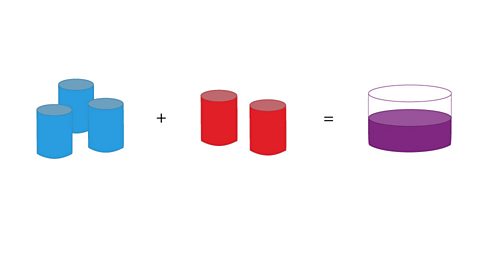
The order matters. If blue:red is , then red:blue is:
Writing for red:blue would reverse the meaning.
A ratio can be simplified just like a fraction: divide every part by the same number. For example:
Both numbers divide by :
The simplified ratio tells us the mixture has the same composition as the picture: 3 equal blue parts for every 2 equal red parts.
Before forming a ratio, make sure the quantities use the same units. For example, compare of water with of cordial. Convert litres to millilitres first:
So the ratio water:cordial is:
Ratio - Ratio and proportion - KS3 Maths - BBC Bitesize
Read BBC Bitesize’s explanation of ratio notation, equivalent ratios, and dividing a quantity into ratio parts. The paint and cordial examples closely match the mixture reasoning used in this lesson.
In the section “How to write ratios,” read ratio notation and equivalents. Focus on preserving the order and multiplying or dividing every part by the same factor. Then, in “How to divide a quantity into a given ratio” and “How to find one share of a ratio given another,” read sharing and mixtures. Notice that both methods begin by finding the value of one part.
Turning a ratio into actual quantities
The numbers in a ratio represent parts, not necessarily amounts. To find actual amounts, first work out the total number of parts.
Suppose a coloured liquid has blue:red in the ratio , and the total volume is .
There are:
equal parts altogether.
One part is therefore:
Now calculate each amount:
So the mixture contains blue and red.
A good check is that the two amounts add back to the total:
This same method connects to last lesson’s fractions and percentages. In a mixture, there are 5 parts in total, so:
So a ratio does not mean “ and .” It means blue makes up of the total and red makes up .
When one amount is already known
Sometimes you know one part of the ratio rather than the total.
Suppose two ingredients are in the ratio , and the second ingredient measures . The second ingredient corresponds to 2 parts:
So one part is:
The first ingredient is 3 parts:
The two amounts are and .
For mixture questions, use this dependable routine:
- Write the ratio in the same order as the quantities named.
- Add the parts only if you have been given a total.
- Find the value of one part by division.
- Multiply by the required number of parts.
- Check units and, when appropriate, check that the amounts add to the total.
In real dental and health settings, follow the manufacturer’s instructions for any product. Ratio mathematics can explain a stated mixture or concentration, but it should not be used to improvise or alter dental products.
Direct proportion: quantities that scale together
Two quantities are in direct proportion when one is always multiplied or divided by the same factor as the other.
For instance, if each identical toothbrush costs pence, the cost changes in direct proportion to the number bought:
| Number of toothbrushes | Cost in pence |
|---|---|
Doubling the number doubles the cost. Halving the number halves the cost. If no toothbrushes are bought, the cost is zero.
Mathematically, if is the cost in pence and is the number of toothbrushes:
The symbol means “is proportional to.” We can make this into an equation by including the constant of proportionality, :
Here, each toothbrush costs pence, so:
The constant is the amount for one unit. It is often called the unit rate.
Direct proportion - KS3 Maths - BBC Bitesize
BBC Bitesize introduces the features that make a relationship directly proportional, including the important zero-value check and a useful non-example.
In “What is direct proportion?”, begin with the pencil table and read the pencil example. Identify the fixed cost per pencil. Then read the temperature counterexample. The key point is that a direct-proportion relationship must have zero in one quantity when the other quantity is zero.
Not every relationship where both values increase is directly proportional. Consider a delivery service that charges a fixed pence delivery fee plus pence per item:
The cost still increases as the number of items increases, but at , the cost is pence rather than zero. Therefore, it is not direct proportion.
Similarly, a bulk discount can prevent price and number of items from being directly proportional, because the price per item changes.
Two methods for solving direct-proportion problems
1. Use a scale factor when it is clear
If 4 identical packs have a mass of , then 12 packs have three times as much mass:
So 12 packs have a mass of:
This approach is fastest when the change is an easy multiplication or division.
2. Use the unitary method for any quantity
The unitary method means finding the value of one unit first.
Suppose 7 identical tubes cost pence. Find the cost of 3 tubes.
First find one tube:
So one tube costs pence.
Then find three tubes:
Therefore, 3 tubes cost pence.
The unitary method works even when the target quantity is awkward, because once you know the value of one, you can find the value of any number.
GCSE Maths - Scaling Up and Down Using Proportions (2026/27 exams)
Watch “GCSE Maths - Scaling Up and Down Using Proportions” by Cognito for two clear demonstrations of the unitary method: one involving prices and one involving recipe quantities.
Watch the bottle example to see the divide-for-one, multiply-for-many structure. Then watch recipe scaling, focusing on why the ingredient amount per cake stays constant as the recipe is scaled.
A fixed-ratio mixture also involves direct proportion. If a mixture is always 3 parts blue to 2 parts red, then making a batch twice as large requires twice as much blue and twice as much red. The ratio stays fixed because each ingredient has been scaled by the same factor.
This is the connection:
- A ratio states the relationship between parts.
- Direct proportion keeps that relationship constant while the overall quantity changes.
Key takeaways
A ratio compares quantities in order:
It means 3 equal parts of the first quantity for every 2 equal parts of the second. Simplify ratios by dividing every part by the same factor, and convert units before comparing quantities.
To divide a total into a ratio:
For direct proportion, both quantities scale by the same factor and both are zero together. It can be represented as:
where is the constant of proportionality, or unit rate. Use a simple scale factor when possible; otherwise, find one unit first with the unitary method.
Next lesson, you will use another important data-handling skill: calculating the mean of a small set of scientific or dental data.
Can't find a good explanation? Sign up and we'll make it for you
Sign up