
Welcome. This 12-lesson course balances maths, science, and introductory dentistry. We begin with a maths tool that will appear throughout the course: recognising that fractions, decimals, and percentages are different ways to describe the same proportion.
In health and dentistry, these forms appear on food labels, survey results, scientific data, and sometimes product information. By the end of this lesson, you should be able to convert confidently between all three forms and interpret what the number is out of.
One quantity, three ways to write it
A fraction describes a part of a whole:
A decimal describes that part using place value: tenths, hundredths, thousandths, and so on.
A percentage means “per hundred.” So:
The final zero in does not change its value, but it can be useful because it shows that the decimal is written in hundredths.
Here are several equivalent forms worth recognising:
| Fraction | Decimal | Percentage |
|---|---|---|
The key idea is not to memorise every possible conversion. It is to remember what each notation means:
- A fraction is division: means .
- A decimal is based on powers of .
- A percentage is a fraction with a denominator of .
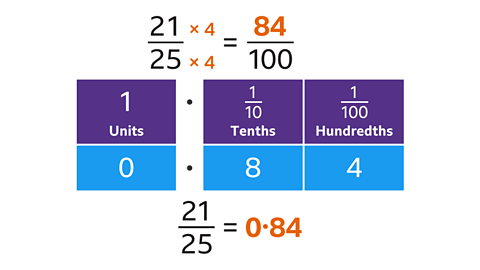
The diagram works because multiplying the numerator and denominator by the same non-zero number preserves the value:
Once the denominator is , the decimal and percentage forms are immediate.
Fractions, Decimals and Percentages
Watch “Fractions, Decimals and Percentages” from Maths Genie for a visual overview of the connections between the three forms. The examples emphasise that each form represents a portion of the same whole.
Begin with the overview, focusing on why the three notations can represent identical values. Then watch decimal conversions to see why multiplying by 100 changes a decimal into a percentage. Continue with percent fractions and fraction percents; notice that equivalent fractions are created by changing the top and bottom by the same factor.
Reliable conversion methods
It is tempting to treat moving a decimal point as a rule to memorise. A safer understanding is that moving it two places changes the number by a factor of . That is exactly what percentages require.
Starting with a percentage
To change a percentage into a decimal, divide by .
To change a percentage into a fraction, write it over , then simplify.
Both conversions begin with the same fact: means out of .
A percentage can include a decimal. For example:
Fractions are usually written with whole-number numerators and denominators, so multiply both parts by :
Its decimal form is:
A useful check: because is much less than , its decimal must be much less than . The answer makes sense; would not.
Starting with a decimal
To change a decimal into a percentage, multiply by and write the percentage sign.
To change a decimal into a fraction, use its place value and simplify.
Similarly:
The number of decimal places tells you the first denominator:
- is seven tenths, so
- is thirty-five hundredths, so
- is one hundred and twenty-five thousandths, so
Then simplify if possible.
Pharmacy Technician Basic Math Skills for Pharmacy Calculations - Fractions, Decimals, Percentages
These two short clips from “Pharmacy Technician Basic Math Skills for Pharmacy Calculations” by Amanda PharmD reinforce the place-value meaning behind decimal fractions and the reverse conversion from percentages to decimals.
Watch decimal fractions to connect 0.35 with \frac{35}{100} before simplifying. Then watch percent decimals, focusing on why removing the percent sign must be accompanied by division by 100.
Starting with a fraction
A fraction can always be converted into a decimal by dividing the numerator by the denominator.
Then convert the decimal into a percentage:
Sometimes you can avoid division by making the denominator . For example:
This method is particularly quick when the denominator is a factor of , such as , , , , , , or .
For a denominator that does not scale neatly to , division is usually best. For example:
In real data, this would commonly be rounded, perhaps to . If a result has been rounded, use an approximation sign:
Reading health information carefully
Conversions matter because health information often gives proportions in more than one format. The important question is always:
What is the whole being used as the reference?
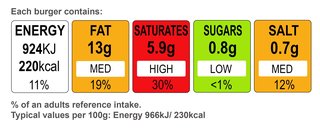
On this label, the burger contains of saturates and this is labelled as of an adult’s reference intake. The two numbers do not mean the same thing:
| Label information | Mathematical form | Meaning |
|---|---|---|
| saturates | A mass measured in grams | The amount in one burger |
| saturates | Three tenths of the stated adult reference intake | |
| energy | Eleven hundredths of the stated reference intake | |
| Less than sugars | Less than | An inequality, not an exact value |
Notice the final row. “Less than ” does not equal exactly . It means:
This is a common reading skill in science: symbols and wording such as “less than,” “more than,” and “approximately” matter.
The image also distinguishes values per burger from information stated per . Comparing percentages is meaningful only when you understand the reference whole. For example, “ of an adult reference intake” and “ of a portion” would not necessarily describe the same amount.
The same care applies to dental or scientific survey data. Suppose an oral-health survey reports that out of participants use interdental brushes. The proportion is:
This says of that group of participants reported using them. It does not automatically prove that of all people do. The reference group is part of the meaning.
A compact conversion guide
| If you are given… | To get… | Method |
|---|---|---|
| A percentage | A decimal | Divide by |
| A decimal | A percentage | Multiply by , then add |
| A percentage | A fraction | Write over , then simplify |
| A decimal | A fraction | Write using place value, then simplify |
| A fraction | A decimal | Divide numerator by denominator |
| A fraction | A percentage | Make an equivalent fraction over , or convert to a decimal and multiply by |
Use two quick sense checks:
- If a proportion is between zero and one whole, its decimal should be between and , and its percentage should be between and .
- Keep the reference whole visible. A percentage has no useful meaning without knowing “percent of what?”
Percentages can be greater than . For instance, equals , meaning one whole plus another quarter. On a reference-intake label, a value above would mean the stated amount exceeds that reference intake.
Key takeaways
Fractions, decimals, and percentages are equivalent representations of a proportion:
Remember the central facts:
- Percent means “out of .”
- Convert percentages and decimals by dividing or multiplying by .
- Convert a fraction to a decimal by division.
- Simplify fractions after writing their first equivalent form.
- In health data, distinguish an amount with units, such as grams, from a percentage of a stated reference amount.
- Treat “less than,” “more than,” and rounded values carefully.
Next, you will use the same proportional reasoning for ratios and direct proportion, including quantities and mixtures.
Can't find a good explanation? Sign up and we'll make it for you
Sign up