
Hello again. In the previous lesson, you translated statements using negation, conjunction, disjunction, implication, and biconditional. In particular, you saw that an implication fails only when is true and is false.
Now we move from writing compound propositions to systematically evaluating them. Truth tables let you test every possible truth assignment, classify a proposition as a tautology, contradiction, or contingency, and decide whether two different-looking propositions are logically equivalent. These are standard short-answer and table-based questions in discrete mathematics exams.
1. Truth tables: testing every possible case
A truth table lists all possible truth values of the atomic propositions in an expression, then evaluates the compound expression one piece at a time.
If an expression has distinct atomic propositions, its truth table has:
rows.
So:
| Atomic propositions | Number of rows |
|---|---|
For two variables and , always begin in this standard order:
| T | T |
| T | F |
| F | T |
| F | F |
For three variables, use eight rows:
| T | T | T |
| T | T | F |
| T | F | T |
| T | F | F |
| F | T | T |
| F | T | F |
| F | F | T |
| F | F | F |
The main technique is simple: create intermediate columns for meaningful inner parts of the expression. Do not try to evaluate a long expression mentally in one step.
For example, to evaluate
first find , then combine that result with using “or.”
Read “3.1 Propositional Logic” from Discrete Mathematics: An Open Introduction. It gives the exact table-building method used in this lesson and introduces logical equivalence through matching final columns.
In the subsection “Truth Tables,” read from the paragraph beginning the truth-table idea through the connective tables and Examples 3.1.1–3.1.2. Focus on why intermediate columns make a compound expression manageable and why three atomic propositions require eight rows. Then read the subsection “Logical Equivalence” through Example 3.1.3. Start with the paragraph comparing implication and disjunction. Notice the test: two propositions are equivalent precisely when their final columns match in every row.
A compact reminder of the connective rules:
| Expression | It is false when... |
|---|---|
| is true | |
| at least one of is false | |
| both are false | |
| is true and is false | |
| and have different values |
The conditional is the usual source of errors. Remember:
is true in three rows and false in only one:
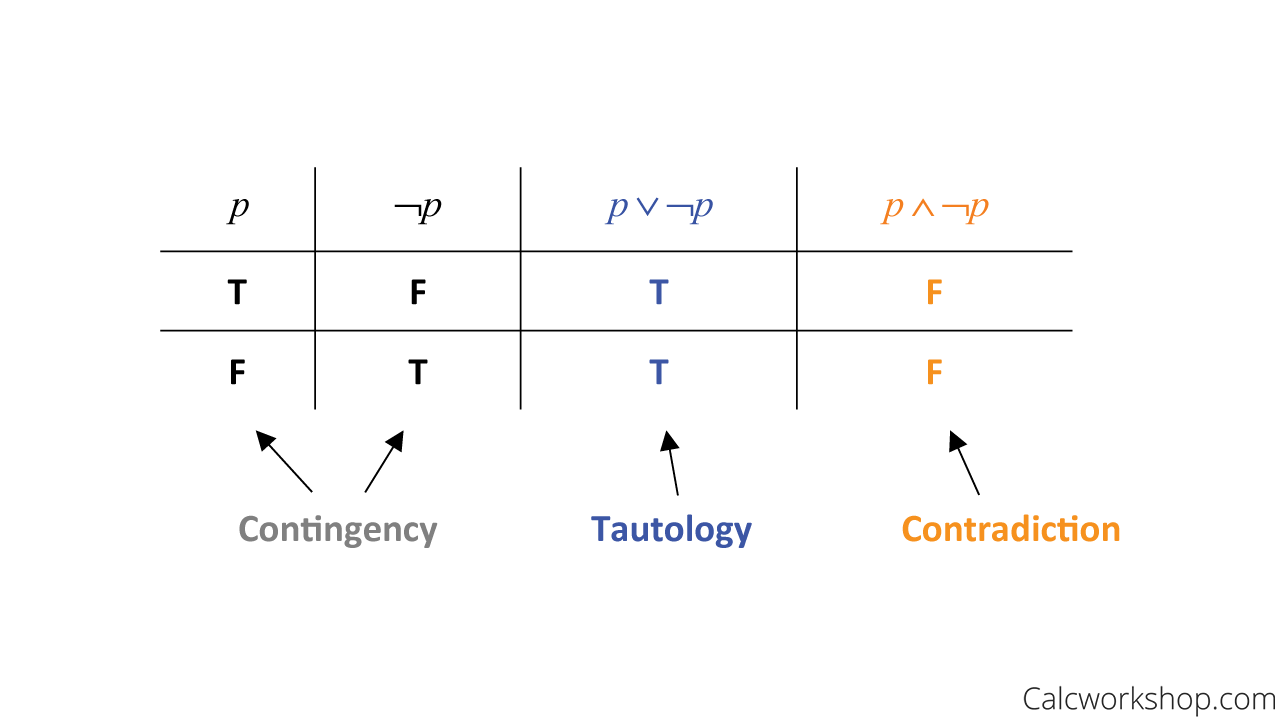
2. Tautology, contradiction, and contingency
Once the table is complete, look only at the final column.
- A tautology has T in every row. It is true because of its logical form, regardless of the truth values assigned to its variables.
- A contradiction has F in every row. It cannot be true under any assignment.
- A contingency has at least one T and at least one F. Its truth depends on the assignment.
Propositional Logic Tautologies, Contradictions, and Contingencies
Watch “Propositional Logic Tautologies, Contradictions, and Contingencies” by TrevTutor for a visual walkthrough of reading the final column of a truth table.
Watch tautologies, then contradictions, followed by contingencies. Focus on the classification rule: all T means tautology, all F means contradiction, and a mixture means contingency.
Worked example: a tautology
Classify:
The expression says: “If both and are true, then is true.” Construct the inner conjunction first.
| T | T | T | T |
| T | F | F | T |
| F | T | F | T |
| F | F | F | T |
The last column is all T. Therefore,
is a tautology.
Notice that the last three rows are true because the antecedent is false. An implication with a false antecedent is true.
Worked example: a contradiction
Consider:
| T | F | F |
| F | T | F |
The final column is all F, so:
is a contradiction. It claims that a proposition is both true and false simultaneously.
Worked example: a contingency
Now consider:
| T | T | T |
| T | F | F |
| F | T | T |
| F | F | T |
The final column has both T and F. Thus,
is a contingency.
A proposition need not be a tautology merely because it has many T entries. For example, the conditional above is true in three of four rows, but one F is enough to make it a contingency.
3. Logical equivalence: same truth value in every case
Two compound propositions are logically equivalent if they have the same truth value in every possible row of their truth tables.
We write:
This notation does not mean that and are identical expressions. It means that they always produce the same final truth value.
One of the most important equivalences is:
Verify it by making columns for both expressions.
| T | T | T | F | T |
| T | F | F | F | F |
| F | T | T | T | T |
| F | F | T | T | T |
The two final columns are identical:
Therefore,
This explains the rule for implication: “If , then ” is true whenever is false or is true.
3 Ways to Show a Logical Equivalence | Ex: DeMorgan's Laws
Watch “3 Ways to Show a Logical Equivalence | Ex: DeMorgan's Laws” by Dr. Trefor Bazett for a concise demonstration of the truth-table test for equivalence.
Watch the formal test. The essential point is that matching truth values in every row provides a rigorous proof that two logical forms are equivalent.
Equivalence versus biconditional
These two symbols are related but used differently:
| Symbol | Meaning |
|---|---|
| A compound proposition: “ if and only if ” | |
| A conclusion: and have identical truth-table columns |
A useful fact is:
exactly when
is a tautology. For now, the easiest exam method is simply to compare the final columns directly.
Showing that two propositions are not equivalent
To show that propositions are not logically equivalent, you need only one row where their truth values differ.
Compare:
and its converse:
| T | T | T | T |
| T | F | F | T |
| F | T | T | F |
| F | F | T | T |
The final columns differ in the second and third rows. Therefore:
This confirms a point from the previous lesson: reversing an implication changes its meaning.
4. An exam-ready procedure
For a question asking you to classify a compound proposition:
- Count the atomic propositions and create rows.
- List truth assignments systematically.
- Make columns for inner expressions first, especially negations, bracketed expressions, conjunctions, and disjunctions.
- Evaluate the outermost connective last.
- Inspect the final column only.
- All T: tautology
- All F: contradiction
- Mixture: contingency
- Write a direct conclusion, such as:
Since the final column contains both T and F, the proposition is a contingency.
For a question asking whether two propositions are logically equivalent:
- Use one truth table containing both expressions.
- Include intermediate columns where necessary.
- Compare the two final columns.
- Conclude precisely:
Since the final columns are identical for all truth assignments, the propositions are logically equivalent.
Or:
Since the final columns differ when and , the propositions are not logically equivalent.
Frequent errors to avoid
- Comparing intermediate columns instead of final columns. Only the completed expressions determine equivalence.
- Forgetting that an implication is false only in the T–F case.
- Classifying by looking at just one row. Every row matters.
- Writing for logical equivalence. Prefer:
- Omitting columns for grouped subexpressions. For example, in
first calculate , then negate that whole column.
You now have a reliable truth-table method for two core tasks: classifying propositions as tautologies, contradictions, or contingencies, and verifying logical equivalence by matching final columns. The key exam habit is mechanical but powerful: list every assignment, evaluate from inner components outward, and make your conclusion from the final column.
Next, you will apply truth tables to propositional arguments: determining whether an argument is valid and finding a counterexample assignment when it is invalid.
Can't find a good explanation? Sign up and we'll make it for you
Sign up