
Hello! This course begins with the language of discrete mathematics: propositional logic. Before working with sets, relations, and functions, you need to be able to state mathematical conditions precisely and read symbolic statements without reversing their meaning.
In this first lesson, you will learn to identify propositions, assign symbols to simple statements, and translate in both directions using negation, conjunction, disjunction, implication, and biconditional. This is a high-value exam skill: most errors come not from symbols themselves, but from incorrectly identifying which part is the condition and which part is the conclusion.
Plan for about 40 minutes: a short video introduction, focused reading, and worked translation patterns.
1. Propositions: the building blocks
A proposition is a declarative sentence that has one definite truth value: it is either true or false.
Examples:
- “ is prime.” — proposition; it is true.
- “Bengaluru is in Karnataka.” — proposition; it is true.
- “Open the door.” — not a proposition; it is a command.
- “What is your register number?” — not a proposition; it is a question.
- “.” — not yet a proposition if has not been specified.
In propositional logic, we do not initially care whether a proposition is actually true. We represent the whole statement by a letter:
These are called simple or atomic propositions. Logical connectives combine them into compound propositions.
Discrete Math 1.2.1 - Translating Propositional Logic Statements
Watch “Discrete Math 1.2.1 - Translating Propositional Logic Statements” by SawFin Mathematics. It gives a practical method for breaking English statements into atomic propositions and then rebuilding the symbolic structure.
Watch the translation method to see how atomic propositions and a main connective are identified. Then watch if and only if especially carefully: these phrases cause many implication-direction errors. Continue with positive statements for the useful habit of defining variables affirmatively, and finish with symbolic to English to practise the reverse translation.
A good working habit is to define letters using positive wording where possible:
Then “The server is not running” becomes , rather than introducing a separate letter for a negative sentence. This keeps expressions readable and prevents accidental double negatives.
2. The five core connectives
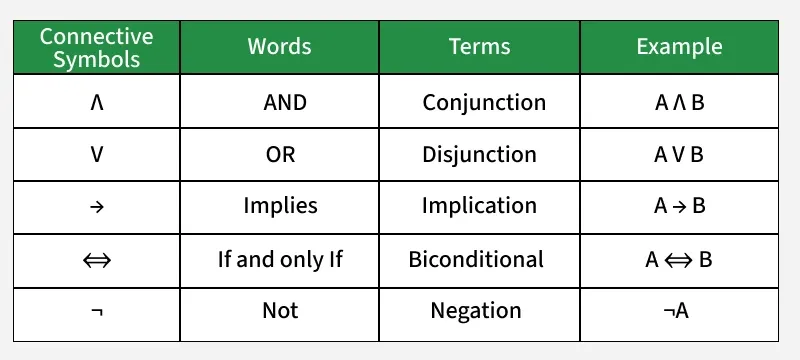
The table below is your essential symbol vocabulary. Different textbooks may use instead of , but the meaning is the same.
| English connective | Name | Symbol | Meaning |
|---|---|---|---|
| not | negation | is false | |
| and | conjunction | both statements hold | |
| or | disjunction | at least one statement holds | |
| if , then | implication / conditional | is sufficient for | |
| if and only if | biconditional | each implies the other |
Negation:
Negation reverses a statement.
If
then
Negation applies to the proposition immediately following it unless parentheses show a larger scope.
Compare:
This means “Either the program does not compile, or the test passes.”
But:
means “It is not the case that the program compiles or the test passes.” The parentheses make the negation apply to the entire group.
Conjunction:
“And” joins two complete propositions:
“The database is online and the user is authenticated” becomes
In logic, but, although, and yet usually act like “and.” They may add emphasis in ordinary English, but not a different logical structure.
becomes
Be careful: not every English use of “and” joins two propositions. For example, “The flag is red and white” is one statement about a flag, not automatically two independent logical statements. In such a case, treat the whole sentence as one atomic proposition unless the question explicitly separates the claims.
Disjunction:
In discrete mathematics, “or” normally means inclusive or: one can be true, the other can be true, or both can be true.
“The student knows Python or Java” becomes
This includes a student who knows both languages.
Ordinary speech sometimes intends “one but not both,” particularly in phrases such as “either or , but not both.” That is exclusive or, which requires a longer expression. Unless the wording explicitly excludes one case, use ordinary inclusive .
2.2 Compound Statements - Contemporary Mathematics | OpenStax
Read the relevant part of OpenStax’s “Compound Statements.” It reinforces the five connectives, then demonstrates the systematic translation process and the role of parentheses.
Begin in “Common Logical Connectives” and read through the connective table, noting that “but” functions as conjunction and that logical “or” is inclusive. In “Translating Compound Statements to Symbolic Form,” read the translation procedure, then follow Example 2.9. Next, in “Translating Compound Statements in Symbolic Form with Parentheses into Words,” read the discussion of grouping. Focus on identifying the main connective before trying to phrase the whole English sentence smoothly.
3. Implication: preserving the direction
The most important connective to translate accurately is implication:
Read it as:
If , then .
Here, is the hypothesis, antecedent, or condition. The statement is the conclusion or consequent.
For example, let
Then:
means:
If a number is divisible by , then it is even.
It does not mean “If a number is even, then it is divisible by .” Reversing the two parts produces the converse:
The converse is a different statement and need not be true.
Common English forms of implication
The safest approach is to rewrite each phrase mentally into “if ..., then ...”.
| English form | Symbolic form |
|---|---|
| If , then | |
| implies | |
| only if | |
| if | |
| is necessary for | |
| is sufficient for |
The two especially testable forms are:
-
“ only if ”
“Only if” introduces a necessary requirement.A student can register only if the fee is paid.
Let mean “The student can register” and mean “The fee is paid.”
-
“ if ”
The word “if” introduces the condition.A student can register if the fee is paid.
A useful verbal test: state the condition after “if” first. For “ only if ,” read it as “If , then .”
What an implication claims
An implication is like a rule or guarantee. It rules out exactly one situation: the condition holds, but the conclusion fails.
For
the unacceptable case is:
For translation, you do not yet need to construct a full truth table; that is the next lesson. But this “rule” interpretation helps you avoid reading as a two-way statement.
4. Biconditional and compound translations
A biconditional states that two conditions are equivalent in both directions:
Read it as:
if and only if .
It combines two implications:
For example:
Then:
means:
An integer is even if and only if it is divisible by .
The phrases “if and only if” and “iff” signal a biconditional. Do not replace “if and only if” with an ordinary “if”; doing so loses one direction of the claim.
A reliable translation procedure
When converting English into notation:
-
Find the complete atomic propositions.
Each must make sense on its own and have a truth value. -
Assign symbols clearly.
Prefer affirmative definitions. -
Locate the main connective.
Is the whole sentence primarily an “and,” an “or,” an “if–then,” or an “if and only if” statement? -
Translate each component.
Add negation precisely where “not” applies. -
Use parentheses to show grouping.
This is essential when one component is itself compound.
Consider the statement:
If the student submits the assignment and passes the viva, then the student receives a certificate.
Let
The condition is not merely ; it is the grouped statement “ and .” Therefore:
Now consider:
The student receives a certificate if and only if the student submits the assignment and passes the viva.
This requires both directions:
The parentheses make clear that the biconditional connects with the entire conjunction.
Translating notation back into English
Work from the outermost connective inward.
Let
Take the expression:
The outermost connective is , so the whole form must be “If ..., then ...”. The hypothesis is , so a correct translation is:
If the system has internet access and the user has valid credentials, then the user can access the portal.
For a negated group:
a careful translation is:
It is not the case that the system has internet access or the user has valid credentials.
This may sound less natural than ordinary English, but it is logically precise. In an exam, precise wording is preferable to a smoother sentence that changes the scope of the negation.
Parentheses beat guessing
When reading symbols, parentheses decide the grouping. Compare:
with
The first says that must hold together with at least one of or . The second says either both and hold, or holds. They are different compound propositions.
When writing an answer, extra parentheses that clarify your intended meaning are almost always helpful. Do not rely on a presumed order of operations when the expression mixes several connectives.
Exam-speed checklist
Before finalizing a translation, check:
- Are all letters assigned to complete propositions?
- Did I distinguish inclusive “or” from an explicitly exclusive “or”?
- Did “but” become ?
- For every implication, did I correctly identify the “if” condition?
- Did I translate “only if” as an implication in the correct direction?
- Did “if and only if” become , not merely ?
- Do parentheses show the intended grouping and negation scope?
You can now move between everyday language and the symbolic language of propositions using all five core connectives. The most important habits are: define atomic propositions clearly, identify the outermost connective, and translate “if,” “only if,” and “if and only if” with deliberate care.
Next, you will use truth tables to determine whether compound propositions are always true, always false, or sometimes true—and to test whether two different-looking expressions are logically equivalent.
Can't find a good explanation? Sign up and we'll make it for you
Sign up