
Welcome back. You have already practised translating statements into symbols and evaluating compound propositions with truth tables. The crucial fact to carry forward is that an implication is false only when its antecedent is true and its consequent is false.
This lesson applies that machinery to arguments. You will learn the exact truth-table test for validity, how to ignore irrelevant rows, and how to write a proper counterexample truth assignment when an argument is invalid. This is a common exam format: construct the table, identify the decisive row, then state a clear conclusion.
1. What “valid” means
A propositional argument consists of one or more premises and a conclusion.
An argument is valid when it is impossible for all premises to be true while the conclusion is false.
This definition is precise. Validity does not mean:
- every premise is actually true in real life;
- the conclusion is actually true in real life;
- the conclusion is true in every row of a truth table.
It means only this:
Whenever the premises are all true, the conclusion must also be true.
Suppose an argument has premises and conclusion . Its logical form is valid exactly when the following compound proposition is a tautology:
The antecedent here collects every premise using “and.” The conditional then asks: if all premises hold, must the conclusion hold?
For an exam truth table, though, the fastest method is usually not to calculate this whole conditional. Instead, look directly at the rows in which every premise is .
2. The decisive-row test
Use this procedure for any short propositional argument.
-
Identify the atomic propositions.
With variables, create rows. -
Make a column for each premise and for the conclusion.
Add intermediate columns for any inner expressions, such as , , or . -
Find the rows where all premises are true.
These are the only rows that matter for testing validity. -
Check the conclusion in those rows.
- If the conclusion is in every such row, the argument is valid.
- If the conclusion is in even one such row, the argument is invalid.
-
For an invalid argument, report that row as a counterexample.
State the truth values assigned to all atomic propositions.
The visual rule is worth remembering: an invalid argument has a row of the form
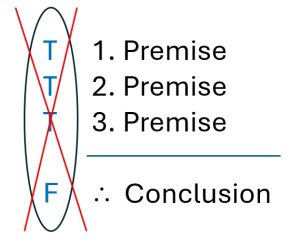
Rows in which one or more premises are false do not disprove an argument. The argument never claims that its conclusion must follow from false premises.
Read the “Deductions” subsection from the open discrete mathematics textbook. It explains validity as a condition on rows where all premises are true, then contrasts a valid and an invalid deduction rule.
In the subsection “Deductions,” begin with the Edith-and-cookie argument and read the modus ponens discussion. Focus on how the text filters the truth table to locate the row where both premises hold. Then go to Example 3.1.7 and read the completed table and the invalidity conclusion. Notice that one row with true premises and a false conclusion is enough.
3. A valid argument: modus ponens
Consider the argument form:
This is called modus ponens. In words:
If , then .
is true.
Therefore, is true.
Make columns for the first premise, the second premise, and the conclusion.
| Premise 1: | Premise 2: | Conclusion: | ||
|---|---|---|---|---|
| T | T | T | T | T |
| T | F | F | T | F |
| F | T | T | F | T |
| F | F | T | F | F |
Now apply the decisive-row test.
- Both premises are true only in the first row.
- In that row, the conclusion is also true.
- There is no row where both premises are true and the conclusion is false.
Therefore, the argument is valid.
Notice the second row carefully. The conclusion is false there, but the first premise is false too. It is therefore not a counterexample.
An exam-ready conclusion is:
In every row in which both premises are true, the conclusion is true. Therefore, the argument is valid.
4. An invalid argument: affirming the consequent
Now reverse the reasoning:
In words:
If a student submits the assignment, then the student receives a confirmation email.
The student received a confirmation email.
Therefore, the student submitted the assignment.
The conclusion does not necessarily follow: perhaps a confirmation email was sent for another reason. Let us verify that formally.
| Premise 1: | Premise 2: | Conclusion: | ||
|---|---|---|---|---|
| T | T | T | T | T |
| T | F | F | F | T |
| F | T | T | T | F |
| F | F | T | F | F |
The third row is decisive:
In that row:
- is ;
- is ;
- , the conclusion, is .
Therefore, the argument is invalid.
The truth assignment
is a counterexample to the argument form.
Written in the original verbal statements, it says:
The student did not submit the assignment, but did receive a confirmation email.
For truth-functional logic, this is enough. It shows a possible arrangement of truth values in which the premises hold but the conclusion fails.
This invalid form is called affirming the consequent. Do not confuse it with modus ponens:
| Form | Status |
|---|---|
| Valid | |
| Invalid |
The small change from to in the second premise completely changes the logic.
Determine the Validity of an Argument From
Watch Terrie Nichols’ “Determine the Validity of an Argument From.” It gives a compact visual demonstration of building a three-variable argument table and locating the counterexample row.
Watch the validity rule for the central criterion. Then watch the table setup and the calculation, noting why separate columns are created for smaller parts of the premises. Finish with the row analysis: the presenter considers only rows with all premises true and identifies the one false conclusion that makes the argument invalid.
5. A three-variable example
Arguments with three atomic propositions require eight rows. Consider:
The conclusion claims that if is true, and both and would imply , then at least one of must be true. That sounds plausible at first, but a truth table decides the matter.
| Conclusion: | |||||
|---|---|---|---|---|---|
| T | T | T | T | T | T |
| T | T | F | F | F | T |
| T | F | T | T | T | T |
| T | F | F | F | T | T |
| F | T | T | T | T | T |
| F | T | F | T | F | T |
| F | F | T | T | T | F |
| F | F | F | T | T | F |
Focus only on rows where all three premises are . The seventh row has:
At this assignment:
but
Thus the argument is invalid. The counterexample assignment is:
This example exposes a frequent error: from “ implies ” one cannot conclude that implies . An implication guarantees only the stated direction.
6. Validity versus truth and soundness
Keep these terms separate in written answers.
- An argument is valid when no truth assignment makes all premises true and the conclusion false.
- An argument is invalid when at least one counterexample truth assignment exists.
- An argument is sound when it is valid and its premises are actually true.
Truth tables test validity of form. They do not investigate real-world facts.
For example, this argument is valid:
Its first premise is not factually true, so the argument is not sound. But its structure is still valid: it has the form .
One unusual but logically correct case: if there is no row in which all premises are true together, then there cannot be a counterexample row. By the definition above, such an argument is valid, although its premises are inconsistent. For most introductory questions, simply follow the table rule rather than trying to judge whether the premises “make sense.”
7. Exam checklist and answer templates
Before finalising a truth-table argument question, check the following.
- Did you include all truth assignments?
- Did you calculate each premise and the conclusion correctly?
- Did you inspect only rows where every premise is ?
- If invalid, did you give values for every atomic proposition?
Use one of these conclusion formats.
When the argument is valid:
In every row where all premises are true, the conclusion is also true. Therefore, the argument is valid.
When the argument is invalid:
When , , and , all premises are true but the conclusion is false. Therefore, the argument is invalid. This truth assignment is a counterexample.
The important habit is to treat a counterexample as a complete package: it must make all premises true and the conclusion false. Merely finding a row with a false conclusion is not enough.
You can now test any short propositional argument systematically. Build the table, isolate the rows where every premise is true, and inspect the conclusion only in those rows. No bad row means valid; one bad row makes the argument invalid and supplies the counterexample.
This completes the propositional-logic module. Next, the course shifts to finite sets: membership, subsets, power sets, and the counting rule .
Can't find a good explanation? Sign up and we'll make it for you
Sign up