
Hello. In the previous lesson, you simplified expressions by expanding brackets, tracking signs, and combining like terms. You also saw that substituting a value can check whether two algebraic expressions are equivalent. Now we focus on the substitution itself: replacing every variable with its given number, then calculating carefully using the order of operations.
By the end of this lesson, you should be able to evaluate expressions with one or more variables, including coefficients, powers, brackets, and negative values. This is a core exam skill: an algebraic rule becomes a numerical answer only after the relevant values are substituted correctly.
Evaluation means “replace, then calculate”
To evaluate an algebraic expression is to find its numerical value for stated variable values.
For example, if
then evaluating
means replacing with :
The brackets in make the multiplication visible. A coefficient written next to a variable always means multiplication:
After substitution, write , not . The latter is the number thirty-six, not multiplied by .
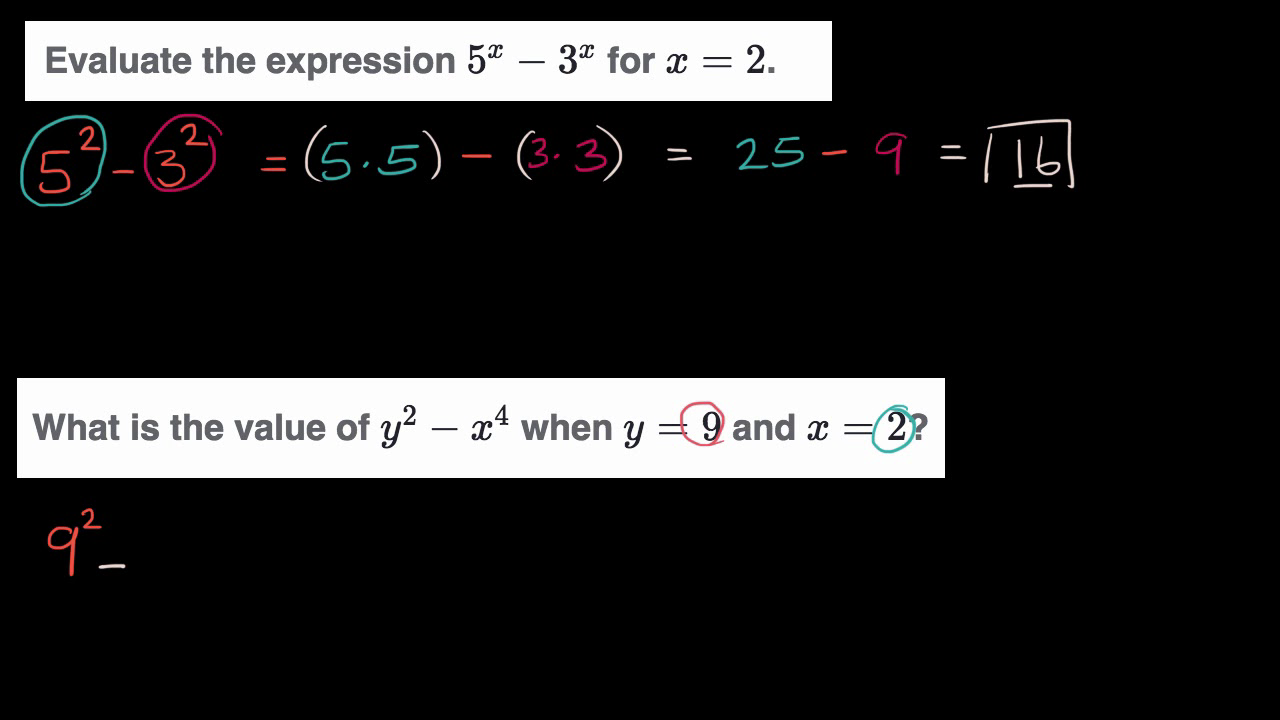
The image’s top example demonstrates a different use of a variable: is an exponent rather than a quantity being multiplied. When ,
Whether a variable appears as a coefficient’s partner, inside brackets, or as an exponent, the rule is the same: replace every occurrence of it.
A dependable substitution routine
Use this routine on nearly every evaluation question:
- Write the original expression.
- Replace each variable with its given value. Put brackets around any substituted negative number.
- Evaluate using the order of operations.
- State the final numerical value clearly.
Consider
when
First substitute, preserving the structure of the expression:
Now apply the order of operations. Evaluate powers before multiplication, then add and subtract from left to right:
So the value is
Why brackets matter for negative values
Brackets are essential when a negative number is substituted into a power:
because the entire number is squared. In contrast,
because the exponent applies to first, and the negative sign remains outside. When a question says , writing as prevents this error.
Also preserve the position of a coefficient:
becomes
not
The coefficient is not part of the square.
Order of operations happens after substitution
Substitution does not change the usual calculation rules. Once the letters have been replaced, evaluate the resulting numerical expression in this order:
- Work inside grouping symbols such as brackets or parentheses.
- Evaluate powers.
- Perform multiplication and division from left to right.
- Perform addition and subtraction from left to right.
For instance, evaluate
when
Substitute first:
The parentheses must be evaluated before the exponent:
A frequent mistake is to calculate as . That incorrectly adds and before performing the multiplication by . Multiplication still has priority over addition.
How To Evaluate Algebraic Expressions
Watch “How To Evaluate Algebraic Expressions” by The Organic Chemistry Tutor for several closely worked substitution examples, including powers, multiple variables, and brackets.
Watch the core examples. The opening example shows how a negative substituted value interacts with subtraction; then follow the exponent example and the final example involving brackets. Pause just before each calculation is completed, write the substituted expression yourself with parentheses, and then compare the order of operations.
Multiple variables: substitute every one, including signed values
An expression can contain several variables, each with its own assigned value. For example, evaluate
when
A clear substitution line is the main protection against mistakes:
Now multiply:
Therefore,
The final positive is important to understand:
There are two negative factors: the subtraction in front of , and the negative value substituted for . Their product is positive.
Writing the substitution as , rather than rushing directly to the answer, makes the sign logic visible to an examiner and to you.
An exam-style example with all key features
Evaluate
when
Start with substitution and brackets:
Next simplify inside the parentheses:
Finally multiply and subtract:
Thus,
Notice the distinct roles of the brackets:
- records multiplication by the substituted value.
- preserves the original bracketed expression.
- ensures that the negative value, not merely the , is squared.
Common errors to catch before they cost marks
| Error | Incorrect form | Correct form | Reason |
|---|---|---|---|
| Joining digits after substitution | when | A coefficient indicates multiplication. | |
| Forgetting an occurrence of a variable | Every must be replaced. | ||
| Losing a negative value | for | Parentheses show the complete substituted value is squared. | |
| Ignoring operation priority | Multiply before adding. | ||
| Changing the original structure | becomes | Substitute first while preserving brackets. |
A quick final check takes only a few seconds:
- Have I replaced every variable?
- Are negative substitutions inside parentheses?
- Did I calculate brackets and powers before multiplication?
- Did I carry signs through each line correctly?
- Is my final answer a number, rather than an expression still containing a variable?
A calculator can be useful as a check, particularly on a longer expression, but enter the same structure you wrote. For example, for the final example, entering 4*(2*(-3)-1)-(-3)^2 preserves the mathematics. It should confirm your working, not replace it.
You can now evaluate algebraic expressions reliably: substitute each stated value, protect negative substitutions with brackets, and apply the order of operations to the resulting numerical expression. These habits will be used repeatedly when formulas arise in geometry, sequences, rates, and graphs.
Next, you will move in the opposite direction: translating written information or a labelled diagram into an algebraic expression or equation.
Can't find a good explanation? Sign up and we'll make it for you
Sign up