
Hello. Previously, you practised evaluating an expression by substituting values carefully and following the order of operations. This lesson reverses that direction: instead of starting with algebra and finding a number, you will start with words or a labelled diagram and build the algebra.
By the end, you should be able to decide whether a situation needs an expression or an equation, define variables clearly, and translate common wording such as “more than,” “less than,” “times,” “per,” and “total.” This is an essential exam skill because many longer problems begin with a correct mathematical model.
From a situation to algebra
Algebra is a compact way to record relationships between quantities.
Suppose a cinema ticket costs dollars. If you buy three tickets, the total cost is
Here, is a variable: it stands for a number that may change. The is a constant: its value is fixed.
The first step in translation is always to identify:
- What can vary or is unknown? Choose a variable for it.
- What is fixed? Record the numerical constants and units.
- How are the quantities related? Identify the operation: addition, subtraction, multiplication, division, or equality.
For example:
A gym charges a joining fee of dollars and dollars per month.
Let be the total cost after one month. The monthly charge is , and the fixed joining fee is , so
If the question only asks for “the total cost,” then is enough as an expression. If it names the total cost using , then
is an equation or formula.
Expression or equation?
An expression represents a quantity:
It does not claim that anything is equal.
An equation says that two quantities have the same value:
A useful exam decision rule is:
| If the wording gives... | Write... |
|---|---|
| A quantity to be described, such as “the cost,” “the perimeter,” or “Sam’s age” | An expression |
| A known total, measurement, balance, or explicit statement of equality | An equation |
| A named output variable, such as for perimeter or for cost | Usually a formula/equation |
The equals sign is not just a signal to calculate. It means: the expression on the left has the same value as the expression on the right.
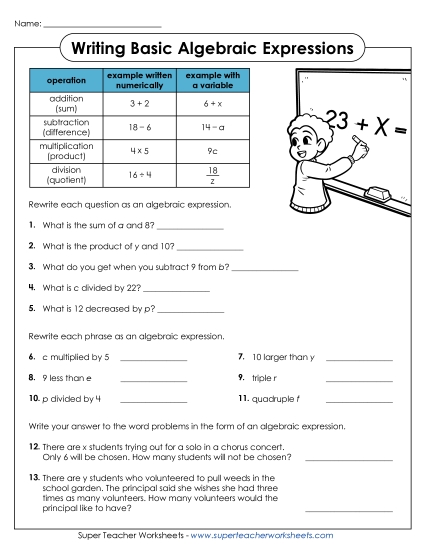
Translating operation words accurately
Most translation errors come from a small set of words. Addition and multiplication can often be rearranged without changing the answer, but subtraction and division cannot. So pay particular attention to the order of quantities in those cases.
Introduction to algebra - KS3 Maths - BBC Bitesize
Read BBC Bitesize’s “Introduction to algebra” to see the language of increasing, decreasing, multiplying, and dividing connected directly to algebraic notation. Its labelled pentagon example also shows how a diagram becomes an expression.
In the section “Writing and interpreting algebraic expressions,” read from the operation examples. Pay special attention to the contrasting meanings of “four less than x” and “x less than four.” Then continue through the pentagon and vegetable-box examples, from the diagram translations. Notice that each variable is defined before it is combined with the others.
Addition
Words such as sum, total, more than, increased by, and added to usually indicate addition.
If is a number:
The phrase begins with “seven,” but the quantity being increased is . Think: start with , then add .
Similarly,
Because addition is commutative,
Both represent the same total, although writing often mirrors the wording “seven more than ” more clearly.
Subtraction: preserve the direction
Words including difference, decreased by, less than, fewer than, take away, and subtract ... from ... can indicate subtraction. The key is to identify what you start with.
You begin with and remove .
However,
You begin with and remove . These expressions are generally not equal.
The word from is an especially helpful signal:
A quick value check can catch a reversal. If , “subtract from ” should give , so is sensible. The reversed expression would give , which does not describe the situation.
Multiplication
Words such as product, times, double, triple, twice, and of commonly indicate multiplication.
When a number multiplies a variable, write the number first:
not , and do not use the letter as a multiplication symbol because it can be confused with the variable .
A crucial distinction:
whereas
“Twice” multiplies; “more than” adds.
Division and rates
Words such as quotient, shared equally, divided by, half, and per often involve division or a rate.
The order matters:
For “per” contexts, identify the rate and the number of units. At dollars per kilogram for kilograms, the variable part of the cost is
The units confirm the translation:
Brackets record the order described in words
Brackets are needed when the wording tells you to perform one operation before another.
Compare these two phrases:
Add to , then multiply by .
The addition happens first, so write
But:
Three times , then add .
The multiplication happens first, so write
These are not the same. For example, if ,
while
Watch for phrases like:
- “the sum of ...”
- “the difference between ...”
- “all of this multiplied by ...”
- “then”
- “the quantity ...”
For instance:
Three times the difference between and
means find the difference first:
The brackets preserve the meaning of “the difference between and ” as one complete quantity.
A reliable translation routine
For an exam question, use the following written routine. It keeps your algebra understandable and makes incorrect assumptions easier to spot.
- Define the variable. Include units where appropriate.
- Underline or identify the known quantities.
- Translate each relationship one piece at a time.
- Use brackets if a whole sum or difference is multiplied, divided, squared, or otherwise treated as one object.
- Decide whether an equals sign is justified.
- Check with a sensible test value if the wording contains subtraction or a multi-step relationship.
Consider this age context:
Hannah is years old. Sophie is 4 years younger than Hannah. Together, their ages total 32 years.
Start by translating Sophie’s age. “Four years younger than Hannah” means subtract from Hannah’s age:
This is an expression for Sophie’s age.
The word “together” tells us to add both ages:
Finally, “their ages total 32” states an equality, so the full translation is:
Do not solve it yet if the question only asks you to form the equation. Forming the correct equation is a separate skill from solving it, and the next lesson will build on that distinction.
Forming equations - Corbettmaths
Watch “Forming equations” by Corbettmaths for a concise model of turning an age comparison into an expression, then using a stated total to form an equation.
Watch the age expression to see why “four years younger” becomes x-4, rather than 4-x. Then watch the total equation, focusing on the moment where the two age expressions are added and set equal to the given total.
Translating labelled diagrams
A labelled diagram communicates information in the same way as a written context. Your job is to identify the target quantity and combine the labels according to the relevant rule.
For a perimeter, add every outside side exactly once. For area, use the appropriate area relationship. For a total cost, add each cost component.
Example: perimeter from labels
Suppose a rectangle has:
- length cm
- width cm
A rectangle has two lengths and two widths. Therefore its perimeter is
This equation is already a correct translation. If the exam asks for a simplified expression, you could simplify it using the expansion skills from the first lesson. But the important modelling step is that you counted each labelled side twice and preserved both expressions with brackets.
If the diagram also states that the perimeter is cm, then the translation becomes an equation:
The given total is what makes the equals sign necessary.
Example: a total from a context
A club sells normal tickets at dollars each and student tickets at dollars each.
Translate each contribution separately:
- normal-ticket income:
- student-ticket income:
So the total income is
Notice that must multiply the entire quantity , not merely . The brackets mean that every student ticket, including the additional five, has the 5-dollar price.
If the total income is stated to be dollars, then write
Example: fixed fee plus a rate
A delivery company charges a fixed fee of dollars plus dollars per kilometre. A delivery travels kilometres.
The rate-based part is
Adding the fixed fee gives the total delivery cost:
If denotes the total cost, a clear formula is
The number is paid once. The number is paid once for each kilometre, so it multiplies .
Forming algebraic expressions - Corbettmaths
Watch “Forming algebraic expressions” by Corbettmaths for worked examples that turn prices, quantities, and comparative ages into algebraic statements.
Watch the cost example and identify the separate cost contributions before they are combined. Then watch the age examples, paying particular attention to how each person’s age is expressed in terms of one chosen variable before a total is formed.
Common translation traps
Before finalising an expression or equation, scan for these errors.
| Wording | Correct translation | Common incorrect translation | Why |
|---|---|---|---|
| 7 more than | “More than” indicates addition, not multiplication. | ||
| 7 less than | Begin with , then subtract . | ||
| less than 7 | Begin with , then subtract . | ||
| Twice , plus 3 | Only is doubled. | ||
| Twice the sum of and 3 | The sum must be formed before doubling. | ||
| dollars per item for items | A per-item rate is multiplied by the number of items. | ||
| Total is 40 | expression only | “Is 40” gives an equality. |
A final meaning check is powerful:
- Does the expression have the correct units?
- Does it increase when the number of items increases, if it should?
- If a person is described as younger, did your expression make their age smaller?
- If you substitute an easy test value, does the expression match the story?
You can now translate words and diagram labels into algebra by defining variables, identifying operations, preserving order with brackets, and using an equals sign only when a relationship of equality is stated. The most important language warning is that subtraction and division depend on order: “less than” and “divided by” must be read carefully.
Next, you will use these translated equations to solve multi-step linear equations, including equations with brackets, variables on both sides, and fractional coefficients.
Can't find a good explanation? Sign up and we'll make it for you
Sign up