
Hello. This course begins by building reliable algebra habits that you can carry into equations, graphs, quadratics, and exam problems. In this lesson, the goal is to turn an expression with brackets, signed terms, coefficients, and powers into an equivalent expression that is shorter, organised, and fully simplified.
The central routine is simple but worth making automatic:
- Simplify inside brackets when possible.
- Remove brackets by distributing any factor, including a negative sign.
- Combine like terms.
- Write the result in a clear order, usually highest powers first.
Terms, coefficients, powers, and “like”
A term is a part of an expression separated by addition or subtraction. The sign belongs to the term after it. For example, the terms in
are , , , , , and .
A term may have:
- a coefficient: the numerical factor, such as in ;
- a variable part: such as ;
- a power (or exponent): the in .
A missing coefficient is still there:
Two terms are like terms only when their variable parts are exactly the same, including powers.
| Like terms | Why | Not like terms | Why not |
|---|---|---|---|
| and | both have | and | different powers |
| and | both have | and | different variable parts |
| and | both have | and | powers belong to different variables |
| and | both are constants | and | one has a variable |
When combining like terms, add or subtract only the coefficients:
Do not alter powers while adding terms. For instance,
not . Powers are part of the label that tells you which terms can be collected. The laws for multiplying and dividing powers are a later topic.
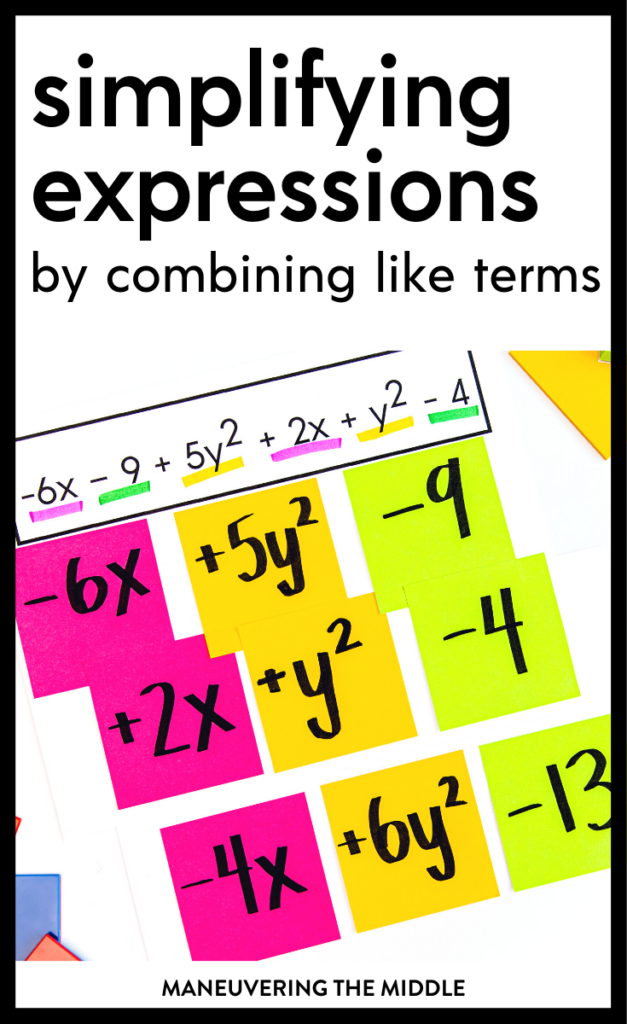
Using that grouping idea:
A conventional final order is descending powers: squared terms first, then first-power terms, then constants. So write this as
Simplifying Algebraic Expressions | Distributive Property & Combining Like Terms | Math with Mr. J
Watch Simplifying Algebraic Expressions: Distributive Property & Combining Like Terms from Math with Mr. J. It gives a compact visual walkthrough of the exact sequence used on typical exam questions: remove brackets first, then collect matching terms.
Watch one bracket to see a coefficient distributed and then combined with an existing like term. Continue with powers and order, paying attention to why x^2, x, and constants are separate groups. Finish with two brackets for a model of distributing twice before collecting terms.
Removing brackets: the distributive property
Brackets indicate that a factor multiplies the entire expression inside. The distributive property states:
Every term inside the bracket must be multiplied by the outside factor. For example:
The power remains attached to its variable. The calculation changes the coefficient from to ; it does not change into some other power.
Signs are factors too
The most common exam error in simplifying expressions is losing a negative sign before a bracket. Treat the sign as part of the multiplier.
| Outside factor | Effect on |
|---|---|
In particular:
Every sign inside changes because every term has been multiplied by . It is not enough to change only the first sign.
For example:
The second line combines . Notice that the negative in front of the bracket affects the bracketed terms only; it does not affect the separate .
2.2: Simplifying Algebraic Expressions
Read the sections “Combining Like Terms” and “Distributive Property and Like Terms” from LibreTexts. They reinforce the precise rule for deciding whether terms match, then show why a negative sign before brackets must be treated as a factor of -1.
In “Combining Like Terms,” begin at the like-term rule and read through Examples 6–9. Focus on the fact that variable factors and exponents do not change when coefficients are combined. Then move to “Distributive Property and Like Terms” and read Examples 11–13. In the paragraph beginning sign before brackets, follow the explanation that a leading minus means multiplication by -1; then compare the incorrect and correct methods in Example 13.
The complete exam method
Consider an expression containing all the main features:
Step 1: Deal with brackets
The first bracket has factor . The second bracket has an implied factor of .
Writing the full expanded line is worthwhile in an exam. It makes it possible to check that every term has been carried across with the correct sign.
Step 2: Collect groups of like terms
There are three groups:
- squared terms: ;
- linear terms: ;
- constants: .
So the simplified expression is
A useful writing pattern is:
Each equality sign says that the expression on the next line has exactly the same value as the one before it. That clear chain of equivalent statements will matter throughout the course and is especially valuable under exam marking.
Common traps and how to avoid them
| Trap | Incorrect work | Why it fails | Reliable habit |
|---|---|---|---|
| Missing a term during distribution | The was not multiplied | Touch each term in the bracket once | |
| Ignoring the negative factor | The factor is , not | Rewrite mentally as | |
| Combining unlike terms | Addition does not combine powers | Compare the complete variable parts first | |
| Treating subtraction as separate from its term | The second term is | Read it as | |
| Combining before brackets are removed | The must multiply both bracketed terms | Expand before collecting across brackets |
Here is a short mixed example that illustrates the routine again:
The key feature is that all brackets disappear before the terms are combined.
A quick check before moving on
Before committing an answer, scan for these four points:
- Brackets: Has every outside factor been distributed to every internal term?
- Signs: Did a minus before brackets change every sign inside?
- Like terms: Did you combine only terms with identical variable parts and powers?
- Order: Is the final expression organised, with higher powers before lower powers and constants last?
You can also test a result by choosing a simple value for the variable and evaluating both the original and simplified forms. For the earlier expression, let :
and
Matching values do not replace correct algebra, but a mismatch immediately reveals that something went wrong.
You now have the core simplification sequence: identify signed terms, distribute through brackets, combine genuinely like terms, and present the result in a clear order. The next lesson builds directly on this: substituting numerical values into expressions and evaluating them using the correct order of operations.
Can't find a good explanation? Sign up and we'll make it for you
Sign up